The sample copy of this report is available for access.
“Global Embodied AI Market to reach a market value of USD 71,325.12 Million by 2033 growing at a CAGR of 37.9%”
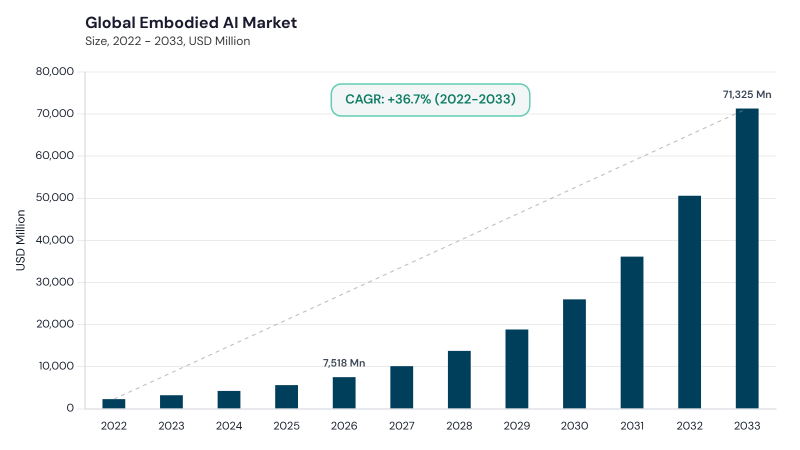
The Global Embodied AI Market is expected to reach USD 71.3 billion by 2033, growing at a CAGR of 37.9% during (2026 - 2033).
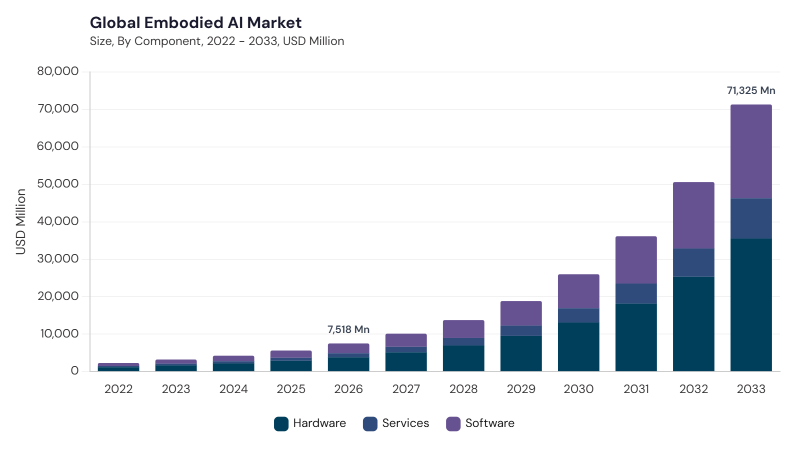
Embodied AI market is driven by increasing demand for smart systems that can perceive, respond, and interact within real-world physical environments. Market expansion further is supported by human machine collaboration, autonomous systems, adaptive robotics, computer vision, edge computing, generative AI-enabled physical platforms, and sensor technologies. The market evolved from early robotics and AI research focused on allowing machine to physically interact with their surroundings. Adaptive algorithms, sensor integration, machine learning, computer vision, and natural language processing enabled more autonomous and context-aware systems.
Embodied AI market is expanding as industries largely adopt embodied AI systems to enhance operational safety, and improve real-time decision making. These systems combine robotics hardware, combine AI software, sensors, and edge computing to perform tasks in dynamic environments. Market demand is surging across healthcare assistance, industrial automation, smart homes, autonomous logistics, and service robotics. Continuous enhancements in mobility, perception, contextual reasoning, and dexterity are strengthening adoption across industrial and commercial applications.
Competitive landscape of the market is driven by humanoid robotics developers, AI infrastructure providers, physical AI technology innovators, and autonomous robotics companies. Market players compete through simulation platforms, robotics foundation models, multimodal perception, AI computing infrastructure, and scalable deployment capabilities. AI model integration, strategic partnerships, regional expansion, and hardware-software co-design remain important competitive levers. Further, embodied AI market is also driven by startups developing specialized robots for healthcare, logistics, education, industrial use cases, and service automation.

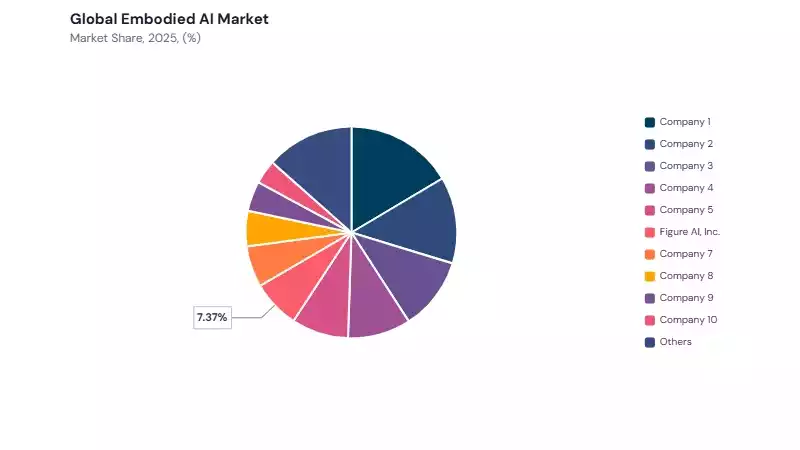
Embodied AI market represents innovation-led competitive landscape, with NVIDIA Corporation, Amazon Robotics, Tesla, Boston Dynamics, and Google DeeoMind standing as leading market players. Apptronik, Agility Robotics, Figure AI, Sanctuary Cognitive Systems, and Figure AI further strengthen competition through autonomous systems, robotic intelligence, humanoid robotics, and physical AI platforms. Competition is driven by simulation-driven training, AI infrastructure, multimodal perception, robot reasoning, commercially scalable embodied AI systems.
Based on Component, the market is segmented into Hardware, Software, and Services. The Hardware market dominated the Global Embodied AI Market by Component in 2025, and would continue to be a dominant market till 2033; thereby, achieving a market value of USD 35.6 billion by 2033, growing at a CAGR of 37.4 % during the forecast period. The Software market is expected to witness a CAGR of 38.2% during (2026 - 2033).
Hardware forms the physical foundation of embodied AI systems by enabling machines to sense, process, move, and interact with real-world environments. Software acts as the intelligence layer that converts sensory input into autonomous decision-making and adaptive behavior. Services help end users deploy, customize, maintain, and scale complex embodied AI systems. The combination of these components supports broader adoption across robotics, autonomous systems, smart appliances, healthcare assistance, logistics automation, and industrial operations.
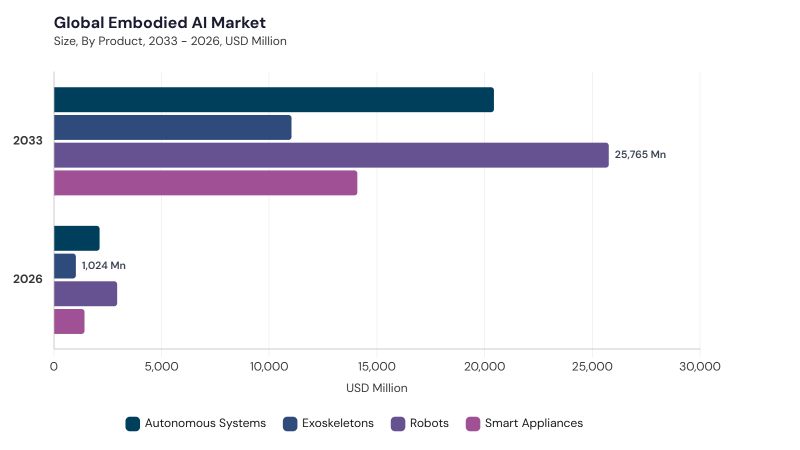
Based on Product, the market is segmented into Robots, Autonomous Systems, Smart Appliances, and Exoskeletons. The Robots market dominated the Global Embodied AI Market by Product in 2025, and would continue to be a dominant market till 2033; thereby, achieving a market value of USD 25.8 billion by 2033, growing at a CAGR of 36.3 % during the forecast period. The Autonomous Systems market is expected to witness a CAGR of 38.2% during (2026 - 2033). Additionally, The Smart Appliances market is expected to witness highest CAGR of 38.7% during (2026 - 2033).
Robots are central to embodied AI because they enable physical interaction, object manipulation, navigation, and task automation in real-world environments. Autonomous Systems extend embodied AI into transportation, surveillance, industrial mobility, and remote operations. Smart Appliances bring embodied intelligence into consumer and commercial settings through connected and adaptive devices. Exoskeletons support human augmentation by combining wearable robotics, AI-based motion recognition, and adaptive assistance for mobility, safety, and physical performance.
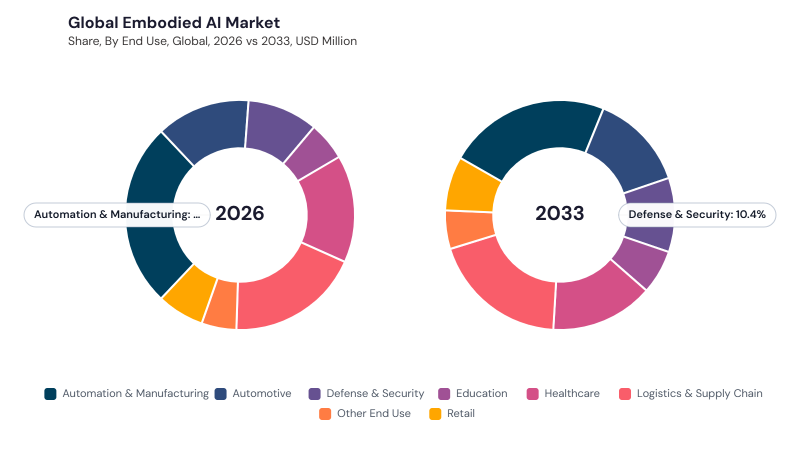
Based on End Use, the market is segmented into Automation & Manufacturing, Logistics & Supply Chain, Healthcare, Automotive, Defense & Security, Retail, Education, and Other End Use. The Automation & Manufacturing market dominated the Global Embodied AI Market by End Use in 2025, and would continue to be a dominant market till 2033; thereby, achieving a market value of USD 16.3 billion by 2033, growing at a CAGR of 35.5 % during the forecast period. The Logistics & Supply Chain market is expected to witness a CAGR of 38.4% during (2026 - 2033). Additionally, The Healthcare market is expected to witness highest CAGR of 37.1% during (2026 - 2033).
Retail and Education are expanding through AI-enabled customer service, inventory management, interactive learning robots, and research platforms. Other End Use includes emerging applications across agriculture, hospitality, construction, energy, and service automation. Embodied AI adoption differs across industries based on automation maturity, operational complexity, safety requirements, and return on investment. The segment landscape reflects the market’s shift from controlled automation toward real-world intelligent physical systems.
Free Valuable Insights: Embodied AI Market Size to reach $71.3 Billion by 2033
Region-wise, the Embodied AI Market is analyzed across North America, Europe, Asia Pacific, and LAMEA. North America market gathered the largest share in embodied AI market in 2025 and is expected to remain dominant till 2033, with achieving a market value of USD 26.7 billion by 2033, expanding at a CAGR of 37.2%. The Europe market is predicted to grow at a CAGR of 37.4% during the forecast period. Moreover, Asia Pacific market is anticipated to witness a CAGR of 38.6% during 2026-2033.
LAMEA is developing steadily through industrial modernization, digital transformation, and gradual adoption of AI-enabled automation technologies. Regional expansion relies on manufacturing capacity, research ecosystems, investment levels, regulatory readiness, and gradual adoption of AI-enabled automation technologies. Regional growth depends on research ecosystems, robotics infrastructure, investment levels, regulatory readiness, manufacturing capacity, and end-use industry adoption. Asia Pacific and North America remain key innovation hubs, while Europe prioritizes compliance, safety, and responsible AI deployment. Also, LAMEA offers developing growth opportunities as public-sector, and industrial automation gradually surges.
| Report Attribute | Details |
|---|---|
| Market size value in 2026 | USD 7.5 billion |
| Market size forecast in 2033 | USD 71.3 billion |
| Base Year | 2025 |
| Historical Period | 2022 to 2024 |
| Forecast Period | 2026 to 2033 |
| Revenue Growth Rate | CAGR of 37.9% from 2026 to 2033 |
| Number of Pages | 628 |
| Tables | 780 |
| Report Coverage | Market Trends, Revenue Estimation and Forecast, Segmentation Analysis, Regional and Country Breakdown, Competitive Landscape, Market Share Analysis, Company Profiling, Companies Strategic Developments, SWOT Analysis, Product Life Cycle Analysis, Value Chain Analysis, Market Consolidation Analysis, Key Customer Criteria, Pandemic Impact Analysis, and Winning Imperatives |
| Segments Covered | Component, Product, End Use, and Geography |
| Country Scope |
|
| Companies Included | NVIDIA Corporation; Tesla, Inc.; Amazon Robotics (Amazon.com, Inc.); Google DeepMind / Google LLC (Alphabet Inc.); Boston Dynamics, Inc. (Hyundai Motor Group); Figure AI, Inc.; Agility Robotics, Inc.; Apptronik, Inc.; Unitree Robotics; Sanctuary Cognitive Systems Corporation |
By Component
By Product
By End Use
By Geography
Valued at USD 7.5 billion in 2026, it's projected to reach USD 71.3 billion by 2033, growing at 37.9% CAGR during 2026-2033.
The Hardware segment leads, expected to reach USD 35.6 billion by 2033.
NVIDIA Corporation, Tesla, Inc., Amazon Robotics, Google DeepMind, Boston Dynamics, Figure AI, Agility Robotics dominate the market.
The Robots segment leads, projected to achieve USD 25.8 billion by 2033.
North America leads, expected to reach USD 26.7 billion by 2033.
Increasing investment and focused research on embodied AI technologies fuel market expansion.
Our team of dedicated experts can provide you with attractive expansion opportunities for your business.








 Unique Offerings