The sample copy of this report is available for access.
The Asia Pacific Embodied AI Market is expected to reach USD 7.9 billion by 2030, growing at a CAGR of 38.6% during (2026 – 2033).
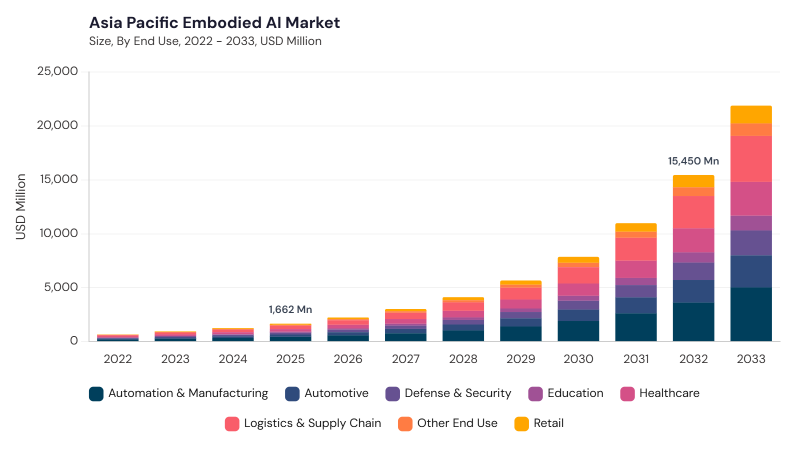
The Asia Pacific Embodied AI Market took shape through the meeting point of robotics, artificial intelligence, sensors, and intelligent control systems. Earlier activity was largely concentrated in laboratories, industrial automation pilots, and robotics-focused research programs where machines were trained to perform structured physical tasks. As AI chips, machine vision, sensor fusion, edge computing, and autonomous decision-making improved, embodied AI began moving into real operating environments. The region’s strong electronics manufacturing base, robotics ecosystem, and government-backed AI programs helped accelerate this transition.
Asia Pacific is progressing through localized embodied AI development, agentic robotics, 5G-enabled physical intelligence, and deployment-ready automation platforms. Countries such as China, Japan, South Korea, Singapore, and India are investing in AI infrastructure, robotics centers, smart manufacturing, and edge-based computing to support real-time embodied intelligence. Market participants are building robots and autonomous systems that can handle labor shortages, improve industrial productivity, support healthcare delivery, and enable intelligent logistics. The region is also seeing stronger attention toward responsible AI governance, safety rules, interoperability, and locally adapted robotic behavior.
Based on Component, the market is segmented into Hardware, Software, and Services. The Hardware market dominated the Asia Pacific Embodied AI Market by Component in 2025, and would continue to be a dominant market till 2033; thereby, achieving a market value of USD 4.0 billion by 2030, growing at a CAGR of 38.1 % during the forecast period. The Software market is expected to witness a CAGR of 38.8% during (2026 - 2033).
Hardware remains the strongest component because embodied AI requires physical systems such as robotic bodies, cameras, LiDAR, tactile sensors, actuators, processors, embedded devices, batteries, and AI-optimized chips. Asia Pacific’s electronics production strength and robotics manufacturing capacity give this segment a strong base across industrial and service applications. Software is growing as perception models, navigation algorithms, simulation tools, reinforcement learning, computer vision, and human-robot interaction platforms improve autonomy. Services are becoming more important as enterprises require integration, customization, training, maintenance, compliance support, and lifecycle management to make embodied AI function effectively in real-world settings.
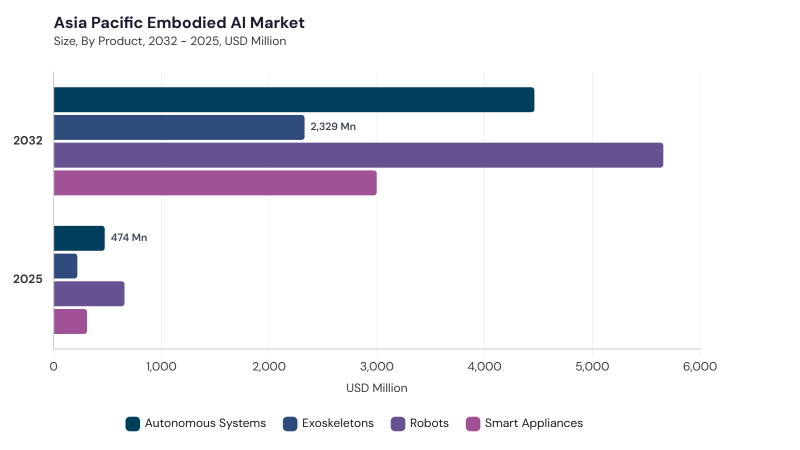
Based on Product, the market is segmented into Robots, Autonomous Systems, Smart Appliances, and Exoskeletons. The Robots market dominated the Asia Pacific Embodied AI Market by Product in 2025, and would continue to be a dominant market till 2033; thereby, achieving a market value of USD 2.9 billion by 2030, growing at a CAGR of 37 % during the forecast period. The Autonomous Systems market is expected to witness a CAGR of 38.8% during (2026 - 2033). Additionally, The Smart Appliances market is expected to witness highest CAGR of 39.4% during (2026 - 2033).
Robots lead the market due to their wide deployment in manufacturing, logistics, healthcare, customer service, smart factories, and public-facing automation. Industrial robots, humanoid robots, service robots, collaborative robots, and mobile robots are increasingly being designed with stronger perception, movement, reasoning, and interaction capabilities. Autonomous Systems are gaining ground through drones, autonomous vehicles, AGVs, inspection platforms, agricultural robots, and defense systems that require independent navigation and situational awareness. Smart Appliances are expanding through connected homes and AI-enabled consumer devices, while Exoskeletons are growing through rehabilitation, elderly care, industrial workforce support, and defense-related human augmentation.
Based on End Use, the market is segmented into Automation & Manufacturing, Logistics & Supply Chain, Healthcare, Automotive, Defense & Security, Retail, Education, and Other End Use. Automation & Manufacturing leads because Asia Pacific hosts major production hubs that are adopting AI-powered robots, smart assembly systems, quality inspection robots, machine tending solutions, and human-machine collaboration tools.
These systems help improve precision, reduce labor pressure, increase factory resilience, and support flexible production across automotive, electronics, semiconductors, and industrial goods. Logistics & Supply Chain is expanding through warehouse automation, robotic sorting, inventory handling, autonomous mobile robots, and last-mile delivery systems. Healthcare, Automotive, and Defense & Security are gaining demand through robotic surgery, rehabilitation, autonomous mobility, surveillance, and intelligent defense platforms, while Retail, Education, and Other End Use are emerging through service robots, interactive learning systems, agriculture, hospitality, and smart city applications.
Free Valuable Insights: Embodied AI Market is Predicted to reach USD 71.3 Billion billion by 2033, at a CAGR of 37.9%
Based on Country, the market is segmented into China, Japan, India, South Korea, Singapore, Malaysia, and Rest of Asia Pacific. The China market dominated the Asia Pacific Embodied AI Market by Country in 2025, and would continue to be a dominant market till 2033; thereby, achieving a market value of USD 2.4 billion by 2030, growing at a CAGR of 36.4 % during the forecast period. The Japan market is expected to witness a CAGR of 37.7% during (2026 - 2033). Additionally, The India market is expected to witness a CAGR of 39.8% during (2026 - 2033).
China leads due to national AI priorities, strong robotics manufacturing, large-scale industrial automation, humanoid robot development, AI chip deployment, and rapid commercialization of physical AI systems. Japan contributes through advanced robotics heritage, labor shortage-driven automation, 5G and edge IoT integration, and strong demand for service and industrial robots. India is advancing through AI infrastructure investments, digital manufacturing initiatives, robotics startups, healthcare automation, and localized deployment models. South Korea, Singapore, and Malaysia add momentum through smart city programs, AI research hubs, domain-specific robotics, semiconductor capabilities, and service automation, while Rest of Asia Pacific benefits from adoption in logistics, agriculture, healthcare, and localized AI-enabled automation.

By Component
By Product
By End Use
By Country
Set to reach $7.9 Billion by 2030, growing at 38.6% CAGR during 2026-2033.
China leads with $2.4 billion by 2030, growing at 36.4% CAGR during the forecast period.
The Hardware segment dominates with a $4.0 billion value by 2030, growing at 38.1% CAGR during the forecast period.
Robots segment hits $2.9 billion by 2030, growing at 37% CAGR during the forecast period.
India is expected to witness a CAGR of 39.8% during 2026-2033.
Smart Appliances segment is expected to witness the highest CAGR of 39.4% during 2026-2033.
Our team of dedicated experts can provide you with attractive expansion opportunities for your business.




 Unique Offerings