The sample copy of this report is available for access.
The North America Electric Scooter Battery Market is expected to reach USD 593.3 million by 2032, growing at a CAGR of 14.1% during (2026 - 2033).
The North America Electric Scooter Battery Market originated with the rise of electric scooters as an urban mobility solution for congestion and pollution challenges. Early batteries included lead-acid and initial lithium-ion technologies, which were limited by energy density, lifecycle, charging efficiency, and safety performance. The market evolved as lithium-ion batteries became commercially viable for light electric vehicles, supported by battery management systems, improved pack design, advanced chemistries, and smart battery monitoring.
Current market development is shaped by safety, rapid charging, sustainability, and fleet efficiency requirements. Manufacturers are adopting safer chemistries, enhanced thermal management, certification-focused designs, modular battery swapping systems, and fast-charging technologies to support shared mobility and private ownership. Recycling programs, ethical material sourcing, circular battery practices, smart BMS, telemetry, and localized production are also influencing product development and supplier strategies across North America.
Based on Scooter Type, the market is segmented into Low-speed, High-speed, and Performance. The Low-speed market dominated the North America Electric Scooter Battery Market by Scooter Type in 2025, and would continue to be a dominant market till 2033; thereby, achieving a market value of USD 359.3 million by 2032, growing at a CAGR of 13.8 % during the forecast period. The High-speed market is expected to witness a CAGR of 14.6% during (2026 - 2033). The Performance market is expected to witness a CAGR of 14.6% during (2026 - 2033).
Low-speed scooters remain widely adopted due to affordability, modest energy requirements, regulatory favorability, shared micromobility use, and suitability for short urban trips. High-speed scooters hold a considerable presence as users seek longer commuting ranges, stronger acceleration, and flexibility across suburban and urban routes. Performance scooters maintain a promising role through enthusiast demand, premium riding characteristics, extended range, high-output battery packs, advanced battery management, and cooling systems designed for stronger power delivery.
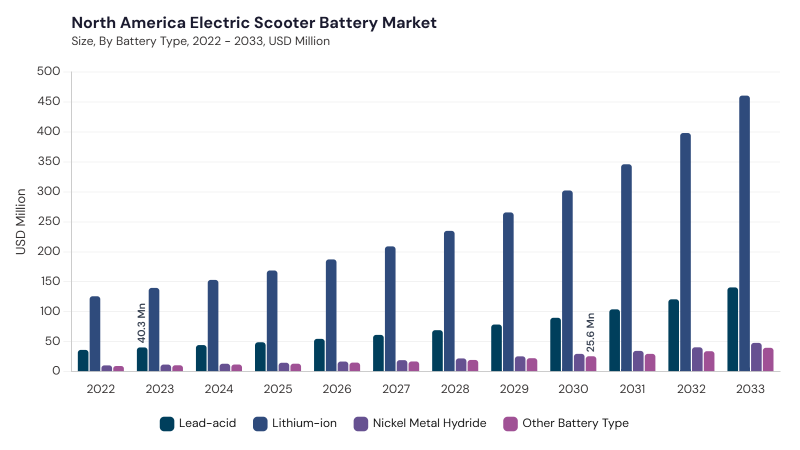
Based on Battery Type, the market is segmented into Lithium-ion, Lead-acid, Nickel Metal Hydride, and Other Battery Type. The Lithium-ion market dominated the North America Electric Scooter Battery Market by Battery Type in 2025, and would continue to be a dominant market till 2033; thereby, achieving a market value of USD 398.1 million by 2032, growing at a CAGR of 13.7 % during the forecast period. The Lead-acid market is expected to witness a CAGR of 14.4% during (2026 - 2033). The Other Battery Type market is expected to witness a CAGR of 14.9% during (2026 - 2033).
Lithium-ion batteries remain central to modern electric scooters due to compact form factor, longer cycle life, faster charging, improved safety systems, and compatibility with urban micromobility requirements. Lead-acid batteries retain relevance in price-sensitive scooter configurations due to established manufacturing, accessible costs, and mature replacement ecosystems, although heavier weight and shorter cycle life limit broader use. Nickel Metal Hydride serves selected applications where durability, thermal stability, and established rechargeable characteristics remain valuable. Other Battery Type includes emerging and specialized chemistries such as solid-state and zinc-based variants being evaluated for improved safety, charging capability, longevity, and environmental performance.
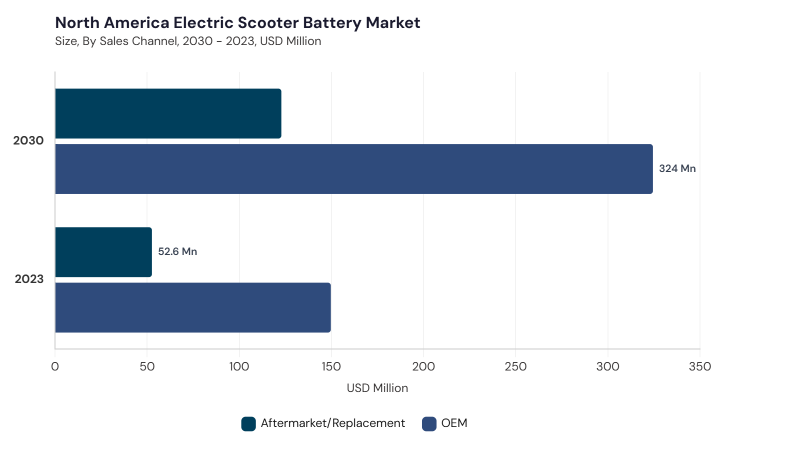
Based on Sales Channel, the market is segmented into OEM and Aftermarket/Replacement. The OEM market dominated the North America Electric Scooter Battery Market by Sales Channel in 2025, and would continue to be a dominant market till 2033; thereby, achieving a market value of USD 427.5 million by 2032, growing at a CAGR of 13.8 % during the forecast period. The Aftermarket/Replacement market is expected to witness a CAGR of 15% during (2026 - 2033).
OEM batteries are important because manufacturers require optimized battery management, safety validation, charger compatibility, motor integration, thermal control, and performance alignment during scooter production. This channel benefits from new scooter shipments, advanced lithium-ion adoption, swappable designs, modular packs, localized sourcing, and heavy-usage requirements from micromobility fleets. Aftermarket/Replacement maintains a promising presence due to battery degradation, longer scooter ownership, repair needs, range restoration, plug-and-play replacement modules, service hubs, and user demand for upgrades beyond original specifications.
Based on Battery Capacity, the market is segmented into 1 kWh-2 kWh, 2 kWh-3 kWh, Above 3 kWh, and Below 1 kWh. 1 kWh-2 kWh batteries serve commuter-oriented scooters requiring reliable daily range without oversized battery packs, making them suitable for mixed urban and suburban mobility. 2 kWh-3 kWh batteries support longer-distance commuting, delivery services, higher sustained performance, and greater operational flexibility.
Above 3 kWh batteries serve premium, performance-focused, and extended-range scooters requiring maximum stored energy, fast-charging capability, and robust thermal control. Below 1 kWh batteries remain relevant for lightweight, portable, entry-oriented scooters used for short trips where affordability, compact size, and reduced battery mass are key priorities.
Based on Voltage, the market is segmented into 48V, 60V, 72V and Above, and Below 48V. 48V batteries remain the central option for mid-tier commuter scooters because they offer a practical blend of acceleration, range, weight, safety, charging speed, and component availability. 60V batteries are gaining traction in performance-oriented scooters requiring higher power delivery, stronger acceleration, hill-climbing capability, and longer operating routes.
72V and Above batteries serve premium and high-performance scooters that require maximum speed, power transfer, extended range, sophisticated BMS, and advanced thermal protection. Below 48V batteries remain concentrated in lightweight, low-speed, affordable, and portable scooters with simpler electrical architectures and modest power requirements.
Free Valuable Insights: The Global Electric Scooter Battery Market will hit USD 6561.2 Million billion by 2033, at a CAGR of 12.8%
Based on Country, the market is segmented into US, Canada, Mexico, and Rest of North America. The US market dominated the North America Electric Scooter Battery Market by Country in 2025, and would continue to be a dominant market till 2033; thereby, achieving a market value of USD 408.0 million by 2032, growing at a CAGR of 13.3 % during the forecast period. The Canada market is expected to witness a CAGR of 16.3% during (2026 - 2033). Additionally, The Mexico market is expected to witness a CAGR of 15.1% during (2026 - 2033).
The US is driven by fast-charging batteries, smart BMS, recycling, and high-capacity battery adoption, while Canada shows growth through clean mobility targets, recyclable batteries, and safety-certified battery systems. Mexico is supported by lithium-ion adoption, modular battery packs, localized production, and smart battery management, whereas Rest of North America is shaped by battery swapping, lithium-ion transition, supply chain localization, and smart diagnostics.

By Scooter Type
By Battery Type
By Sales Channel
By Battery Capacity
By Voltage
By Country
Set to reach $593.3 Million by 2032, growing at 14.1% CAGR during 2026-2033.
The US leads with $408.0 million by 2032, growing at 13.3% CAGR during 2026-2033.
The dominance of lithium-ion batteries, reaching $398.1 million by 2032, is a key growth driver.
The low-speed segment will achieve $359.3 million by 2032, growing at 13.8% CAGR during 2026-2033.
Canada is expected to witness a CAGR of 16.3% during 2026-2033.
The aftermarket/replacement channel is expected to witness a CAGR of 15% during 2026-2033.
Our team of dedicated experts can provide you with attractive expansion opportunities for your business.




 Unique Offerings
