The sample copy of this report is available for access.
“Global Electric Scooter Battery Market to reach a market value of USD 6561.21 Million by 2033 growing at a CAGR of %”
The Global Electric Scooter Battery Market is expected to reach USD 6561.2 million by 2033, growing at a CAGR of 12.8% during (2026 - 2033).
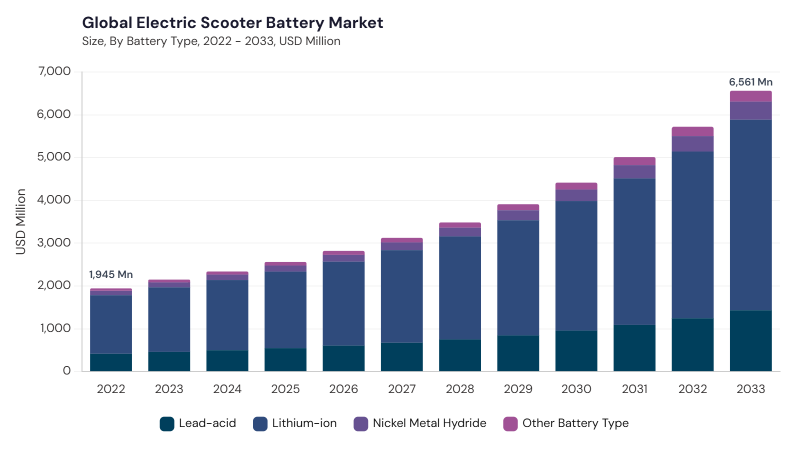
Electric scooter battery demand is gaining momentum as two-wheeler electrification, rising fuel prices, urban commuting needs, and clean mobility policies reshape personal and fleet transportation. Buyers are increasingly looking for batteries that offer longer riding range, quicker charging, dependable safety, lower running cost, and consistent performance in daily use. Expansion of battery swapping networks, last-mile delivery fleets, smart battery management systems, and advances in energy density, heat control, cycle life, and recyclable materials are further improving market prospects.
Increasing demand for clean, affordable, and practical urban mobility is expanding the role of battery systems in electric scooter adoption. Battery performance is becoming central to customer decisions because range, charging time, safety, lifespan, and replacement cost directly influence total ownership economics. Fleet operators and shared mobility providers are increasing demand for swappable, durable, and remotely monitored batteries that reduce downtime. Manufacturers are also improving chemistry selection, smart BMS integration, thermal management, and lifecycle services to address reliability and safety concerns. As electric scooters move deeper into commuting, delivery, and shared mobility applications, battery suppliers are becoming strategic technology partners rather than simple component providers.
Competition in the market is shaped by chemistry expertise, manufacturing scale, cost control, safety performance, pack design, and OEM relationships. Large lithium-ion manufacturers compete with electric two-wheeler battery specialists, lead-acid suppliers, and regional pack assemblers. Differentiation is increasingly based on energy density, fast charging, cycle life, thermal stability, BMS intelligence, recycling capabilities, and battery-swapping compatibility. Regional suppliers remain important in cost-sensitive markets, while global companies benefit from R&D scale and broad battery technology portfolios. Partnerships with scooter OEMs, mobility operators, recycling firms, and service networks are becoming important as the market shifts toward integrated battery ecosystems.
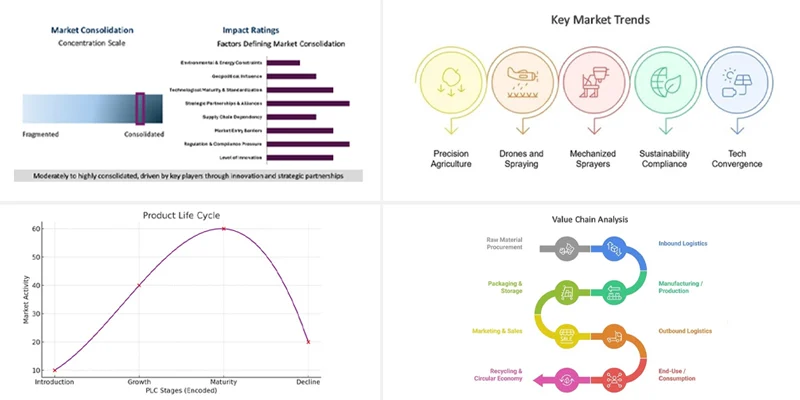

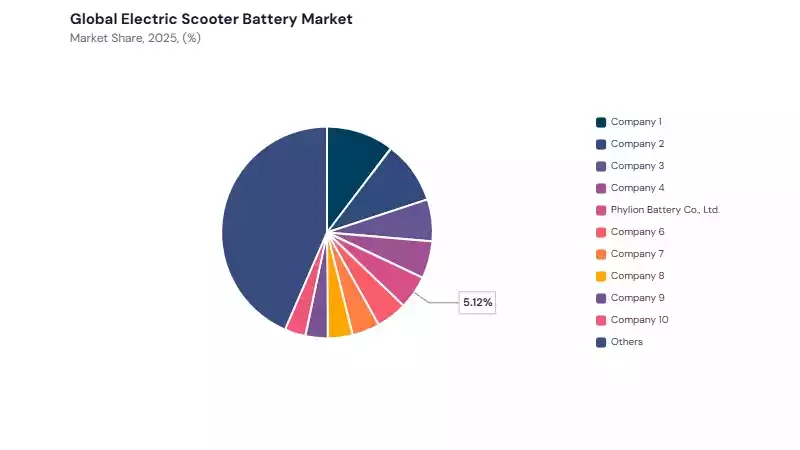
The global Electric Scooter Battery Market is moderately fragmented, with competition across large lithium-ion battery manufacturers, electric two-wheeler specialists, lead-acid producers, and diversified energy-storage companies. CATL, BYD, EVE Energy, Tianneng, Phylion, Gotion High-tech, Sunwoda, LG Energy Solution, Panasonic Energy, and Samsung SDI represent key competitive participants. Leading players compete through cell chemistry, battery management systems, safety engineering, cost efficiency, and OEM integration. Regional suppliers and local pack assemblers remain important because scooter pricing, battery chemistry, voltage, range, and sourcing requirements vary widely by market. Battery swapping, lifecycle management, and recycling are becoming stronger competitive differentiators.
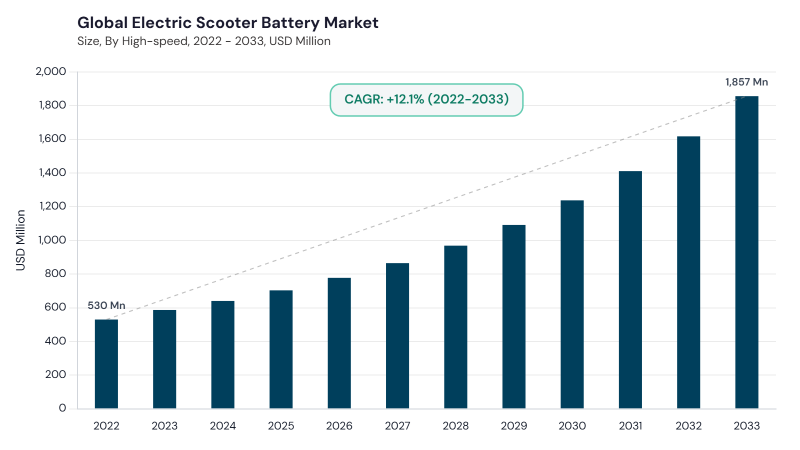
Based on scooter type, the market is segmented into Low-speed, High-speed, and Performance. The Low-speed market dominated the Global Electric Scooter Battery Market by Scooter Type in 2025, and would continue to be a dominant market till 2033; thereby, achieving a market value of USD 4018.8 million by 2033, growing at a CAGR of 12.5 % during the forecast period. The High-speed market is expected to witness a CAGR of 13.2% during (2026 - 2033). The Performance market is expected to witness a CAGR of 13.7% during (2026 - 2033).
Low-speed scooters remain important because they serve short-distance commuting, neighborhood travel, campus mobility, and cost-sensitive urban transportation. High-speed scooters are gaining demand as riders seek stronger acceleration, longer range, and greater flexibility for extended commuting. Performance scooters require more advanced battery packs capable of higher power output, better thermal management, and sustained delivery under demanding operating conditions. This segmentation highlights how battery requirements change from affordable daily mobility to premium, high-capability electric scooter use cases.
Based on battery type, the market is segmented into Lithium-ion, Lead-acid, Nickel Metal Hydride, and Other Battery Type. The Lithium-ion market dominated the Global Electric Scooter Battery Market by Battery Type in 2025, and would continue to be a dominant market till 2033; thereby, achieving a market value of USD 4451.4 million by 2033, growing at a CAGR of 12.4 % during the forecast period. The Lead-acid market is expected to witness a CAGR of 13.1% during (2026 - 2033). The Other Battery Type market is expected to witness a CAGR of 15.2% during (2026 - 2033).
Lithium-ion batteries are widely preferred in modern electric scooters because they offer lighter weight, higher energy density, faster charging, and longer operating life. Lead-acid batteries continue to serve price-sensitive applications where low upfront cost and established supply networks remain important. Nickel Metal Hydride batteries retain relevance through durability and rechargeable performance, though their role is narrower. Other battery types include emerging chemistries and specialized energy-storage solutions that may gain relevance as safety, sustainability, and cost priorities evolve.
Based on sales channel, the market is segmented into OEM and Aftermarket/Replacement. The OEM market dominated the Global Electric Scooter Battery Market by Sales Channel in 2025, and would continue to be a dominant market till 2033; thereby, achieving a market value of USD 4781.4 million by 2033, growing at a CAGR of 12.4 % during the forecast period. The Aftermarket/Replacement market is expected to witness a CAGR of 13.9% during (2026 - 2033).
OEM demand is supported by rising electric scooter production and deeper integration of battery packs with motors, controllers, chargers, safety systems, and BMS platforms. Vehicle manufacturers increasingly prefer battery systems designed around specific scooter architectures to improve performance, safety, and compatibility. Aftermarket and replacement demand is driven by battery degradation, aging installed fleets, ownership extension, and the need to restore vehicle range. Replacement channels also remain important for users seeking compatible, affordable, and reliable battery upgrades.
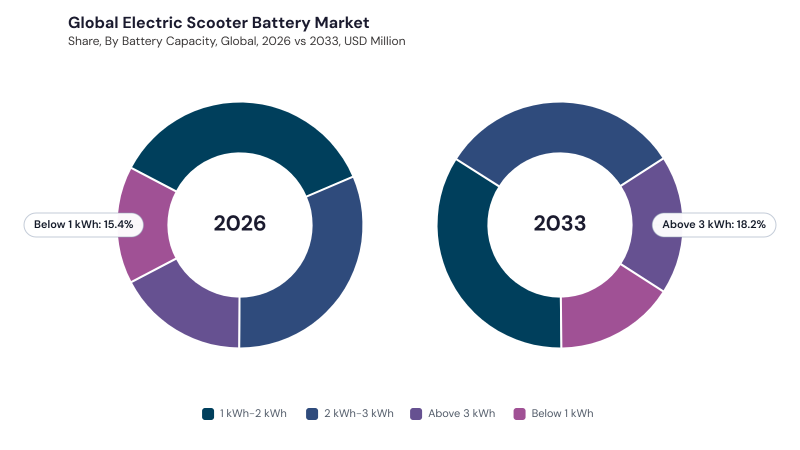
Based on battery capacity, the market is segmented into 1 kWh-2 kWh, 2 kWh-3 kWh, Above 3 kWh, and Below 1 kWh. The 1 kWh-2 kWh market dominated the Global Electric Scooter Battery Market by Battery Capacity in 2025, and would continue to be a dominant market till 2033; thereby, achieving a market value of USD 2242.9 million by 2033, growing at a CAGR of 12 % during the forecast period. The 2 kWh-3 kWh market is expected to witness a CAGR of 13% during (2026 - 2033). Additionally, The Above 3 kWh market is expected to witness highest CAGR of 13.7% during (2026 - 2033).
The 1 kWh-2 kWh range is widely used in commuter scooters because it balances practical range, vehicle weight, charging convenience, and affordability. The 2 kWh-3 kWh segment supports scooters designed for longer daily travel, stronger performance, and reduced charging frequency. Above 3 kWh batteries are used in long-range and performance-oriented models requiring greater stored energy and sustained output. Below 1 kWh batteries remain relevant for lightweight, compact, and short-range mobility applications where low cost and small pack size are important.
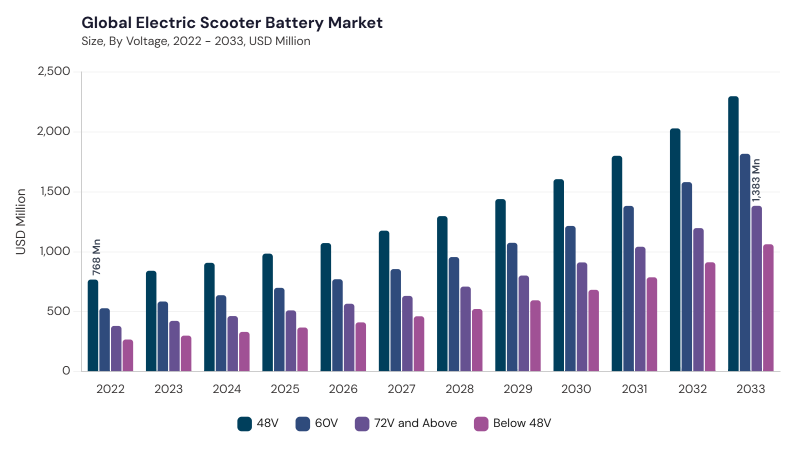
Based on voltage, the market is segmented into 48V, 60V, 72V and Above, and Below 48V. The 48V market dominated the Global Electric Scooter Battery Market by Voltage in 2025, and would continue to be a dominant market till 2033; thereby, achieving a market value of USD 2297.9 million by 2033, growing at a CAGR of 11.5 % during the forecast period. The 60V market is expected to witness a CAGR of 13% during (2026 - 2033). Additionally, The 72V and Above market is expected to witness highest CAGR of 13.6% during (2026 - 2033).
The 48V segment is widely adopted because it provides a balanced combination of power output, efficiency, affordability, and compatibility with mainstream scooter components. The 60V segment is gaining importance as manufacturers develop scooters with stronger acceleration, longer range, and improved commuting capability. The 72V and Above category supports performance-oriented models that need higher motor output and sustained power availability. Below 48V batteries serve lightweight, low-speed, and cost-sensitive scooters where simpler configurations and compact designs remain priorities.
Free Valuable Insights: Electric Scooter Battery Market Size to reach $6561.2 Million by 2033
Region-wise, the Electric Scooter Battery Market is analyzed across North America, Europe, Asia Pacific, and LAMEA. The Asia Pacific market dominated the Global Electric Scooter Battery Market by Region in 2025, and would continue to be a dominant market till 2033; thereby, achieving a market value of USD 4910.5 million by 2033, growing at a CAGR of 12.5 % during the forecast period. The North America market is expected to witness a CAGR of 14.1% during (2026 - 2033). Additionally, The Europe market is expected to witness a CAGR of 14.3% during (2026 - 2033).
Asia Pacific leads the market due to extensive electric two-wheeler production, dense battery manufacturing ecosystems, high scooter adoption, and continued investment in battery and charging technologies. North America is supported by growing interest in micromobility, urban transportation alternatives, and premium electric scooters. Europe is shaped by sustainable mobility initiatives, emission-reduction policies, and rising use of electric two-wheelers for personal transportation. LAMEA is gradually expanding as fuel costs, urban mobility requirements, electric scooter availability, and charging infrastructure development support adoption.
| Report Attribute | Details |
|---|---|
| Market size value in 2026 | USD 2820.5 million |
| Market size forecast in 2033 | USD 6561.2 million |
| Base Year | 2025 |
| Historical Period | 2022 to 2024 |
| Forecast Period | 2026 to 2033 |
| Revenue Growth Rate | CAGR of 12.8% from 2026 to 2033 |
| Number of Pages | XX |
| Tables | XX |
| Report Coverage | Market Definition, Market Overview, COVID-19 Impact, Market Composition and Scenario, Key Factors Impacting Market, Market Share Analysis, Recent Developments, Segment Analysis, Regional Analysis, Company Profiles, SWOT Analysis, Key Customer Criteria, and Winning Imperatives |
| Segments Covered | Scooter Type, Battery Type, Sales Channel, Battery Capacity, Voltage, and Geography |
| Country Scope |
|
| Companies Included | Contemporary Amperex Technology Co., Ltd.; BYD Company Ltd.; EVE Energy Co., Ltd.; Tianneng Battery Group Co., Ltd.; Phylion Battery Co., Ltd.; Gotion High-tech Co., Ltd.; Sunwoda Electronic Co., Ltd.; LG Energy Solution Ltd.; Panasonic Energy Co., Ltd.; Samsung SDI Co., Ltd. |
By Scooter Type
By Battery Type
By Sales Channel
By Battery Capacity
By Voltage
By Geography
Expected to reach USD 6561.2 million by 2033, growing at 12.8% CAGR during the forecast period (2026-2033).
Asia Pacific is the fastest-growing region, with urbanization and demand for last-mile transportation boosting growth.
Contemporary Amperex Technology, BYD, EVE Energy, Tianneng Battery, Phylion Battery, and Gotion High-tech lead the market.
Enhanced battery technologies and rising environmental awareness are boosting electric scooter battery demand.
The current market size data for 2026 is not specified in the provided information.
The report highlights the significance of enhanced battery technologies for greater range and reliability in scooters.
Our team of dedicated experts can provide you with attractive expansion opportunities for your business.






 Unique Offerings
