The sample copy of this report is available for access.
The Europe Electric Scooter Battery Market is expected to reach USD 398.8 million by 2031, growing at a CAGR of 14.3% during (2026 - 2033).
The Europe Electric Scooter Battery Market originated from the wider emergence of electric mobility solutions aimed at supporting sustainable alternatives to conventional transportation. Early electric scooters used rudimentary lead-acid batteries, which limited adoption due to heavy weight and poor energy density. The transition toward lithium-ion batteries marked a major turning point, enabling higher energy capacity, lower weight, longer lifecycle, and broader use across European urban mobility applications.
Current market development is shaped by high-capacity fast-charging batteries, sustainability requirements, smart battery management, and urban micro-mobility expansion. Manufacturers are improving cell chemistry, thermal management, energy density, battery lifecycle, and connected monitoring capabilities to support longer range, reduced downtime, and safer operation. Recyclable materials, second-life battery applications, battery recycling programs, modular designs, and localized European supply chains are also strengthening the market’s alignment with circular economy and regulatory priorities.
Based on Scooter Type, the market is segmented into Low-speed, High-speed, and Performance. The Low-speed market dominated the Europe Electric Scooter Battery Market by Scooter Type in 2025, and would continue to be a dominant market till 2033; thereby, achieving a market value of USD 246.9 million by 2031, growing at a CAGR of 13.9 % during the forecast period. The High-speed market is expected to witness a CAGR of 14.7% during (2026 - 2033). The Performance market is expected to witness a CAGR of 15.5% during (2026 - 2033).
Low-speed scooters remain widely adopted due to their suitability for short-distance urban travel, shared micro-mobility services, compact battery requirements, and moderate-power operation. High-speed scooters maintain a considerable presence as riders seek greater travel flexibility between urban centers and surrounding residential areas, supported by improved cell efficiency and power delivery. Performance scooters hold a promising role through demand for premium models offering stronger acceleration, extended riding capability, high-discharge cells, and advanced thermal controls for demanding operating conditions.
Based on Battery Type, the market is segmented into Lithium-ion, Lead-acid, Nickel Metal Hydride, and Other Battery Type. The Lithium-ion market dominated the Europe Electric Scooter Battery Market by Battery Type in 2025, and would continue to be a dominant market till 2033; thereby, achieving a market value of USD 273.6 million by 2031, growing at a CAGR of 13.9 % during the forecast period. The Lead-acid market is expected to witness a CAGR of 14.5% during (2026 - 2033). The Other Battery Type market is expected to witness a CAGR of 17.9% during (2026 - 2033).
Lithium-ion batteries remain central to modern scooter platforms because they support compact design, intelligent battery monitoring, optimized charging, rapid charging, and extended mileage. Lead-acid batteries retain relevance in economical scooter configurations where initial acquisition cost, familiar servicing practices, and established recycling channels remain important. Nickel Metal Hydride serves limited applications that value dependable rechargeable operation and established battery technology, although lower energy density limits broader adoption. Other Battery Type includes developing chemistries and specialized storage technologies targeting improved durability, material efficiency, safety, sustainability, and circularity.
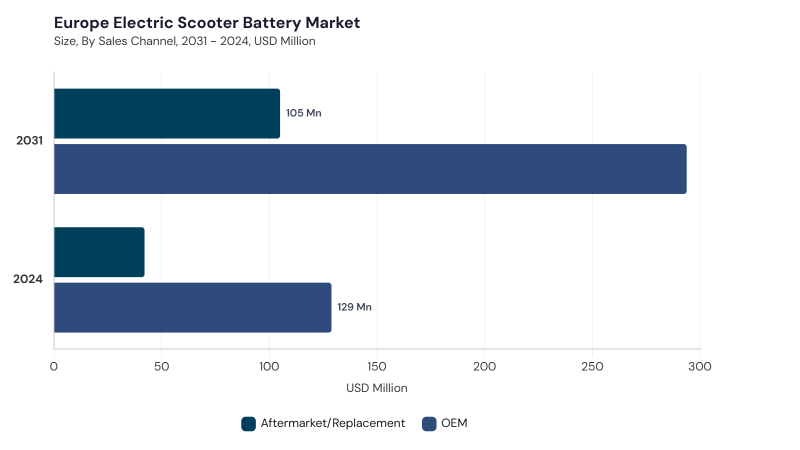
Based on Sales Channel, the market is segmented into OEM and Aftermarket/Replacement. The OEM market dominated the Europe Electric Scooter Battery Market by Sales Channel in 2025, and would continue to be a dominant market till 2033; thereby, achieving a market value of USD 293.8 million by 2031, growing at a CAGR of 13.9 % during the forecast period. The Aftermarket/Replacement market is expected to witness a CAGR of 15.4% during (2026 - 2033).
OEM batteries are important because newly produced scooters require factory-specified packs with optimized compatibility, safety certification, traceability, lifecycle management, energy density, and charging performance. This channel benefits from product innovation, urban mobility adoption, and manufacturer focus on compact, lightweight, and reliable battery integration. Aftermarket/Replacement maintains a promising presence due to the growing installed scooter base, battery degradation, refurbishment requirements, compatible replacement packs, service-life extension, and consumer interest in maintaining existing mobility platforms rather than replacing complete scooters.
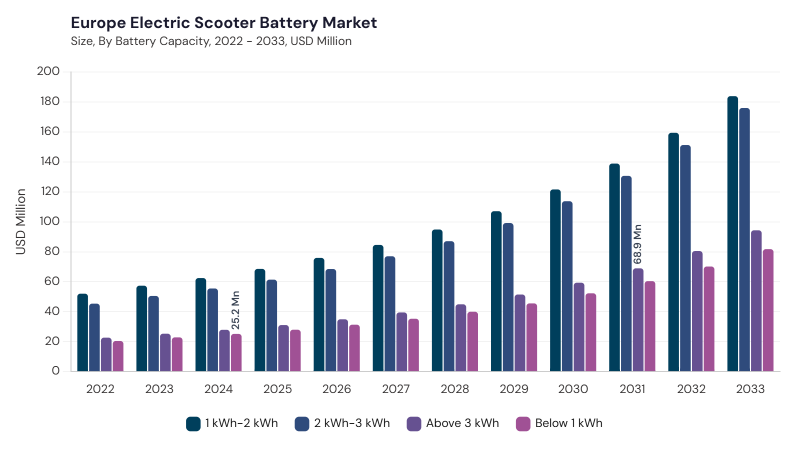
Based on Battery Capacity, the market is segmented into 1 kWh-2 kWh, 2 kWh-3 kWh, Above 3 kWh, and Below 1 kWh. 1 kWh-2 kWh batteries align well with everyday European mobility patterns, offering a balance between portability, range, affordability, and practical charging needs. 2 kWh-3 kWh batteries support users seeking additional range for longer daily travel, reduced charging frequency, higher performance, and suburban mobility.
Above 3 kWh batteries serve higher-powered and long-range scooters that require sustained energy availability, premium performance, and stronger thermal management. Below 1 kWh batteries remain concentrated in lightweight, entry-level, and highly localized mobility products used for brief trips where compact construction, reduced pack mass, and affordability are key requirements.
Based on Voltage, the market is segmented into 48V, 60V, 72V and Above, and Below 48V. 48V batteries remain widely used in mainstream commuter scooters due to their balance of performance, cost efficiency, drivetrain compatibility, standard charger support, and daily-use reliability. 60V batteries serve scooters requiring stronger acceleration, longer urban routes, higher loads, and improved performance for personal commuting and delivery applications.
72V and Above batteries support premium and performance-oriented scooters requiring higher electrical output, extended range, efficient power transfer, sophisticated BMS, and robust safety certification. Below 48V batteries remain relevant for entry-level and lightweight scooters designed for short urban journeys, casual riders, portability, straightforward charging, and moderate motor output.
Free Valuable Insights: The Worldwide Electric Scooter Battery Market is projected to reach USD 6561.2 Million billion by 2033, at a CAGR of 12.8%
Based on Country, the market is segmented into Germany, UK, France, Russia, Spain, Italy, and Rest of Europe. The Germany market dominated the Europe Electric Scooter Battery Market by Country in 2025, and would continue to be a dominant market till 2033; thereby, achieving a market value of USD 77.5 million by 2031, growing at a CAGR of 12.7 % during the forecast period. The UK market is expected to witness a CAGR of 13.1% during (2026 - 2033). Additionally, The France market is expected to witness a CAGR of 15% during (2026 - 2033).
Germany is supported by clean mobility policies, smart BMS, modular batteries, and swappable solutions, while the UK is shaped by rapid charging, safety compliance, recyclability, and second-life applications. France reflects strong demand from shared e-scooter services, battery telemetry, recycling partnerships, and modular systems, whereas Russia emphasizes cold-climate durability, localized supply chains, and temperature-resistant batteries. Spain is advancing through circular economy practices, IoT-enabled battery packs, and shared mobility demand; Italy is driven by smart monitoring, faster charging, recyclable components, and second-life use; and Rest of Europe is supported by fast-charging batteries, recycling pathways, predictive maintenance, and localized assembly.

By Scooter Type
By Battery Type
By Sales Channel
By Battery Capacity
By Voltage
By Country
Set to reach $398.8 Million by 2031, growing at 14.3% CAGR during 2026-2033.
Germany leads with $77.5 million by 2031, growing at 12.7% CAGR during 2026-2033.
Rising demand for low-speed scooters, projected to reach $246.9 million by 2031 at 13.9% CAGR.
Lithium-ion segment will reach $273.6 million by 2031, growing at 13.9% CAGR during 2026-2033.
The UK market is expected to witness a CAGR of 13.1% during 2026-2033.
Performance scooter segment is expected to grow at 15.5% CAGR during 2026-2033.
Our team of dedicated experts can provide you with attractive expansion opportunities for your business.




 Unique Offerings
