The sample copy of this report is available for access.
The Asia Pacific Electric Scooter Battery Market is expected to reach USD 3.3 billion by 2030, growing at a CAGR of 12.5% during (2026 - 2033).
The Asia Pacific Electric Scooter Battery Market originated alongside the early adoption of electric scooters as urban congestion and environmental concerns encouraged cleaner transportation solutions. Initial development relied on lead-acid batteries, which were limited by weight and energy density. As lithium-ion technology matured, the region shifted toward higher-density battery systems supported by stronger battery chemistry, large-scale manufacturing, and improved battery management systems that enhanced safety, lifespan, and operating performance.
Current market development is shaped by higher energy-density lithium-ion batteries, faster charging, battery swapping infrastructure, sustainability, and smart battery management. Battery swapping models are reducing range anxiety and charging downtime, particularly in dense urban areas and shared mobility fleets. Recycling technologies, second-life applications, IoT-enabled monitoring, AI-driven battery optimization, modular packs, and localized production in major markets such as China and India are strengthening operational efficiency and market competitiveness.
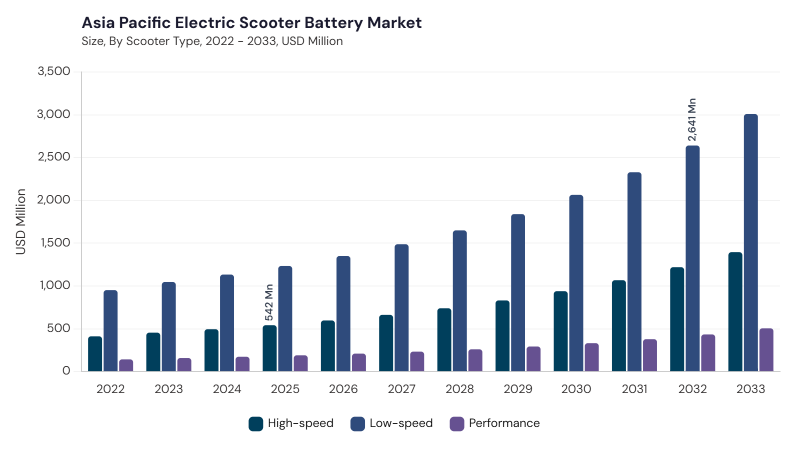
Based on Scooter Type, the market is segmented into Low-speed, High-speed, and Performance. The Low-speed market dominated the Asia Pacific Electric Scooter Battery Market by Scooter Type in 2025, and would continue to be a dominant market till 2033; thereby, achieving a market value of USD 2.0 billion by 2030, growing at a CAGR of 12.1 % during the forecast period. The High-speed market is expected to witness a CAGR of 12.9% during (2026 - 2033). The Performance market is expected to witness a CAGR of 13.4% during (2026 - 2033).
Low-speed scooters remain widely adopted due to affordability, compact battery requirements, energy efficiency, daily commuting use, and suitability for last-mile transportation in high-density cities. High-speed scooters maintain a considerable presence as users seek longer commuting range, broader metropolitan travel, stronger motor output, and improved drivetrain integration. Performance scooters hold a promising role through premium electric two-wheelers that require stronger acceleration, high-discharge cells, intelligent battery controls, improved cooling architectures, and advanced vehicle features.
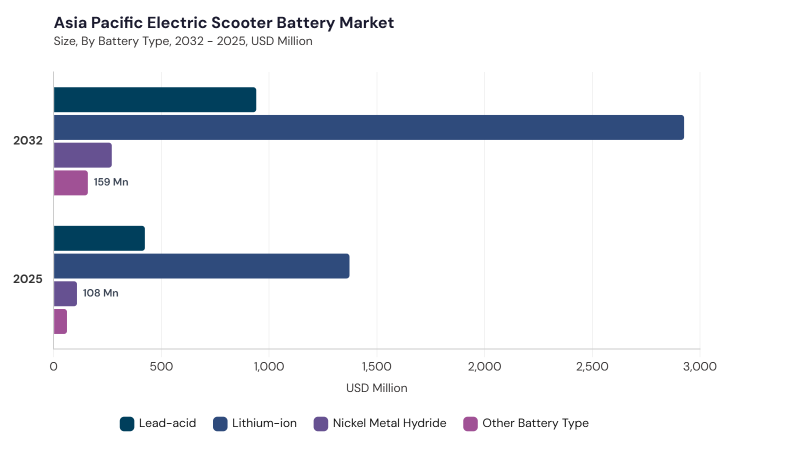
Based on Battery Type, the market is segmented into Lithium-ion, Lead-acid, Nickel Metal Hydride, and Other Battery Type. The Lithium-ion market dominated the Asia Pacific Electric Scooter Battery Market by Battery Type in 2025, and would continue to be a dominant market till 2033; thereby, achieving a market value of USD 2.2 billion by 2030, growing at a CAGR of 12.1 % during the forecast period. The Lead-acid market is expected to witness a CAGR of 12.7% during (2026 - 2033). The Other Battery Type market is expected to witness a CAGR of 14.9% during (2026 - 2033).
Lithium-ion batteries remain central to the market due to superior energy density, lightweight construction, longer lifecycle, faster charging capability, and strong fit with private ownership and commercial fleet use. Lead-acid batteries retain a substantial presence in cost-sensitive scooter models, especially where affordability, established servicing networks, and mature manufacturing infrastructure remain important. Nickel Metal Hydride serves selected applications requiring proven rechargeable performance, durability, and thermal tolerance, though its role is narrowing as lithium-based chemistries expand. Other Battery Type includes solid-state batteries, lithium-polymer variations, hybrid systems, and other emerging chemistries targeting improved safety, charging speed, lifecycle performance, and material availability.
Based on Sales Channel, the market is segmented into OEM and Aftermarket/Replacement. The OEM market dominated the Asia Pacific Electric Scooter Battery Market by Sales Channel in 2025, and would continue to be a dominant market till 2033; thereby, achieving a market value of USD 2.4 billion by 2030, growing at a CAGR of 12.1 % during the forecast period. The Aftermarket/Replacement market is expected to witness a CAGR of 13.5% during (2026 - 2033).
OEM batteries are important because scooter manufacturers require pack-level integration, warranty support, regulatory compliance, energy management, thermal safety, and optimized performance across new electric scooter models. This channel benefits from high production volumes, closer supplier-OEM collaboration, and rising demand for longer-life and faster-charging batteries. Aftermarket/Replacement maintains a promising presence due to the region’s large installed base of electric two-wheelers, battery aging, intensive usage cycles, refurbishment demand, compatible replacement packs, and consumer interest in extending vehicle life or upgrading performance.
Based on Battery Capacity, the market is segmented into 1 kWh-2 kWh, 2 kWh-3 kWh, Above 3 kWh, and Below 1 kWh. 1 kWh-2 kWh batteries support routine urban and suburban commuting while balancing cost, range, charging frequency, and vehicle maneuverability. 2 kWh-3 kWh batteries serve longer-range commuter scooters and delivery applications requiring greater power, fewer charging intervals, improved acceleration, and stronger load support.
Above 3 kWh batteries are used in premium, high-speed, long-range, and commercial scooters requiring higher energy reserves, fast-charging algorithms, and stronger thermal management. Below 1 kWh batteries remain relevant in lightweight, entry-oriented scooters designed for localized mobility, short trips, reduced vehicle mass, and highly price-sensitive markets.
Based on Voltage, the market is segmented into 48V, 60V, 72V and Above, and Below 48V. 48V batteries remain widely used in high-volume electric two-wheelers because they offer a practical balance of usable power, energy efficiency, manufacturing economics, component availability, and cost per kilometer. 60V batteries support scooters requiring improved acceleration, higher motor output, longer commuting routes, hill-climbing capability, and mixed urban-rural travel.
72V and Above batteries serve premium and performance-oriented scooters requiring stronger power delivery, extended range, higher speeds, advanced safety systems, and intelligent battery management. Below 48V batteries are concentrated in compact, low-speed, economical, and short-distance scooters where simple electrical configurations and modest energy requirements remain suitable.
Free Valuable Insights: Electric Scooter Battery Market is Predicted to reach USD 6561.2 Million billion by 2033, at a CAGR of 12.8%
Based on Country, the market is segmented into China, Japan, India, South Korea, Australia, Malaysia, and Rest of Asia Pacific. The China market dominated the Asia Pacific Electric Scooter Battery Market by Country in 2025, and would continue to be a dominant market till 2033; thereby, achieving a market value of USD 2.2 billion by 2030, growing at a CAGR of 11.6 % during the forecast period. The Japan market is expected to witness a CAGR of 9.7% during (2026 - 2033). Additionally, The India market is expected to witness a CAGR of 13.4% during (2026 - 2033).
China is shaped by lithium-ion transition, domestic manufacturing scale, fast charging, traceability, and circular battery practices, while Japan reflects solid-state development, IoT-based monitoring, predictive maintenance, and V2G-enabled battery concepts. India is driven by battery swapping, localized manufacturing, smart BMS, LFP and solid-state development, and recycling systems. South Korea is supported by safety-focused batteries, fast charging, IoT monitoring, and advanced quality control; Australia is influenced by solid-state batteries, safety certification, and localized testing; Malaysia is progressing through battery swapping, AI-based monitoring, and tropical-climate battery design; and Rest of Asia Pacific is shaped by swappable systems, modular packs, recycling, and region-specific battery customization.

By Scooter Type
By Battery Type
By Sales Channel
By Battery Capacity
By Voltage
By Country
Set to reach $3.3 Billion by 2030, growing at 12.5% CAGR during 2026-2033.
China leads with a market value of $2.2 billion by 2030, growing at 11.6% CAGR during 2026-2033.
Rising demand for high-speed scooters, with this segment growing at 12.9% CAGR during 2026-2033.
Lithium-ion segment to reach $2.2 billion by 2030, growing at 12.1% CAGR during 2026-2033.
India is expected to grow at a CAGR of 13.4% during 2026-2033.
OEM channel to achieve $2.4 billion by 2030, growing at 12.1% CAGR during 2026-2033.
Our team of dedicated experts can provide you with attractive expansion opportunities for your business.




 Unique Offerings
