The sample copy of this report is available for access.
The LAMEA Electric Scooter Battery Market is expected to reach USD 250.5 million by 2029, growing at a CAGR of 13.3% during (2026 - 2033).
The LAMEA Electric Scooter Battery Market originated with the broader adoption of electric mobility solutions across Latin America, the Middle East, and Africa. Early adoption was modest, supported mainly by small-scale imports and fragmented use of electric scooters powered by conventional lead-acid batteries. Over time, the transition from lead-acid to lithium-ion technologies improved battery weight, energy density, lifecycle, safety, and scooter usability, supporting wider acceptance across urban mobility applications.
Current market development is shaped by government support, regional battery customization, smart battery technologies, recycling, and second-life applications. Subsidies and favorable regulations are encouraging adoption and local manufacturing, while IoT-enabled battery management and real-time diagnostics are improving reliability, lifecycle management, and aftermarket service models. Battery recycling, circular economy practices, thermal management, localized production, charging stations, and battery swapping networks are also strengthening the market’s alignment with regional sustainability and infrastructure needs.
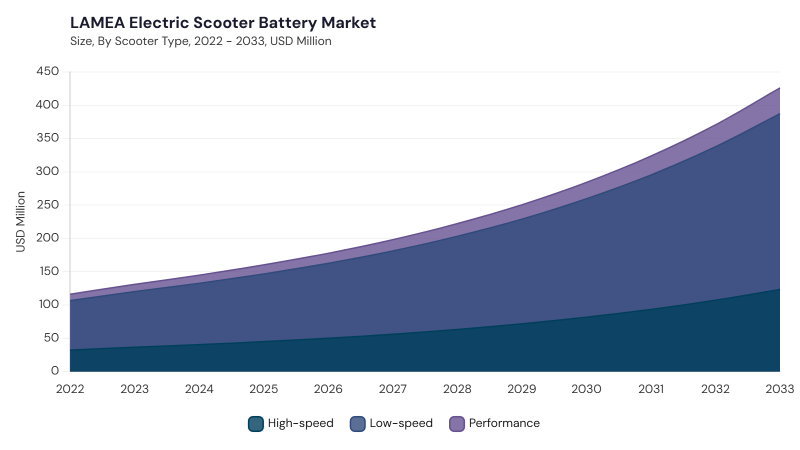
Based on Scooter Type, the market is segmented into Low-speed, High-speed, and Performance. The Low-speed market dominated the LAMEA Electric Scooter Battery Market by Scooter Type in 2025, and would continue to be a dominant market till 2033; thereby, achieving a market value of USD 157.3 million by 2029, growing at a CAGR of 13 % during the forecast period. The High-speed market is expected to witness a CAGR of 13.7% during (2026 - 2033). The Performance market is expected to witness a CAGR of 14.4% during (2026 - 2033).
Low-speed scooters remain widely adopted due to manageable charging requirements, moderate battery needs, affordability, operating simplicity, and suitability for first-mile and last-mile urban mobility. High-speed scooters maintain a considerable presence as riders seek greater travel flexibility across longer urban and suburban routes, supported by higher-output batteries and more capable electric drivetrains. Performance scooters hold a promising role through demand for premium electric mobility products in comparatively affluent urban markets, where high-power packs, enhanced thermal protection, intelligent energy controls, stronger acceleration, and extended range are important.
Based on Battery Type, the market is segmented into Lithium-ion, Lead-acid, Nickel Metal Hydride, and Other Battery Type. The Lithium-ion market dominated the LAMEA Electric Scooter Battery Market by Battery Type in 2025, and would continue to be a dominant market till 2033; thereby, achieving a market value of USD 174.4 million by 2029, growing at a CAGR of 12.9 % during the forecast period. The Lead-acid market is expected to witness a CAGR of 13.6% during (2026 - 2033). The Other Battery Type market is expected to witness a CAGR of 17.3% during (2026 - 2033).
Lithium-ion batteries remain central to the market due to higher energy density, lighter weight, longer cycle life, faster charging, advanced monitoring features, and suitability for commuter scooters, delivery vehicles, and shared scooter fleets. Lead-acid batteries retain a substantial presence in value-oriented electric mobility applications where affordability, familiar maintenance practices, and accessible replacement networks remain important. Nickel Metal Hydride serves limited applications requiring dependable rechargeable technology, stable cycling, and thermal performance, although its role remains specialized as manufacturers favor lighter and higher-density chemistries. Other Battery Type includes solid-state, zinc-air, lithium-polymer, and alternative storage technologies being explored for durability, thermal resilience, charging performance, safety, and reduced environmental impact.
Based on Sales Channel, the market is segmented into OEM and Aftermarket/Replacement. The OEM market dominated the LAMEA Electric Scooter Battery Market by Sales Channel in 2025, and would continue to be a dominant market till 2033; thereby, achieving a market value of USD 187.2 million by 2029, growing at a CAGR of 12.9 % during the forecast period. The Aftermarket/Replacement market is expected to witness a CAGR of 14.4% during (2026 - 2033).
OEM batteries are important because new scooter models require vehicle-level compatibility, integrated battery protection, safety compliance, warranty support, and performance consistency under regional climatic and usage conditions. This channel benefits from increasing electric scooter adoption, clean mobility initiatives, and manufacturer focus on advanced lithium-ion platforms. Aftermarket/Replacement maintains a promising presence due to aging batteries, intensive scooter use for commuting and commercial mobility, battery degradation, repair requirements, local distribution channels, and consumer demand for affordable replacement or upgrade solutions.
Based on Battery Capacity, the market is segmented into 1 kWh-2 kWh, 2 kWh-3 kWh, Above 3 kWh, and Below 1 kWh. 1 kWh-2 kWh batteries suit frequent short and medium-distance journeys common across densely populated cities and localized transport networks, offering a balance of range, weight, cost, and charging convenience. 2 kWh-3 kWh batteries support longer operating ranges, reduced charging frequency, semi-professional use, and scooters designed for more extensive daily usage.
Above 3 kWh batteries serve higher-powered, premium, commercial, and extended-range models requiring greater stored energy, improved thermal management, and stronger durability. Below 1 kWh batteries remain relevant for lightweight, compact, and cost-oriented scooters intended for limited-distance transportation where affordability and lower vehicle weight are key priorities.
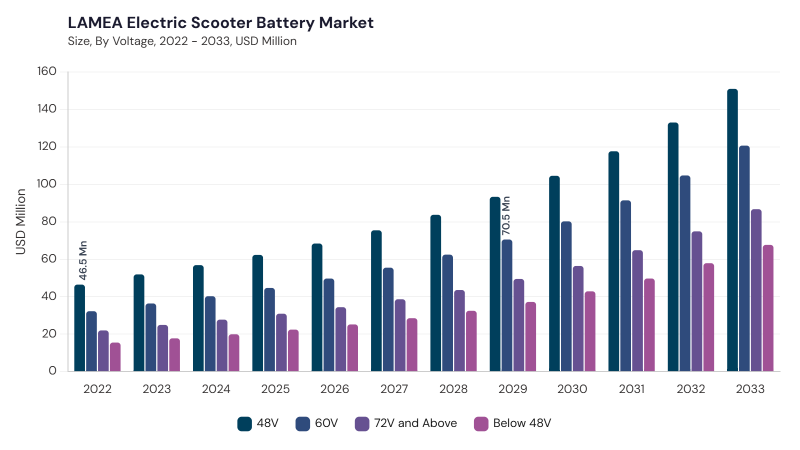
Based on Voltage, the market is segmented into 48V, 60V, 72V and Above, and Below 48V. 48V batteries remain widely used across imported and locally distributed scooter models because they provide adequate torque, moderate performance, cost efficiency, and compatibility with established drivetrain configurations. 60V batteries are gaining relevance for scooters requiring greater motor capability, stronger acceleration, longer routes, recreational use, and commercial delivery applications.
72V and Above batteries support premium scooters, off-road models, shared mobility platforms, courier applications, higher load capacity, and sustained high-power operation. Below 48V batteries remain concentrated in entry-level scooters designed for short-range transportation, affordability, uncomplicated operation, low-speed mobility, and first-time electric scooter users.
Free Valuable Insights: Electric Scooter Battery Market Size Worth USD 6561.2 Million billion by 2033
Based on Country, the market is segmented into Brazil, Argentina, UAE, Saudi Arabia, South Africa, Nigeria, and Rest of LAMEA. The Brazil market dominated the LAMEA Electric Scooter Battery Market by Country in 2025, and would continue to be a dominant market till 2033; thereby, achieving a market value of USD 74.1 million by 2029, growing at a CAGR of 12.1 % during the forecast period. The Argentina market is expected to witness a CAGR of 15% during (2026 - 2033). Additionally, The UAE market is expected to witness a CAGR of 12.1% during (2026 - 2033).
Brazil is supported by electric mobility incentives, lithium-ion improvements, shared scooter fleets, and localized assembly, while Argentina is shaped by lithium-ion adoption, smart BMS, local production, and sodium-ion exploration. The UAE reflects solid-state battery adoption, smart BMS, recycling, and AI-enabled power management, whereas Saudi Arabia emphasizes climate-resilient batteries, LFP cells, smart BMS, and heat-resistant solutions. South Africa is advancing through renewable-energy charging, swapping networks, and localized battery packs; Nigeria is driven by swapping infrastructure, sodium-ion interest, and localized assembly; and Rest of LAMEA is supported by recycling, battery-as-a-service, localized production, smart diagnostics, and thermal regulation.

By Scooter Type
By Battery Type
By Sales Channel
By Battery Capacity
By Voltage
By Country
Set to reach $250.5 Million by 2029, growing at 13.3% CAGR during 2026-2033.
Brazil leads with $74.1 million by 2029, growing at 12.1% CAGR during the forecast period.
Rising demand for low-speed scooters, expected to reach $157.3 million by 2029 at 13% CAGR during 2026-2033.
Lithium-ion segment to reach $174.4 million by 2029, growing at 12.9% CAGR during the forecast period.
The UAE market is expected to witness a CAGR of 12.1% during 2026-2033.
OEM channel to reach $187.2 million by 2029, growing at 12.9% CAGR during the forecast period.
Our team of dedicated experts can provide you with attractive expansion opportunities for your business.




 Unique Offerings
