The sample copy of this report is available for access.
The North America CXL Memory Module Market is expected to reach USD 1710.4 million by 2032, growing at a CAGR of 48.2% during (2026 - 2033).
The North America CXL Memory Module Market evolved from conventional fixed memory architectures toward coherent and composable memory systems designed to address bottlenecks in AI, high-performance computing, and data-centric infrastructure. Traditional processor-attached memory restricted flexibility and efficient resource utilization, while Compute Express Link introduced coherent sharing between processors, accelerators, and memory devices. Successive CXL developments expanded switching, memory pooling, fabric connectivity, and disaggregated architectures, improving scalability and system utilization. The market has consequently progressed toward modular memory expansion platforms capable of supporting cloud, hyperscale, enterprise, and heterogeneous computing environments.
AI workload expansion, heterogeneous computing, memory disaggregation, pooling, and next-generation memory integration are shaping current market development. CXL-enabled DRAM, flash, and persistent memory architectures are increasingly used to expand capacity beyond processor-attached resources while reducing memory bottlenecks. Hyperscale operators and cloud providers are exploring composable infrastructure that dynamically allocates memory according to workload requirements. Ecosystem standardization, smart memory controllers, advanced switching, software support, and emerging photonic interconnect technologies are further improving interoperability, bandwidth efficiency, and scalability across next-generation North American data center environments.
Based on Product Type, the market is segmented into 2.0-Compliant and 3.0-Compliant. The 2.0-Compliant market dominated the North America CXL Memory Module Market by Product Type in 2025, and would continue to be a dominant market till 2033; thereby, achieving a market value of USD 1428.6 million by 2032, growing at a CAGR of 48 % during the forecast period. The 3.0-Compliant market is expected to witness a CAGR of 49.6% during (2026 - 2033).
2.0-Compliant modules support memory expansion, switching, and pooling through commercially deployable server architectures, enabling data centers to increase memory capacity without completely redesigning existing systems. Their compatibility with established platforms makes them relevant for cloud computing, virtualization, enterprise workloads, databases, and AI inference. 3.0-Compliant modules extend the architecture toward fabric-attached memory, multi-level switching, peer-to-peer connectivity, and memory sharing across multiple compute domains. These capabilities align with future hyperscale AI, HPC, and composable infrastructure deployments requiring independently scalable memory and compute resources.
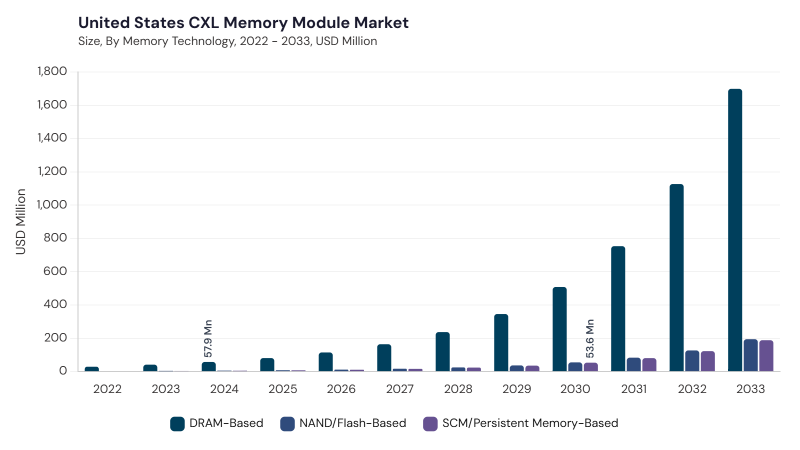
Based on Memory Technology, the market is segmented into DRAM-Based, NAND/Flash-Based, and SCM/Persistent Memory-Based. The DRAM-Based market dominated the North America CXL Memory Module Market by Memory Technology in 2025, and would continue to be a dominant market till 2033; thereby, achieving a market value of USD 1402.2 million by 2032, growing at a CAGR of 47.8 % during the forecast period. The NAND/Flash-Based market is expected to witness a CAGR of 50.1% during (2026 - 2033). Additionally, The SCM/Persistent Memory-Based market is expected to witness highest CAGR of 50.5% during (2026 - 2033).
DRAM-Based modules provide high-speed volatile memory expansion and coherent sharing across processors and accelerators, making them suitable for AI, analytics, databases, and latency-sensitive cloud workloads. NAND/Flash-Based modules offer larger persistent capacity and lower cost per bit, supporting memory tiering, caching, nearline expansion, and workloads that benefit from retaining data beyond power cycles. SCM/Persistent Memory-Based solutions combine persistent access with lower latency than conventional storage and support memory-centric computing, checkpointing, fast recovery, persistent databases, and workload acceleration. Together, these technologies enable differentiated memory hierarchies aligned with varying requirements for speed, persistence, capacity, and cost.

Based on Form Factor, the market is segmented into Add-in Card, E3.S, and U.2/U.3 and Other Form Factor. The Add-in Card market dominated the North America CXL Memory Module Market by Form Factor in 2025, and would continue to be a dominant market till 2033; thereby, achieving a market value of USD 835.4 million by 2032, growing at a CAGR of 47.5 % during the forecast period. The E3.S market is expected to witness a CAGR of 48.6% during (2026 - 2033). Additionally, The U.2/U.3 and Other Form Factor market is expected to witness highest CAGR of 50.2% during (2026 - 2033).
Add-in Card solutions provide modular memory expansion through existing PCIe slots and allow enterprises and data centers to introduce CXL without extensive chassis redesign, making them suitable for AI, databases, analytics, and server upgrades. E3.S modules support compact and dense server configurations with improved serviceability, thermal efficiency, and standardized deployment in hyperscale and edge environments. U.2/U.3 and Other Form Factor serve specialized and legacy-compatible architectures requiring hot-swappable configurations, alternative physical layouts, or gradual migration toward CXL-enabled infrastructure. Form-factor selection therefore reflects trade-offs among scalability, density, thermal management, serviceability, and platform compatibility.
Based on Application, the market is segmented into Artificial Intelligence and Machine Learning, High-Performance Computing, Database and Analytics, Virtualization and Cloud, and Enterprise. Artificial Intelligence and Machine Learning use CXL memory pooling and expansion to support large datasets, model training, inference, and coherent memory sharing between CPUs and accelerators. High-Performance Computing applies CXL to scientific simulations, engineering workloads, genomics, and distributed computation requiring large memory footprints and efficient data movement.
Database and Analytics benefit from in-memory processing, real-time analytics, and reduced data-access bottlenecks, while Virtualization and Cloud use dynamic memory allocation, memory pooling, and composable infrastructure to improve utilization and virtual machine density. Enterprise applications apply CXL to ERP, CRM, analytics, hybrid cloud, and business-critical systems requiring scalable memory without complete server replacement.
Based on End User, the market is segmented into Hyperscale Data Centers, Cloud Service Providers, Enterprise Data Centers, OEM/ODM Server Manufacturers, Research and Government Computing, and Other End User. Hyperscale Data Centers use CXL to build composable memory pools, improve server utilization, and support AI and cloud-scale workloads requiring very large memory capacities. Cloud Service Providers deploy CXL for elastic infrastructure, multi-tenant environments, scalable instances, and dynamic resource allocation, while Enterprise Data Centers use it for virtualization, databases, analytics, infrastructure modernization, and phased capacity expansion.
OEM/ODM Server Manufacturers integrate CXL-compatible slots, controllers, and modules into next-generation server platforms, enabling broader ecosystem adoption. Research and Government Computing applies CXL to scientific modeling, supercomputing, defense analytics, and experimental architectures, while Other End User includes telecommunications, financial services, media production, and other specialized computing environments requiring low latency and flexible memory scaling.
Free Valuable Insights: The Global CXL Memory Module Market will hit USD 6243.6 Million billion by 2033, at a CAGR of 49.1%
Based on Country, the market is segmented into US, Canada, Mexico, and Rest of North America. The US market dominated the North America CXL Memory Module Market by Country in 2025, and would continue to be a dominant market till 2033; thereby, achieving a market value of USD 1377.0 million by 2032, growing at a CAGR of 47.3 % during the forecast period. The Canada market is expected to witness a CAGR of 52.7% during (2026 - 2033). Additionally, The Mexico market is expected to witness a CAGR of 51% during (2026 - 2033).
Across North America, CXL memory module adoption is being shaped by AI infrastructure, memory disaggregation, cloud expansion, composable architectures, interoperability, and energy-efficient computing. The US emphasizes large-capacity memory expansion, heterogeneous memory, ecosystem validation, AI workloads, and advanced CXL architectures, while Canada focuses on AI-driven computing, flexible form factors, smart memory controllers, cloud collaboration, and scalable memory pooling. Mexico is advancing heterogeneous computing, localized manufacturing, energy-efficient module design, supply-chain integration, and enterprise modernization, whereas Rest of North America continues to develop AI-optimized memory solutions, modular data center architectures, rack-scale pooling, photonic interconnects, and advanced thermal and power management.

By Product Type
By Memory Technology
By Form Factor
By Application
By Memory End User
By Country
Set to reach $1710.4 Million by 2032, growing at 48.2% CAGR during 2026-2033.
The US leads with $1377.0 million by 2032, growing at a CAGR of 47.3% during 2026-2033.
Rising enterprise cloud adoption and AI-driven workloads are the main catalysts.
Expected to reach $1428.6 million by 2032, growing at 48% CAGR during 2026-2033.
The Canada market is expected to witness a CAGR of 52.7% during 2026-2033.
The SCM/Persistent Memory-Based market is expected to witness highest CAGR of 50.5% during 2026-2033.
Our team of dedicated experts can provide you with attractive expansion opportunities for your business.




 Unique Offerings