The sample copy of this report is available for access.
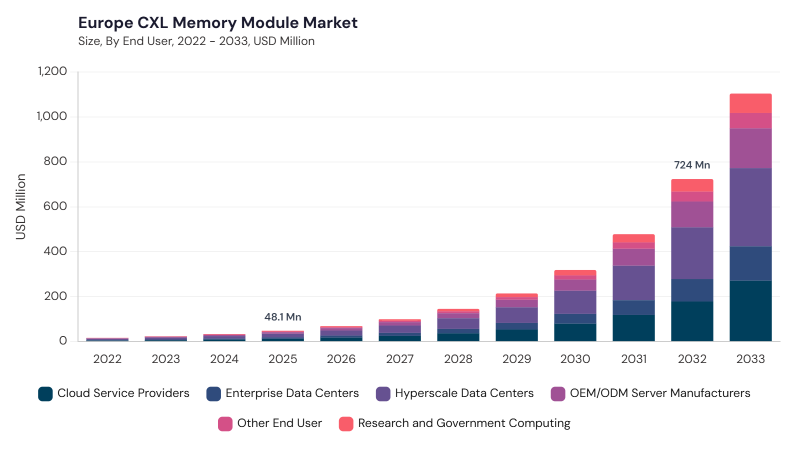
The Europe CXL Memory Module Market is expected to reach USD 478.1 million by 2031, growing at a CAGR of 48.6% during (2026 - 2033).
The Europe CXL Memory Module Market evolved alongside Compute Express Link technology as data centers and server environments sought alternatives to traditional memory architectures constrained by fixed capacity, latency, and limited resource sharing. CXL introduced a high-speed, coherent PCIe-based interconnect linking CPUs, memory, and accelerators, gradually shifting the industry from proprietary interfaces toward an open ecosystem. Adoption strengthened with CXL 2.0 memory pooling and expansion capabilities, while subsequent architectures moved toward fabric-attached and composable memory. The market is now progressing from experimental deployment toward commercially viable infrastructure supporting AI, cloud, HPC, and heterogeneous computing.
AI and machine learning workloads, memory disaggregation, open standards, energy efficiency, and ecosystem interoperability are shaping current market development. European operators are increasingly exploring pooled memory architectures that improve utilization while reducing dependence on fixed processor-attached DRAM. Adoption is also being influenced by sovereign AI infrastructure, EuroHPC investments, cloud modernization, and sustainability-focused data center design. Advanced controllers, firmware optimization, persistent memory, photonic interconnects, high-bandwidth memory integration, and modular server architectures are broadening CXL deployment opportunities while improving scalability, latency, and infrastructure efficiency.
Based on Product Type, the market is segmented into 2.0-Compliant and 3.0-Compliant. The 2.0-Compliant market dominated the Europe CXL Memory Module Market by Product Type in 2025, and would continue to be a dominant market till 2033; thereby, achieving a market value of USD 402.2 million by 2031, growing at a CAGR of 48.4 % during the forecast period. The 3.0-Compliant market is expected to witness a CAGR of 50% during (2026 - 2033).
2.0-Compliant modules support switching, memory pooling, and scalable expansion through comparatively mature server architectures, making them suitable for AI inference, virtualization, analytics, cloud computing, and HPC environments. They enable operators to increase memory capacity without proportionally expanding compute resources, helping improve infrastructure utilization. 3.0-Compliant modules extend CXL toward fabric-attached memory, multi-level switching, peer-to-peer communication, and shared resources across multiple hosts. These capabilities align with sovereign AI, hyperscale computing, supercomputing, and future composable data centers, although deployment remains more selective because it requires newer processor platforms, switching infrastructure, software, and broader interoperability validation.
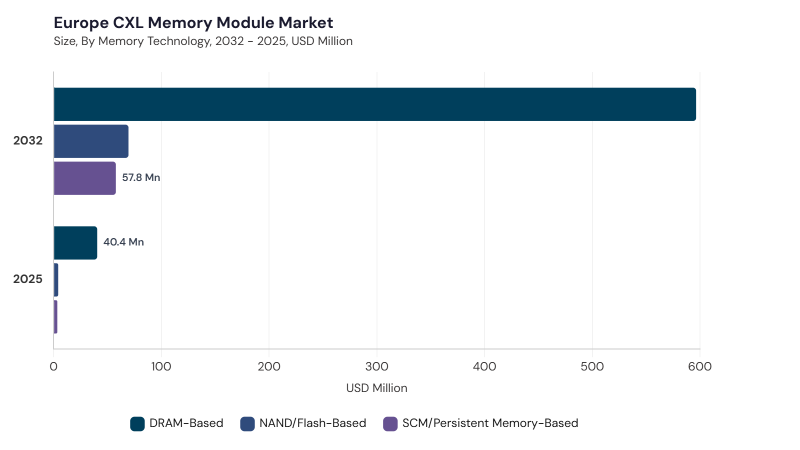
Based on Memory Technology, the market is segmented into DRAM-Based, NAND/Flash-Based, and SCM/Persistent Memory-Based. The DRAM-Based market dominated the Europe CXL Memory Module Market by Memory Technology in 2025, and would continue to be a dominant market till 2033; thereby, achieving a market value of USD 395.3 million by 2031, growing at a CAGR of 48.2 % during the forecast period. The NAND/Flash-Based market is expected to witness a CAGR of 50.5% during (2026 - 2033). Additionally, The SCM/Persistent Memory-Based market is expected to witness highest CAGR of 51.1% during (2026 - 2033).
DRAM-Based modules provide low-latency volatile memory expansion and pooling for AI, HPC, virtualization, databases, and other workloads requiring rapid processor access. NAND/Flash-Based modules provide higher-capacity non-volatile tiers suited to caching, checkpointing, analytical datasets, AI pipelines, and workloads where persistence and capacity economics are important. SCM/Persistent Memory-Based solutions bridge the performance gap between DRAM and conventional storage by combining persistence with faster access, supporting memory-centric databases, fast recovery, telecommunications, scientific computing, and durable data states. These technologies collectively enable multi-tier memory architectures aligned with workload-specific requirements for latency, persistence, capacity, resilience, and cost.
Based on Form Factor, the market is segmented into Add-in Card, E3.S, and U.2/U.3 and Other Form Factor. The Add-in Card market dominated the Europe CXL Memory Module Market by Form Factor in 2025, and would continue to be a dominant market till 2033; thereby, achieving a market value of USD 236.0 million by 2031, growing at a CAGR of 47.9 % during the forecast period. The E3.S market is expected to witness a CAGR of 49.1% during (2026 - 2033). Additionally, The U.2/U.3 and Other Form Factor market is expected to witness highest CAGR of 50.8% during (2026 - 2033).
Add-in Cards provide a modular entry route for expanding memory through existing PCIe-based server environments and are relevant to AI, scientific computing, databases, virtualization, and infrastructure modernization. E3.S supports compact, dense, serviceable server architectures aligned with cloud, AI, edge, and HPC requirements where rack space, thermal efficiency, and power usage are important. U.2/U.3 and Other Form Factor remain relevant for established enterprise layouts, hot-swappable configurations, front-access servicing, and gradual migration toward CXL-enabled infrastructure. Form-factor selection across Europe is increasingly influenced by memory density, cooling requirements, energy performance, serviceability, server compatibility, and infrastructure utilization.
Based on Application, the market is segmented into Artificial Intelligence and Machine Learning, High-Performance Computing, Database and Analytics, Virtualization and Cloud, and Enterprise. Artificial Intelligence and Machine Learning benefit from CXL memory expansion and coherent resource sharing across CPUs, GPUs, and accelerators supporting training, inference, generative AI, computer vision, and scientific AI. High-Performance Computing uses CXL for climate modelling, engineering simulations, pharmaceutical research, scientific computing, and other workloads requiring scalable memory resources.
Database and Analytics applications benefit from larger memory pools for financial processing, industrial analytics, real-time decisions, and scientific datasets, while Virtualization and Cloud use dynamic allocation and memory pooling to improve server utilization and workload consolidation. Enterprise applications include ERP, CRM, financial systems, industrial software, analytics, AI inference, and virtualization requiring flexible modernization of existing computing environments.
Based on End User, the market is segmented into Hyperscale Data Centers, Cloud Service Providers, Enterprise Data Centers, OEM/ODM Server Manufacturers, Research and Government Computing, and Other End User. Hyperscale Data Centers use CXL to expand memory independently from compute, improve accelerator utilization, and support AI, cloud, analytics, and distributed workloads. Cloud Service Providers benefit from pooled and composable memory supporting multi-tenant infrastructure, virtual machines, AI services, and flexible resource allocation, while Enterprise Data Centers apply CXL to infrastructure modernization, databases, virtualization, analytics, and phased capacity expansion.
OEM/ODM Server Manufacturers enable wider adoption through CXL-ready servers, controller integration, firmware, interoperability testing, and thermal engineering. Research and Government Computing uses CXL across supercomputing, AI infrastructure, scientific research, national computing programs, and experimental architectures, while Other End User includes telecommunications, financial services, automotive computing, industrial research, energy, and media environments requiring low-latency access to large datasets.
Free Valuable Insights: The Worldwide CXL Memory Module Market is projected to reach USD 6243.6 Million billion by 2033, at a CAGR of 49.1%
Based on Country, the market is segmented into Germany, UK, France, Russia, Spain, Italy, and Rest of Europe. The Germany market dominated the Europe CXL Memory Module Market by Country in 2025, and would continue to be a dominant market till 2033; thereby, achieving a market value of USD 108.1 million by 2031, growing at a CAGR of 46.8 % during the forecast period. The UK market is expected to witness a CAGR of 47.5% during (2026 - 2033). Additionally, The France market is expected to witness a CAGR of 49.7% during (2026 - 2033).
Across Europe, CXL memory adoption is being shaped by AI infrastructure, HPC modernization, composable computing, interoperability, sustainability, and data sovereignty priorities. Germany emphasizes AI-driven memory disaggregation, advanced CXL standards, modular data centers, interoperability, and high-performance computing, while the UK focuses on AI workloads, PCIe-CXL convergence, scalable architectures, energy efficiency, and localized R&D. France is advancing memory pooling, standards compliance, energy-conscious module design, AI/HPC integration, and persistent memory, whereas Russia emphasizes localized hardware, heterogeneous memory, CXL controller development, compression technologies, and sovereign computing infrastructure. Spain focuses on AI memory expansion, software-defined memory, photonic interconnects, and high-bandwidth architectures, while Italy emphasizes memory pooling, near-memory acceleration, sustainable data center infrastructure, and AI/HPC modernization. Rest of Europe continues to develop AI-oriented memory expansion, multi-protocol interoperability, composable architectures, localized supply chains, sustainability, and cost-efficient reuse of existing memory resources.

By Product Type
By Memory Technology
By Form Factor
By Application
By Memory End User
By Country
Set to reach $478.1 Million by 2031, growing at 48.6% CAGR during 2026-2033.
Germany leads with $108.1 million by 2031, growing at 46.8% CAGR during the forecast period.
Rising enterprise cloud adoption and AI-driven workloads are the main catalysts.
The 2.0-Compliant segment will reach $402.2 million by 2031, growing at 48.4% CAGR during 2026-2033.
The UK market is expected to witness a CAGR of 47.5% during 2026-2033.
SCM/Persistent Memory-Based technology is expected to witness the highest CAGR of 51.1% during 2026-2033.
Our team of dedicated experts can provide you with attractive expansion opportunities for your business.




 Unique Offerings