The sample copy of this report is available for access.
The LAMEA CXL Memory Module Market is expected to reach USD 74.8 million by 2029, growing at a CAGR of 51.3% during (2026 - 2033).
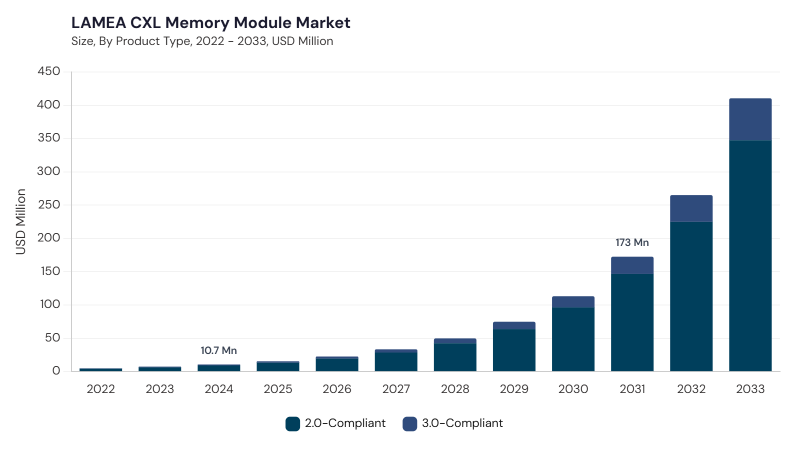
The LAMEA CXL Memory Module Market evolved from conventional DDR- and GDDR-based memory architectures toward coherent memory systems designed for cloud computing, artificial intelligence, high-performance computing, and data-intensive enterprise workloads. Compute Express Link introduced cache-coherent communication between CPUs, GPUs, accelerators, and memory devices, helping address bandwidth, latency, and scalability limitations associated with traditional architectures. The introduction of CXL 2.0 further enabled memory pooling and switching, encouraging a transition from isolated hardware resources toward disaggregated computing. Regional adoption is now progressing across data centers, cloud infrastructure, enterprise systems, and edge environments as interoperability and ecosystem support improve.
Heterogeneous computing, regional digital transformation, memory disaggregation, edge computing, and localized infrastructure development are shaping current market trends. Enterprises and service providers increasingly require flexible memory pools capable of supporting AI inference, analytics, cloud workloads, and accelerator-rich computing systems. Improved standardization and chipset compatibility are reducing integration barriers, while advancements in DDR5, persistent memory, power management, and thermal optimization are strengthening module performance. Localization of supply chains, regional manufacturing, sustainability requirements, and investment in AI-focused digital infrastructure are also widening opportunities for CXL memory adoption throughout LAMEA.
Based on Product Type, the market is segmented into 2.0-Compliant and 3.0-Compliant. The 2.0-Compliant market dominated the LAMEA CXL Memory Module Market by Product Type in 2025, and would continue to be a dominant market till 2033; thereby, achieving a market value of USD 63.8 million by 2029, growing at a CAGR of 51 % during the forecast period. The 3.0-Compliant market is expected to witness a CAGR of 52.9% during (2026 - 2033).
2.0-Compliant modules support memory expansion, switching, and pooling while providing a comparatively accessible pathway for enterprises, cloud providers, and data center operators introducing CXL into PCIe-based environments. These solutions are particularly relevant for AI inference, virtualization, analytics, cloud databases, and other workloads requiring additional memory without proportional server expansion. 3.0-Compliant modules extend the architecture toward fabric-attached memory, advanced switching, peer-to-peer communication, and wider resource sharing across multiple hosts. Their adoption is likely to concentrate initially in sovereign AI facilities, hyperscale environments, advanced Gulf data centers, and specialized HPC deployments requiring composable infrastructure.
Based on Memory Technology, the market is segmented into DRAM-Based, NAND/Flash-Based, and SCM/Persistent Memory-Based. The DRAM-Based market dominated the LAMEA CXL Memory Module Market by Memory Technology in 2025, and would continue to be a dominant market till 2033; thereby, achieving a market value of USD 62.9 million by 2029, growing at a CAGR of 50.8 % during the forecast period. The NAND/Flash-Based market is expected to witness a CAGR of 53.1% during (2026 - 2033). Additionally, The SCM/Persistent Memory-Based market is expected to witness highest CAGR of 54.6% during (2026 - 2033).
DRAM-Based modules provide high-speed volatile memory expansion suitable for AI, virtualization, real-time analytics, and cloud workloads requiring rapid access and coherent processor connectivity. NAND/Flash-Based modules offer higher-capacity non-volatile expansion for caching, tiered memory, analytics, content delivery, and data-intensive environments where persistence and cost efficiency are important. SCM/Persistent Memory-Based solutions combine lower latency with non-volatility, supporting in-memory databases, transactional processing, rapid recovery, edge computing, and mission-critical applications requiring data persistence. These technologies enable differentiated memory tiers aligned with performance, capacity, persistence, availability, and cost requirements.
Based on Form Factor, the market is segmented into Add-in Card, E3.S, and U.2/U.3 and Other Form Factor. The Add-in Card market dominated the LAMEA CXL Memory Module Market by Form Factor in 2025, and would continue to be a dominant market till 2033; thereby, achieving a market value of USD 37.7 million by 2029, growing at a CAGR of 50.5 % during the forecast period. The E3.S market is expected to witness a CAGR of 51.6% during (2026 - 2033). Additionally, The U.2/U.3 and Other Form Factor market is expected to witness highest CAGR of 54.3% during (2026 - 2033).
Add-in Cards provide flexible memory expansion through PCIe slots and support scalable upgrades across enterprise data centers, telecommunications, cloud infrastructure, and AI environments without extensive motherboard redesign. E3.S modules offer compact, serviceable, and thermally optimized configurations suitable for dense cloud, AI, edge, and hyperconverged infrastructure where rack efficiency is important. U.2/U.3 and Other Form Factor support storage-oriented, hot-swappable, and specialized server configurations, allowing gradual integration of CXL memory alongside established infrastructure. Form-factor selection is therefore influenced by density, cooling requirements, maintenance accessibility, compatibility, capacity, and deployment flexibility.
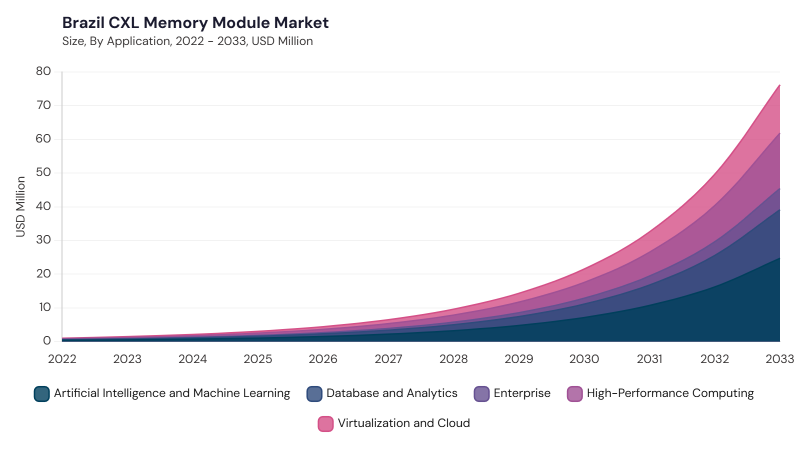
Based on Application, the market is segmented into Artificial Intelligence and Machine Learning, High-Performance Computing, Database and Analytics, Virtualization and Cloud, and Enterprise. Artificial Intelligence and Machine Learning use CXL memory to support training, inference, neural networks, smart-city applications, and accelerator-heavy computing through flexible memory pooling and low-latency access. High-Performance Computing applies CXL to seismic interpretation, energy exploration, weather modeling, mining analysis, engineering, and scientific simulation requiring coherent memory across heterogeneous processors.
Database and Analytics benefit from larger memory pools supporting financial services, telecommunications, public-sector platforms, and real-time data processing, while Virtualization and Cloud use dynamic memory allocation and composable architectures to improve utilization. Enterprise applications include telecommunications, banking, healthcare, government systems, analytics, and private infrastructure modernization.
Based on End User, the market is segmented into Hyperscale Data Centers, Cloud Service Providers, Enterprise Data Centers, OEM/ODM Server Manufacturers, Research and Government Computing, and Other End User. Hyperscale Data Centers use CXL to expand memory capacity, support AI and cloud workloads, improve server density, and reduce memory fragmentation across large computing environments. Cloud Service Providers benefit from memory pooling, elastic infrastructure, localized hosting, and heterogeneous compute integration, while Enterprise Data Centers adopt CXL for infrastructure refreshes, databases, analytics, AI, and private cloud applications.
OEM/ODM Server Manufacturers support adoption by integrating CXL-compatible controllers, memory modules, firmware, and validation into new server platforms. Research and Government Computing applies CXL to geoscience, national laboratories, scientific simulation, AI, and publicly funded computing programs, while Other End User includes telecommunications, media, education, specialized hosting, and emerging digital infrastructure ventures.
Free Valuable Insights: CXL Memory Module Market Size Worth USD 6243.6 Million billion by 2033
Based on Country, the market is segmented into Brazil, Argentina, UAE, Saudi Arabia, South Africa, Nigeria, and Rest of LAMEA. The UAE market dominated the LAMEA CXL Memory Module Market by Country in 2025, and would continue to be a dominant market till 2033; thereby, achieving a market value of USD 17.6 million by 2029, growing at a CAGR of 49.2 % during the forecast period. The Argentina market is expected to witness a CAGR of 52.8% during (2026 - 2033). Additionally, The Brazil market is expected to witness a CAGR of 50.2% during (2026 - 2033).
Across LAMEA, CXL memory module adoption is being shaped by AI infrastructure, cloud expansion, memory disaggregation, localized manufacturing, interoperability, and cost-efficient modernization. Brazil emphasizes AI workloads, PCIe integration, localized data centers, DDR5 support, and memory pooling, while Argentina focuses on dynamic memory sharing, local manufacturing, digital infrastructure modernization, and international CXL compatibility. The UAE is advancing AI-oriented memory expansion, open ecosystems, localized module design, thermal optimization, and sovereign data infrastructure, whereas Saudi Arabia emphasizes computational memory, edge computing, near-data processing, CXL 3.0, and AI-focused digital platforms. South Africa focuses on AI workloads, bandwidth scaling, localized support, system-level integration, and hyperscale infrastructure, while Nigeria emphasizes rack-scale pooling, PCIe-CXL integration, energy efficiency, localized assembly, and AI/HPC modernization. Rest of LAMEA continues to develop scalable memory pooling, edge computing, interoperability, regional manufacturing, thermal management, and energy-efficient CXL architectures.

By Product Type
By Memory Technology
By Form Factor
By Application
By Memory End User
By Country
Set to reach $74.8 Million by 2029, growing at 51.3% CAGR during 2026-2033.
The UAE leads with $17.6 million by 2029, growing at a CAGR of 49.2% during the forecast period.
Rising demand for DRAM-Based technology, achieving $62.9 million by 2029, growing at 50.8% CAGR during 2026-2033.
The 2.0-Compliant segment will reach $63.8 million by 2029, growing at 51% CAGR during 2026-2033.
Brazil is expected to witness a CAGR of 50.2% during 2026-2033.
The SCM/Persistent Memory-Based segment is expected to witness the highest CAGR of 54.6% during 2026-2033.
Our team of dedicated experts can provide you with attractive expansion opportunities for your business.



 Unique Offerings