The sample copy of this report is available for access.
The Asia Pacific CXL Memory Module Market is expected to reach USD 596.7 million by 2030, growing at a CAGR of 50% during (2026 - 2033).
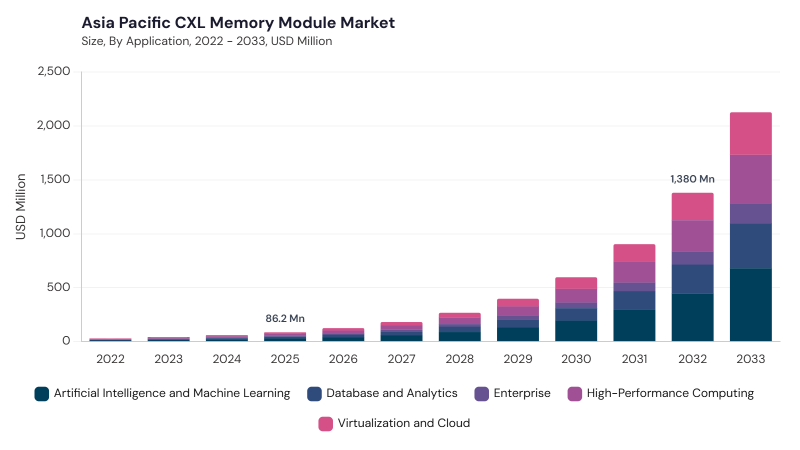
The Asia Pacific CXL Memory Module Market evolved in response to rising demand for high-bandwidth, low-latency memory architectures supporting cloud computing, artificial intelligence, big data, and heterogeneous processing environments. Traditional memory frameworks increasingly struggled with scalability and data-transfer bottlenecks, prompting adoption of Compute Express Link as a coherent interface between CPUs, accelerators, and memory devices. Standardization, expanding semiconductor support, and integration of CXL modules into AI server infrastructure gradually moved the technology from experimental deployment toward commercial adoption. The region now combines extensive semiconductor manufacturing capability with growing demand for scalable, disaggregated, and composable memory architectures.
AI and machine learning expansion, memory pooling, open hardware standardization, localized manufacturing, and heterogeneous computing are shaping current market development. CXL-enabled systems increasingly allow memory resources to be dynamically shared across processors and accelerators, improving utilization in AI, cloud, HPC, and data-intensive environments. Regional collaboration through technology ecosystems and industry forums is improving interoperability and accelerating commercialization, while localized manufacturing strengthens supply-chain responsiveness. Non-volatile memory integration, advanced controllers, co-packaged optics, silicon photonics, enhanced security, and energy-efficient module designs are further broadening the performance and deployment potential of CXL memory across Asia Pacific.
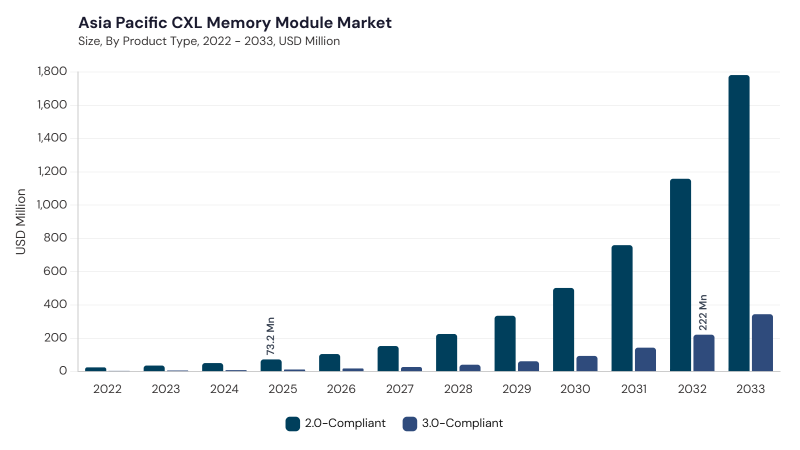
Based on Product Type, the market is segmented into 2.0-Compliant and 3.0-Compliant. The 2.0-Compliant market dominated the Asia Pacific CXL Memory Module Market by Product Type in 2025, and would continue to be a dominant market till 2033; thereby, achieving a market value of USD 502.5 million by 2030, growing at a CAGR of 49.7 % during the forecast period. The 3.0-Compliant market is expected to witness a CAGR of 51.4% during (2026 - 2033).
2.0-Compliant modules provide commercially practical memory expansion, pooling, and coherent resource sharing through PCIe-based server environments, making them relevant for cloud, AI, edge, virtualization, and enterprise applications. Their broader ecosystem readiness supports adoption across hyperscale and data center infrastructure seeking scalable memory without extensive architectural replacement. 3.0-Compliant modules extend the technology toward multi-host memory sharing, advanced fabric topologies, improved switching, and more sophisticated disaggregated computing. These capabilities position them for next-generation hyperscale AI, distributed HPC, and composable infrastructure, although adoption remains comparatively selective because of newer platform, software, and interoperability requirements.
Based on Memory Technology, the market is segmented into DRAM-Based, NAND/Flash-Based, and SCM/Persistent Memory-Based. The DRAM-Based market dominated the Asia Pacific CXL Memory Module Market by Memory Technology in 2025, and would continue to be a dominant market till 2033; thereby, achieving a market value of USD 494.4 million by 2030, growing at a CAGR of 49.6 % during the forecast period. The NAND/Flash-Based market is expected to witness a CAGR of 51.9% during (2026 - 2033). Additionally, The SCM/Persistent Memory-Based market is expected to witness highest CAGR of 52.5% during (2026 - 2033).
DRAM-Based modules provide low-latency volatile memory expansion suitable for AI training, analytics, virtualization, cloud computing, and other performance-sensitive applications requiring rapid access to large memory pools. NAND/Flash-Based modules offer higher-capacity, non-volatile expansion and support tiered architectures, checkpointing, edge computing, caching, and data-intensive applications where persistence and cost efficiency are important. SCM/Persistent Memory-Based solutions bridge the gap between conventional DRAM and storage by combining persistence with lower latency, supporting rapid recovery, mission-critical workloads, financial systems, telecommunications, and AI inference. Together, these technologies enable heterogeneous memory hierarchies optimized around performance, persistence, capacity, and resource efficiency.
Based on Form Factor, the market is segmented into Add-in Card, E3.S, and U.2/U.3 and Other Form Factor. The Add-in Card market dominated the Asia Pacific CXL Memory Module Market by Form Factor in 2025, and would continue to be a dominant market till 2033; thereby, achieving a market value of USD 295.7 million by 2030, growing at a CAGR of 49.3 % during the forecast period. The E3.S market is expected to witness a CAGR of 50.4% during (2026 - 2033). Additionally, The U.2/U.3 and Other Form Factor market is expected to witness highest CAGR of 52.3% during (2026 - 2033).
Add-in Cards enable modular CXL memory expansion through established PCIe slots and support high-capacity configurations across AI, HPC, telecom, financial services, and specialized server environments. E3.S modules provide compact, dense, and serviceable deployment suited to cloud, hyperscale, edge, and enterprise systems where rack density, power efficiency, and thermal optimization are important. U.2/U.3 and Other Form Factor support hot-swappable, storage-oriented, and specialized server configurations, enabling gradual migration toward CXL without extensive chassis redesign. Form-factor adoption is therefore influenced by density, serviceability, thermal requirements, capacity, server compatibility, and the pace of infrastructure modernization.
Based on Application, the market is segmented into Artificial Intelligence and Machine Learning, High-Performance Computing, Database and Analytics, Virtualization and Cloud, and Enterprise. Artificial Intelligence and Machine Learning use CXL to expand memory pools across CPUs, GPUs, and accelerators, supporting large models, inference, training, computer vision, and data-intensive AI workloads. High-Performance Computing applies CXL to simulations, weather forecasting, semiconductor design, engineering research, genomics, and scientific modeling requiring scalable and coherent memory access.
Database and Analytics benefit from larger memory pools supporting real-time processing, digital platforms, financial systems, telecommunications data, and extensive industrial datasets, while Virtualization and Cloud use disaggregated memory to improve workload consolidation, elasticity, and server utilization. Enterprise environments adopt CXL for ERP, business analytics, hybrid infrastructure, AI-enabled applications, and phased modernization of mission-critical systems.
Based on End User, the market is segmented into Hyperscale Data Centers, Cloud Service Providers, Enterprise Data Centers, OEM/ODM Server Manufacturers, Research and Government Computing, and Other End User. Hyperscale Data Centers use CXL to create scalable memory pools, improve accelerator utilization, and support AI, analytics, cloud, and large distributed workloads. Cloud Service Providers apply CXL to multi-tenant environments, AI-as-a-Service, containerized workloads, hybrid cloud, and flexible resource provisioning, while Enterprise Data Centers benefit from incremental memory expansion and workload consolidation without complete hardware replacement.
OEM/ODM Server Manufacturers accelerate market adoption by integrating CXL controllers, slots, firmware, thermal solutions, and interoperability support into new platforms. Research and Government Computing applies CXL to supercomputing, climate modeling, scientific research, national security, and AI programs, while Other End User includes telecommunications, industrial automation, media, edge computing, and other specialized environments requiring scalable low-latency memory.
Free Valuable Insights: CXL Memory Module Market is Predicted to reach USD 6243.6 Million billion by 2033, at a CAGR of 49.1%
Based on Country, the market is segmented into China, Japan, India, South Korea, Singapore, Malaysia, and Rest of Asia Pacific. The China market dominated the Asia Pacific CXL Memory Module Market by Country in 2025, and would continue to be a dominant market till 2033; thereby, achieving a market value of USD 155.7 million by 2030, growing at a CAGR of 47.2 % during the forecast period. The Japan market is expected to witness a CAGR of 48.5% during (2026 - 2033). Additionally, The India market is expected to witness a CAGR of 51.6% during (2026 - 2033).
Across Asia Pacific, CXL memory adoption is being shaped by AI infrastructure, semiconductor manufacturing, memory disaggregation, cloud expansion, localization, and interoperability. China emphasizes AI/HPC memory expansion, hybrid memory architectures, reuse of legacy memory, localized controllers, and CXL 2.0/3.0 adoption, while Japan focuses on pooled memory, AI-oriented server infrastructure, CXL standard progression, sustainability, and domestic semiconductor capability. India is advancing AI-ready data centers, memory reuse, scalable CXL architectures, localized manufacturing, and cloud partnerships, whereas South Korea emphasizes CXL DRAM innovation, system validation, high-bandwidth memory integration, domestic semiconductor leadership, and AI infrastructure. Singapore focuses on AI-oriented memory pooling, custom silicon, co-packaged optics, cloud infrastructure, and ecosystem collaboration, while Malaysia is strengthening local manufacturing, CXL controller development, advanced packaging, interoperability, and hyperscale server support. Rest of Asia Pacific continues to develop heterogeneous computing, localized supply chains, AI-oriented memory expansion, silicon photonics, co-packaged optics, and flexible regional CXL ecosystems.

By Product Type
By Memory Technology
By Form Factor
By Application
By Memory End User
By Country
Set to reach $596.7 Million by 2030, growing at 50% CAGR during 2026-2033.
China leads with $155.7 million by 2030, growing at 47.2% CAGR during 2026-2033.
Rising demand for DRAM-Based technology, reaching $494.4 million by 2030 at 49.6% CAGR during 2026-2033.
Expected to achieve $502.5 million by 2030, growing at 49.7% CAGR during 2026-2033.
India market is expected to witness a CAGR of 51.6% during 2026-2033.
Expected to witness the highest CAGR of 52.5% during 2026-2033.
Our team of dedicated experts can provide you with attractive expansion opportunities for your business.




 Unique Offerings