The sample copy of this report is available for access.
“Global CXL Memory Module Market to reach a market value of USD 6,243.62 Million by 2033 growing at a CAGR of 49.1%”
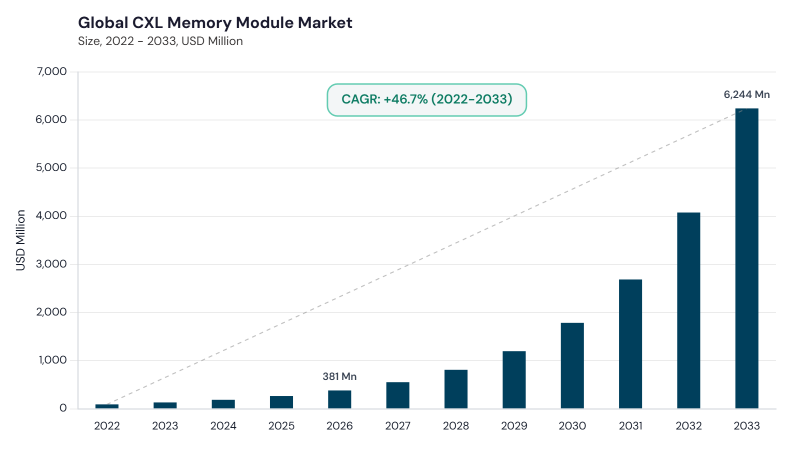
The Global CXL Memory Module Market is expected to reach USD 6243.6 million by 2033, growing at a CAGR of 49.1% during (2026 - 2033).
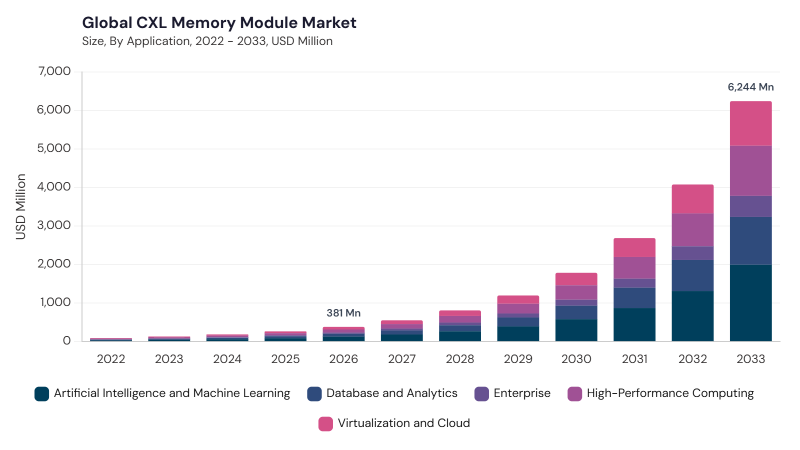
CXL memory modules market is experiencing growth across accelerators, memory devices, and processors; supported by growing need for memory expansion, lower latency, higher bandwidth, coherent connectivity, lower latency, and scalable resource utilization. Market adoption is further driven by composable infrastructure, hyperscale data centers, AI workloads, cloud computing, high-performance computing, memory pooling, hyperscale data centers, advanced CXL controllers, and next-generation server architectures. CXL memory module market originated from the requirement to address memory-capacity and bandwidth constraints in heterogeneous computing environments, and modern data center.
CXL memory module market is anticipated to grow as HPC, AI, in-memory databases, AI, and virtualization workloads require faster, larger, and more flexible memory architectures. CXL allows memory pooling, disaggregation, and expansion beyond traditional CPU-attached DRAM limitations, helping data centers reduce overprovisioning, and enhance utilization. Manufacturers are advancing CXL 2.0 and 3.0 modules, E3.S form factors, DDR5-based designs, persistent memory options, add-in cards, and software-managed memory platforms to strengthen next-generation data processing. T5
Market is technology-intensive and highly fragmented, with competition driven by CXL-native memory module suppliers, global memory manufacturers, server platform providers, controller developers, and composable infrastructure specialists. Market players compete through module capacity, latency optimization, interoperability, bandwidth, form-factor flexibility, CXL controller design, AI infrastructure readiness, and thermal efficiency. Market competition will depend on fabric-based pooling, CXL 3.x adoption, high-capacity modules, software-defined memory management, and broader validation across server, CPU, cloud, and hyperscale ecosystems.

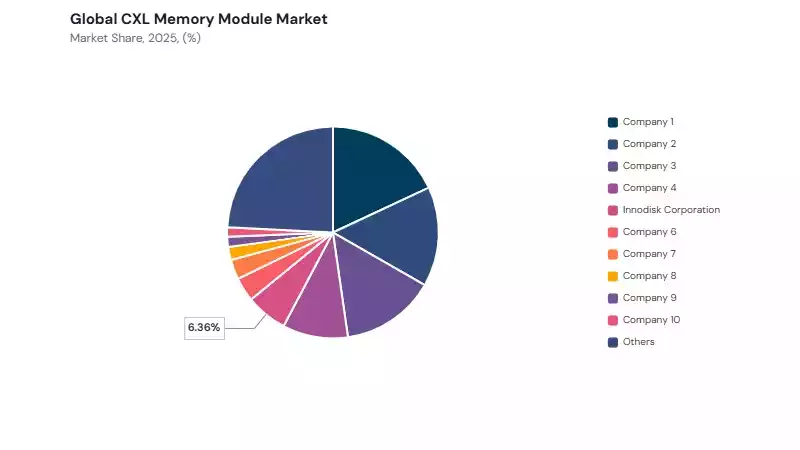
Micron Technology, Samsung Electronics, and SK Hynix are some of the leading players in the CXL memory module market. Market growth is further strengthened by players including XCENA, Innodisk, SMART Modular Technologies, Panmnesia, Viking Technology, GIGABYTE, and Etron Technology positioning themselves through E3.S modules, CXL add-in cards, controllers, server platforms, and composable memory technologies.
Based on Product Type, the market is segmented into 2.0-Compliant and 3.0-Compliant. The 2.0-Compliant market dominated the Global CXL Memory Module Market by Product Type in 2025, and would continue to be a dominant market till 2033; thereby, achieving a market value of USD 5224.5 million by 2033, growing at a CAGR of 48.8 % during the forecast period. The 3.0-Compliant market is expected to witness a CAGR of 50.4% during (2026 - 2033).
2.0-Compliant leads the market due to stronger current ecosystem maturity, compatibility with PCIe 5.0-based server infrastructure, and support for memory expansion and pooling. This segment is important for hyperscale, cloud, AI inference, virtualization, and enterprise workloads requiring scalable memory without complete server replacement. 3.0-Compliant modules are gaining importance as data centers move toward fabric-attached resources, multi-level switching, peer-to-peer communication, and composable infrastructure. Adoption is expected to strengthen as platform qualification, software support, and next-generation CXL ecosystems mature.
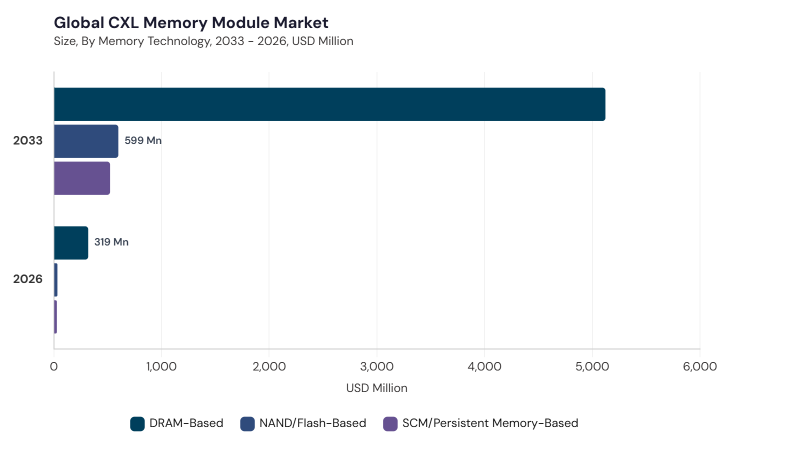
Based on Memory Technology, the market is segmented into DRAM-Based, NAND/Flash-Based, and SCM/Persistent Memory-Based. The DRAM-Based market dominated the Global CXL Memory Module Market by Memory Technology in 2025, and would continue to be a dominant market till 2033; thereby, achieving a market value of USD 5121.9 million by 2033, growing at a CAGR of 48.6 % during the forecast period. The NAND/Flash-Based market is expected to witness a CAGR of 51% during (2026 - 2033). Additionally, The SCM/Persistent Memory-Based market is expected to witness highest CAGR of 51.5% during (2026 - 2033).
DRAM-Based modules dominate the market due to low latency, high bandwidth, mature server integration, and strong suitability for AI, HPC, databases, analytics, and cloud workloads. NAND/Flash-Based modules support cost-effective capacity expansion, storage-memory tiering, and persistent data use cases where large capacity matters. SCM/Persistent Memory-Based solutions are emerging through demand for faster persistent access, reduced storage latency, and memory-tiering architectures. Together, these technologies support the shift toward heterogeneous memory systems that balance performance, capacity, persistence, and cost.
Based on Form Factor, the market is segmented into Add-in Card, E3.S, and U.2/U.3 and Other Form Factor. The Add-in Card market dominated the Global CXL Memory Module Market by Form Factor in 2025, and would continue to be a dominant market till 2033; thereby, achieving a market value of USD 3045.3 million by 2033, growing at a CAGR of 48.4 % during the forecast period. The E3.S market is expected to witness a CAGR of 49.5% during (2026 - 2033). Additionally, The U.2/U.3 and Other Form Factor market is expected to witness highest CAGR of 51.2% during (2026 - 2033).
Add-in Card leads the market due to PCIe-based compatibility, flexible server deployment, ease of upgrades, and suitability for expanding memory capacity in existing data center infrastructure. E3.S is gaining strong demand as dense server architectures require compact, serviceable, and thermally efficient CXL memory modules. U.2/U.3 and Other Form Factor support specialized server configurations, enterprise-grade reliability, and alternative deployment models where mechanical compatibility or hot-plug serviceability is important. Form-factor diversity enables CXL adoption across hyperscale, enterprise, AI, HPC, and edge infrastructure.
Based on Application, the market is segmented into Artificial Intelligence and Machine Learning, High-Performance Computing, Database and Analytics, Virtualization and Cloud, and Enterprise. The Artificial Intelligence and Machine Learning market dominated the Global CXL Memory Module Market by Application in 2025, and would continue to be a dominant market till 2033; thereby, achieving a market value of USD 1993.9 million by 2033, growing at a CAGR of 48 % during the forecast period. The High-Performance Computing market is expected to witness a CAGR of 48.7% during (2026 - 2033). Additionally, The Database and Analytics market is expected to witness highest CAGR of 50% during (2026 - 2033).
Artificial Intelligence and Machine Learning lead the market due to large model training, inference, accelerator memory pressure, and requirements for efficient sharing of massive datasets across compute resources. High-Performance Computing benefits from simulations, scientific research, and computational workloads requiring scalable memory capacity. Database and Analytics adoption is driven by in-memory processing and real-time data requirements, while Virtualization and Cloud use CXL for pooling and improved utilization across virtualized infrastructure. Enterprise adoption is growing through business-critical workloads, server consolidation, and infrastructure modernization.
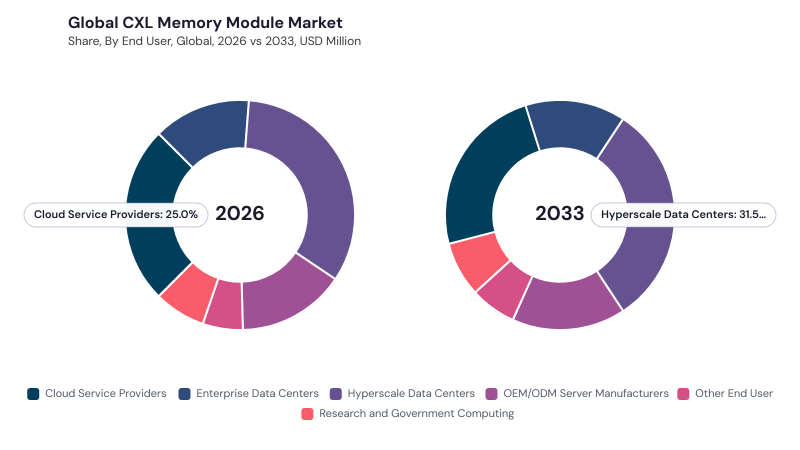
Based on Memory End User, the market is segmented into Hyperscale Data Centers, Cloud Service Providers, Enterprise Data Centers, OEM/ODM Server Manufacturers, Research and Government Computing, and Other End User. The Hyperscale Data Centers market dominated the Global CXL Memory Module Market by End User in 2025, and would continue to be a dominant market till 2033; thereby, achieving a market value of USD 1965.8 million by 2033, growing at a CAGR of 48 % during the forecast period. The Cloud Service Providers market is expected to witness a CAGR of 48.4% during (2026 - 2033). Additionally, The Enterprise Data Centers market is expected to witness highest CAGR of 49.6% during (2026 - 2033).
Hyperscale Data Centers dominate the market due to large AI infrastructure requirements, memory-intensive workloads, server fleet optimization, and strong incentives to improve memory utilization. Cloud Service Providers require CXL memory to support scalable instances, workload density, and flexible infrastructure. OEM/ODM Server Manufacturers are important because CXL must be integrated into next-generation server platforms. Enterprise Data Centers are adopting CXL for infrastructure refreshes and memory expansion, while Research and Government Computing benefits from HPC, simulation, and scientific data processing requirements.
Free Valuable Insights: CXL Memory Module Market Size to reach $6243.6 Million by 2033
Region-wise, the CXL Memory Module Market is analyzed across North America, Europe, Asia Pacific, and LAMEA.
In 2025, the North America region led the CXL memory module market and is anticipated to continue at same position till 2033, by achieving a market value of USD 2602.6 million by 2033, expanding at a CAGR od 48.2%. The Asia Pacific market is predicted to expand at a CAGR of 50% during 2026-2033. Furthermore, the Europe region is estimated to grow with a CAGR of 48.6% during the forecast period.
North America region led the market because of strong AI computing investment, extensive hyperscale data center infrastructure, early adoption of CXL-enabled memory architectures, and advanced server ecosystems. APAC market is driven by semiconductor manufacturing strength, cloud expansion, high-performance server deployment, and AI infrastructure investment. Europe region is developing from HPC initiatives, data center modernization, memory-efficient computing demand, and cloud infrastructure development. Moreover, LAMEA market is expanding through enterprise data centers, cloud services, advanced server adoption, and AI infrastructure.
| Report Attribute | Details |
|---|---|
| Market size value in 2026 | USD 381.5 million |
| Market size forecast in 2033 | USD 6243.6 million |
| Base Year | 2025 |
| Historical Period | 2022 to 2024 |
| Forecast Period | 2026 to 2033 |
| Revenue Growth Rate | CAGR of 49.1% from 2026 to 2033 |
| Number of Pages | 834 |
| Tables | 960 |
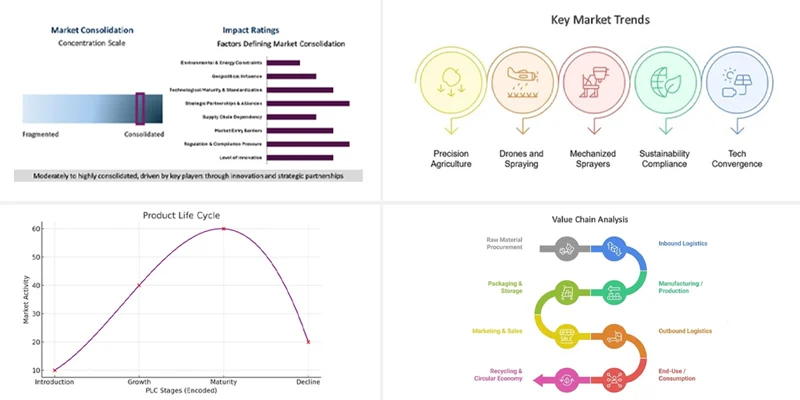
| Report Coverage | Market Trends, Revenue Estimation and Forecast, Segmentation Analysis, Regional and Country Breakdown, Competitive Landscape, Market Share Analysis, Company Profiling, Companies Strategic Developments, SWOT Analysis, Product Life Cycle Analysis, Value Chain Analysis, Market Consolidation Analysis, Key Customer Criteria, Pandemic Impact Analysis, and Winning Imperatives |
| Segments Covered | Product Type, Memory Technology, Form Factor, Application, Memory End User, Region |
| Country Scope |
|
| Companies Included | Samsung Electronics Co., Ltd., Micron Technology, Inc., SK hynix Inc., SMART Modular Technologies, Innodisk Corporation, Viking Technology, GIGABYTE Technology Co., Ltd., XCENA, Panmnesia, Inc., and Etron Technology, Inc. |
By Product Type
By Memory Technology
By Form Factor
By Application
By Memory End User
By Geography
Expected to reach USD 6243.6 million by 2033, growing at 49.1% CAGR during 2026-2033.
AI and high-performance computing workloads drive demand, enhancing memory and storage efficiency.
Samsung Electronics Co., Ltd., Micron Technology, Inc., and SK hynix Inc. lead the market.
Adoption of CXL 2.0 and 3.0 standards boosts memory and storage efficiency.
Integration with DDR5 and chiplet-based architectures enhances flexibility and performance.
The market is projected to grow at 49.1% CAGR during the forecast period (2026-2033).
Our team of dedicated experts can provide you with attractive expansion opportunities for your business.








 Unique Offerings