The sample copy of this report is available for access.
The North America Automotive Multi-camera System Market is expected to reach USD 2.5 billion by 2032, growing at a CAGR of 15.7% during (2026 - 2033).
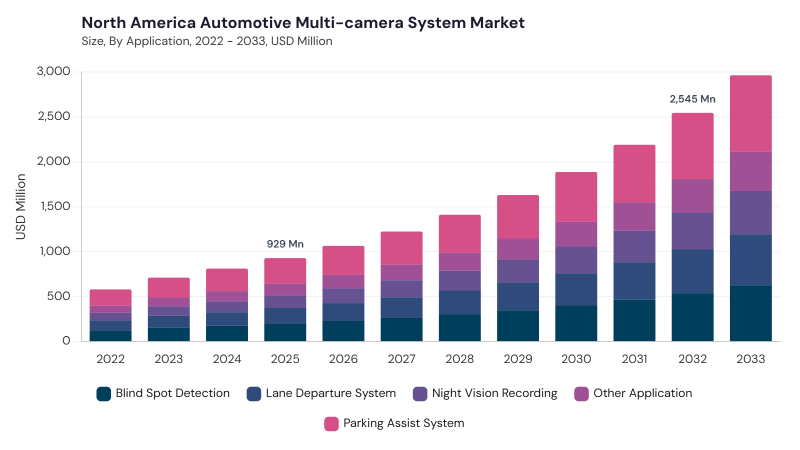
The North America Automotive Multi-camera System Market evolved alongside the advancement of automotive safety technologies, beginning with rear-view and side cameras used for parking assistance and blind-spot visibility. Over time, these systems progressed into multi-camera architectures capable of delivering a 360-degree field of vision around the vehicle. Advancements in image processing, sensor miniaturization, ultra-wide-angle lenses, high-resolution sensors, and real-time data integration supported the shift from basic collision avoidance toward semi-autonomous driving support.
Current market development is shaped by the integration of artificial intelligence and machine learning into camera systems, enabling improved object recognition, predictive safety alerts, and stronger ADAS performance. Miniaturized and robust camera hardware is supporting adoption across compact, electric, passenger, and commercial vehicles without compromising vehicle design or durability. Supply chain reconfiguration, semiconductor availability concerns, reshoring initiatives, and regional sourcing are also influencing production strategies, delivery timelines, pricing, and competitive positioning across North America.
Based on Application, the market is segmented into Parking Assist System, Blind Spot Detection, Lane Departure System, Night Vision Recording, and Other Application. Parking Assist System remains a foundational application due to its role in improving low-speed maneuvering, parking visibility, and driver convenience across passenger cars, SUVs, and light commercial vehicles. Blind Spot Detection supports safer lane changes and side monitoring, while Lane Departure System strengthens road-marking recognition and vehicle-position monitoring within ADAS packages.
Night Vision Recording improves visibility in low-light and nighttime conditions through infrared, low-light sensors, and computational image enhancement, while Other Application includes uses such as recording, occupant-related monitoring, digital viewing, vehicle surveillance, traffic sign recognition, pedestrian detection, and automated emergency braking support.
Based on View Type, the market is segmented into 2D and 3D. 2D systems continue to benefit from mature technology, lower processing requirements, cost-effective integration, and strong suitability for high-volume vehicle platforms, including passenger cars, SUVs, pickup trucks, and commercial vehicles. 3D systems are gaining relevance across surround-view monitoring, automated parking, advanced object recognition, collision avoidance, and higher-level ADAS applications.
Their adoption is supported by image stitching, camera calibration, AI-based perception, centralized vehicle computing, and the need for enhanced depth awareness, although higher costs, processing needs, calibration complexity, and validation requirements limit wider deployment in entry-level vehicles.
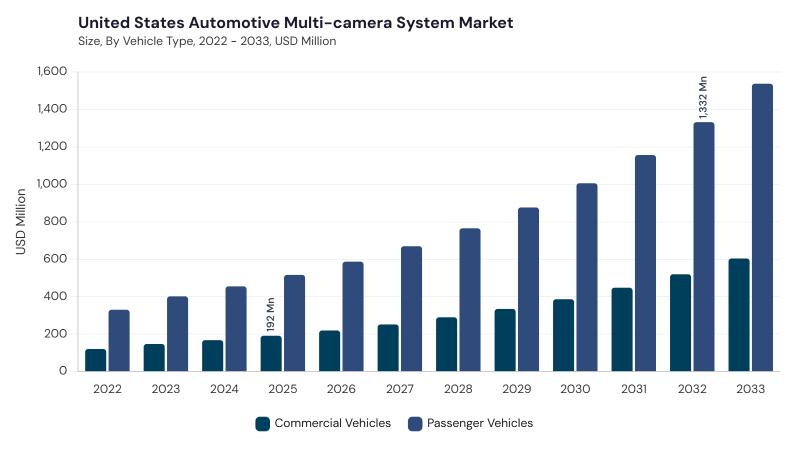
Based on Vehicle Type, the market is segmented into Passenger Vehicles and Commercial Vehicles. The Passenger Vehicles market dominated the North America Automotive Multi-camera System Market by Vehicle Type in 2025, and would continue to be a dominant market till 2033; thereby, achieving a market value of USD 1.8 billion by 2032, growing at a CAGR of 15.5 % during the forecast period. The Commercial Vehicles market is expected to witness a CAGR of 16.3% during (2026 - 2033).
Passenger Vehicles cover sedans, SUVs, electric vehicles, and connected vehicle platforms where multi-camera systems support 360-degree surround views, lane-keeping assistance, parking aids, and forward collision warnings. Commercial Vehicles, including trucks, buses, and delivery vans, maintain a promising role due to fleet operators’ focus on reducing visibility gaps, improving maneuverability, supporting driver monitoring, and lowering collision risks. Ruggedized camera systems, fleet telematics integration, blind-spot monitoring, rear-view assistance, driver fatigue detection, and regulatory compliance needs are strengthening adoption across commercial fleets.
Free Valuable Insights: The Global Automotive Multi-camera System Market will hit USD 10.4 Billion billion by 2033, at a CAGR of 16.5%
Based on Country, the market is segmented into US, Canada, Mexico, and Rest of North America. The US market dominated the North America Automotive Multi-camera System Market by Country in 2025, and would continue to be a dominant market till 2033; thereby, achieving a market value of USD 1.8 billion by 2032, growing at a CAGR of 15 % during the forecast period. The Canada market is expected to witness a CAGR of 17.8% during (2026 - 2033). Additionally, The Mexico market is expected to witness a CAGR of 17.3% during (2026 - 2033).
The US market reflects mature adoption driven by ADAS expansion, backup-camera mandates, AI-enabled object recognition, electrification, autonomous vehicle development, and broader integration of multi-camera systems across passenger vehicles and commercial fleets. Canada is shaped by safety regulations, harsh-weather requirements, real-time high-definition camera feeds, OEM-technology collaborations, and demand for scalable solutions across passenger and fleet applications. Mexico is supported by rising safety awareness, AI-enabled smart sensing, localization-led cost efficiency, telematics integration, and growing adoption of multi-camera systems in mid- to high-end vehicles. Rest of North America is advancing through ADAS fusion, AI and machine learning integration, software-defined vehicle architectures, modular system design, and scalable camera solutions aligned with evolving safety and automation needs.

By Vehicle Type
By View Type
By Application
By Country
Set to reach $2.5 Billion by 2032, growing at a CAGR of 15.7% during 2026-2033.
The US leads with $1.8 billion by 2032, growing at a CAGR of 15% during the forecast period.
Passenger vehicles dominate, reaching $1.8 billion by 2032 with a CAGR of 15.5% during 2026-2033.
Commercial vehicles expected to witness a CAGR of 16.3% during 2026-2033.
Canada is expected to witness a CAGR of 17.8% during 2026-2033.
Mexico is expected to witness a CAGR of 17.3% during 2026-2033.
Our team of dedicated experts can provide you with attractive expansion opportunities for your business.




 Unique Offerings
