The sample copy of this report is available for access.
“Global Automotive Multi-camera System Market to reach a market value of USD 10412.05 Million by 2033 growing at a CAGR of %”
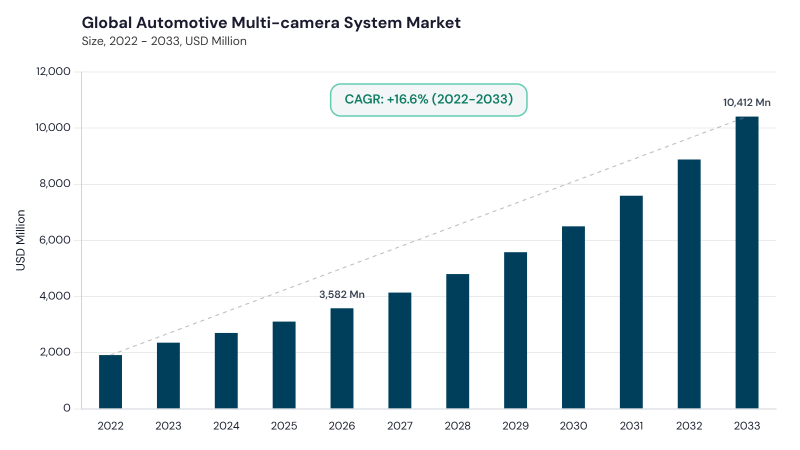
The Global Automotive Multi-camera System Market is expected to reach USD 10.4 billion by 2033, growing at a CAGR of 16.5% during (2026 - 2033).
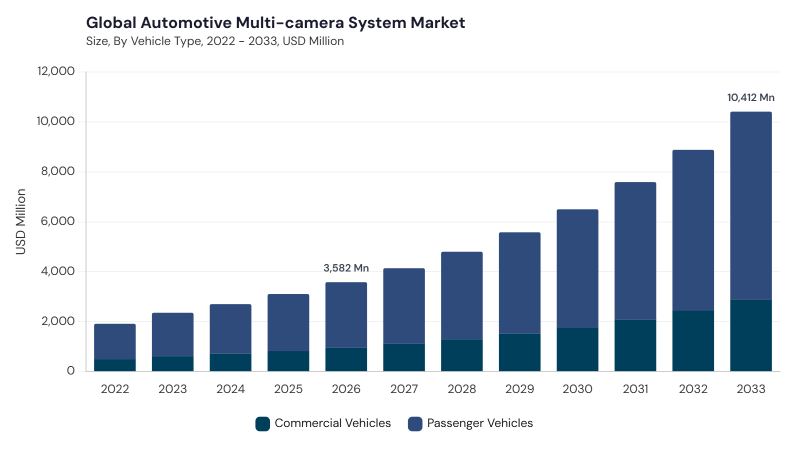
Growing demand for enhanced vehicle safety, improved driver visibility, advanced parking assistance, and automated driving capabilities is driving the Automotive Multi-camera System Market across passenger and commercial vehicles. Automakers are prioritizing 360-degree surround viewing, blind-spot reduction, obstacle detection, and real-time environmental awareness through ADAS, parking solutions, and autonomous vehicle platforms. Growth is further strengthened by vehicle electrification, premium safety feature adoption, road safety regulations, automotive imaging sensors, AI-based processing, sensor fusion, night vision, and compact camera modules. The market has evolved from basic rear-view and parking cameras into integrated multi-camera architectures supporting ADAS and semi-autonomous driving.
Increasing integration of multi-camera systems with ADAS, automated parking, autonomous driving, and connected vehicle platforms is expanding the market’s role in modern vehicle safety architecture. Demand is rising as automakers move from single-camera visibility features toward multi-angle perception systems that support object detection, lane monitoring, 360-degree visualization, and real-time environmental awareness. Improvements in high-resolution sensors, embedded processors, AI-based image analytics, and low-light imaging are strengthening system performance across diverse driving conditions. Vehicle electrification and software-defined architectures are also creating more opportunities for centralized camera processing and scalable camera platforms.
Competition is innovation-led, with suppliers differentiating through camera resolution, image quality, AI processing, sensor fusion, low-latency data transmission, system reliability, and ease of OEM integration. Global automotive technology suppliers are expanding from basic surround-view systems toward centralized ADAS platforms that combine cameras with radar, ultrasonic sensors, LiDAR, and high-performance compute. Partnerships with semiconductor companies, software developers, and automakers are important for reducing integration complexity and accelerating development. Cost optimization is also critical as OEMs seek to extend multi-camera systems beyond luxury and premium vehicles.
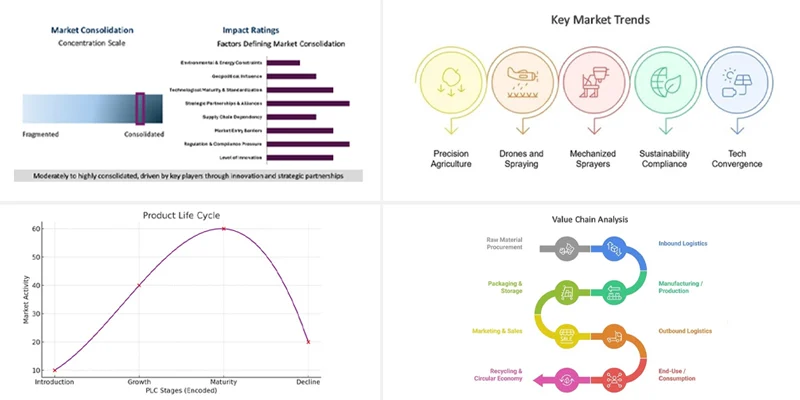

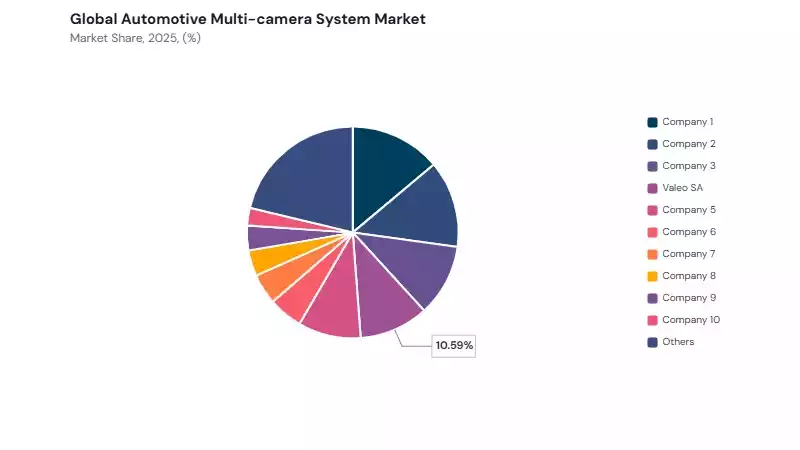
The Automotive Multi-camera System Market shows moderate consolidation, with major automotive suppliers competing through surround-view platforms, ADAS camera systems, centralized processing, image processing software, and multi-sensor integration. Bosch, Continental, Magna, Valeo, DENSO TEN, Hyundai Mobis, Aptiv, FORVIA, ZF, and Motherson have differentiated positions across 360-degree visualization, parking assistance, mirror replacement, satellite cameras, and automated-driving perception. Competition is shifting from standalone camera modules toward integrated hardware-software architectures that support multiple vehicle functions. Suppliers with scalable platforms, OEM relationships, strong validation capabilities, and regional manufacturing footprints are better positioned as camera content per vehicle rises.
Based on vehicle type, the market is segmented into Passenger Vehicles and Commercial Vehicles. The Passenger Vehicles market dominated the Global Automotive Multi-camera System Market by Vehicle Type in 2025, and would continue to be a dominant market till 2033; thereby, achieving a market value of USD 7.5 billion by 2033, growing at a CAGR of 16.2 % during the forecast period. The Commercial Vehicles market is expected to witness a CAGR of 17.1% during (2026 - 2033).
Passenger vehicles represent the leading adoption base as automakers integrate surround-view cameras, blind-spot monitoring, automated parking, and lane-related assistance into cars, SUVs, and electric vehicle platforms. Demand is supported by consumer preference for convenience, premium safety features, and semi-autonomous capabilities. Commercial vehicles use multi-camera systems to improve driver visibility, reduce blind zones, assist maneuvering, and enhance fleet safety. Trucks, buses, vans, and logistics vehicles increasingly rely on ruggedized camera systems, driver monitoring, and fleet-oriented visual data to reduce accidents and improve operating efficiency.
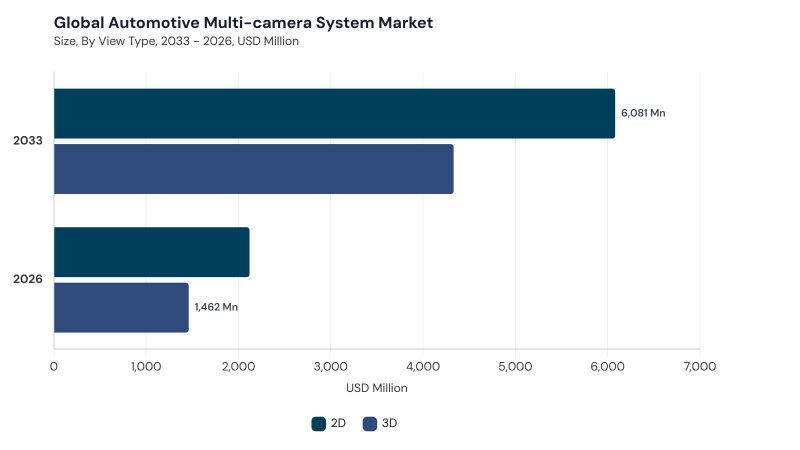
Based on view type, the market is segmented into 2D and 3D. The 2D market dominated the Global Automotive Multi-camera System Market by View Type in 2025, and would continue to be a dominant market till 2033; thereby, achieving a market value of USD 6.0 billion by 2033, growing at a CAGR of 16.2 % during the forecast period. The 3D market is expected to witness a CAGR of 16.8% during (2026 - 2033).
2D systems remain widely used due to mature integration, lower processing requirements, and strong fit with rearview, side-view, parking, and surround visualization functions. These systems support mass-market adoption by improving visibility without heavily increasing vehicle electronics cost. 3D systems are gaining relevance as automakers adopt advanced visualization, object recognition, automated parking, and environmental perception technologies. By combining multi-camera feeds with advanced image processing, 3D systems improve spatial awareness and support premium ADAS and autonomous driving applications.
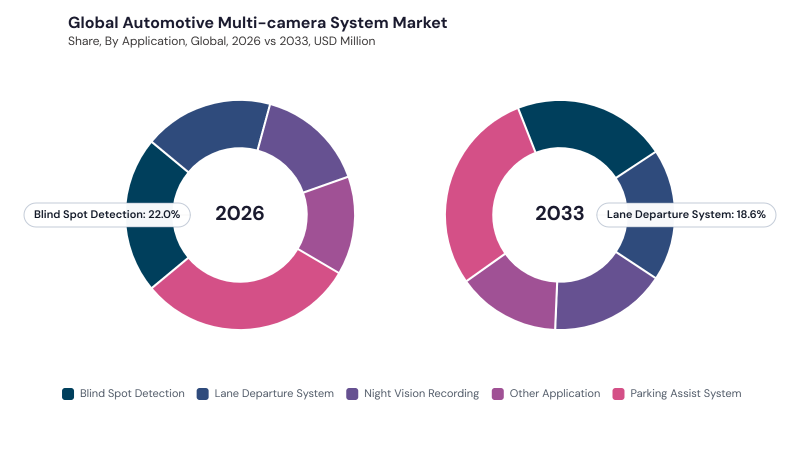
Based on application, the market is segmented into Parking Assist System, Blind Spot Detection, Lane Departure System, Night Vision Recording, and Other Application. The Parking Assist System market dominated the Global Automotive Multi-camera System Market by Application in 2025, and would continue to be a dominant market till 2033; thereby, achieving a market value of USD 3.0 billion by 2033, growing at a CAGR of 15.5 % during the forecast period. The Blind Spot Detection market is expected to witness a CAGR of 16.2% during (2026 - 2033). Additionally, The Lane Departure System market is expected to witness highest CAGR of 16.8% during (2026 - 2033).
Parking assist systems use multiple cameras to improve low-speed maneuvering and provide 360-degree visibility in tight spaces. Blind spot detection supports safer lane changes by monitoring areas outside mirror visibility, while lane departure systems use camera inputs to identify unintended drifting and support driver-assistance functions. Night vision recording strengthens low-light visibility through infrared and enhanced imaging technologies. Other applications include driver monitoring, recording, vehicle surveillance, in-cabin sensing, environment mapping, and emerging connected-vehicle use cases.
Free Valuable Insights: Automotive Multi-camera System Market Size to reach $10.4 Billion by 2033
Region-wise, the Automotive Multi-camera System Market is analyzed across North America, Europe, Asia Pacific, and LAMEA. The Asia Pacific market dominated the Global Automotive Multi-camera System Market by Region in 2025, and would continue to be a dominant market till 2033; thereby, achieving a market value of USD 4.1 billion by 2033, growing at a CAGR of 16.9 % during the forecast period. The North America market is expected to witness a CAGR of 15.7% during (2026 - 2033). Additionally, The Europe market is expected to witness a CAGR of 16.2% during (2026 - 2033).
Asia Pacific leads the market due to substantial vehicle production, growing penetration of camera-based safety systems, and rapid deployment of connected and automated vehicle technologies. North America shows strong adoption through ADAS, parking assistance, collision avoidance, and consumer demand for advanced safety features. Europe benefits from stringent safety requirements, automated-driving development, and integration of camera-based monitoring across passenger and commercial vehicles. LAMEA remains smaller but is gradually expanding as vehicle fleets modernize and camera-equipped vehicle availability increases.
| Report Attribute | Details |
|---|---|
| Market size value in 2026 | USD 3.5 billion |
| Market size forecast in 2033 | USD 10.4 billion |
| Base Year | 2025 |
| Historical Period | 2022 to 2024 |
| Forecast Period | 2026 to 2033 |
| Revenue Growth Rate | CAGR of 16.5% from 2026 to 2033 |
| Number of Pages | 501 |
| Tables | 390 |
| Report Coverage | Market Trends, Revenue Estimation and Forecast, Segmentation Analysis, Regional and Country Breakdown, Competitive Landscape, Market Share Analysis, Company Profiling, Companies Strategic Developments, SWOT Analysis, Product Life Cycle Analysis, Value Chain Analysis, Market Consolidation Analysis, Key Customer Criteria, Pandemic Impact Analysis, and Winning Imperatives |
| Segments Covered | Vehicle Type, View Type, Application, and Geography |
| Country Scope |
|
| Companies Included | Robert Bosch GmbH; Continental AG; Magna International Inc.; Valeo SA; DENSO TEN Limited; Hyundai Mobis Co., Ltd.; Aptiv PLC; FORVIA SE; ZF Friedrichshafen AG; Motherson Group |
By Vehicle Type
By View Type
By Application
By Geography
Expected to reach USD 10.4 billion by 2033, growing at 16.5% CAGR during the forecast period (2026-2033).
Passenger vehicles lead with a projected market value of USD 7.5 billion by 2033.
Robert Bosch GmbH, Continental AG, Magna International Inc., Valeo SA, and DENSO TEN Limited are key players.
Asia Pacific leads with a market value of USD 4.1 billion by 2033.
Enhanced vehicle safety and demand for advanced driver assistance boost the market.
Parking Assist System leads with a market value of USD 3.0 billion by 2033.
Our team of dedicated experts can provide you with attractive expansion opportunities for your business.






 Unique Offerings
