The sample copy of this report is available for access.
The Europe Automotive Multi-camera System Market is expected to reach USD 2032.1 million by 2031, growing at a CAGR of 16.2% during (2026 - 2033).
The Europe Automotive Multi-camera System Market originated from the broader integration of advanced driver assistance systems aimed at improving vehicle safety and driver awareness. Early adoption centered on rearview and side-view cameras for parking support and blind-spot reduction, before advancements in camera sensors, image processing, and vehicle electronic control units enabled 360-degree surround-view systems. The market has evolved toward integrated camera networks supporting automated parking, collision avoidance, pedestrian protection, autonomous driving requirements, electrification, connectivity, and smart mobility concepts.
Current market development is shaped by stronger European safety requirements, AI-enabled real-time environment mapping, and rising consumer demand for safer and more convenient vehicle experiences. Automakers are integrating complex camera configurations to support blind-spot coverage, pedestrian detection, semi-autonomous driving, electric vehicle platforms, infotainment systems, and connected vehicle functions. Suppliers are also focusing on ultra-high-definition imaging, embedded AI, sensor fusion, regional manufacturing, and camera performance under low-light, adverse-weather, and complex urban driving conditions.
Based on Application, the market is segmented into Parking Assist System, Blind Spot Detection, Lane Departure System, Night Vision Recording, and Other Application. Parking Assist System remains a foundational application as multiple wide-angle and rearview cameras help drivers maneuver safely in dense European urban environments and integrate with ultrasonic sensors and automated parking functions.
Blind Spot Detection improves side-area monitoring and vulnerable road-user awareness, while Lane Departure System supports lane-boundary interpretation, lane-monitoring, and lane-support technologies. Night Vision Recording extends driver awareness during darkness and poor visibility through thermal and low-light imaging, while Other Application includes digital mirrors, vehicle recording, remote observation, traffic sign recognition, pedestrian detection, cross-traffic alert, autonomous parking, driver monitoring, and additional intelligent-vehicle functions.
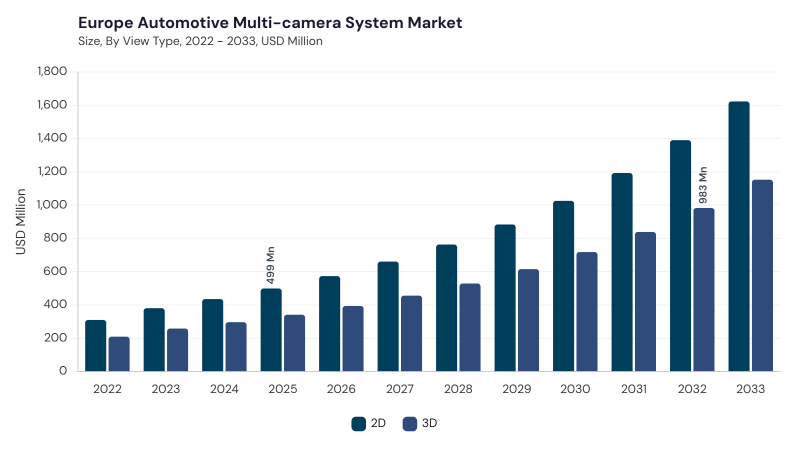
Based on View Type, the market is segmented into 2D and 3D. 2D systems continue to be widely used because of their established technology, economical architecture, efficient processing requirements, and practical integration across mass-market and premium vehicles. These systems are especially useful in European urban environments with narrow roads, compact parking spaces, pedestrians, cyclists, and vulnerable road users.
3D systems are gaining traction in premium cars, electric vehicles, connected vehicles, automated parking, bird’s-eye visualization, spatial recognition, obstacle detection, and advanced ADAS packages, although processing requirements, calibration needs, software complexity, and higher component costs continue to limit adoption in entry-level vehicles.
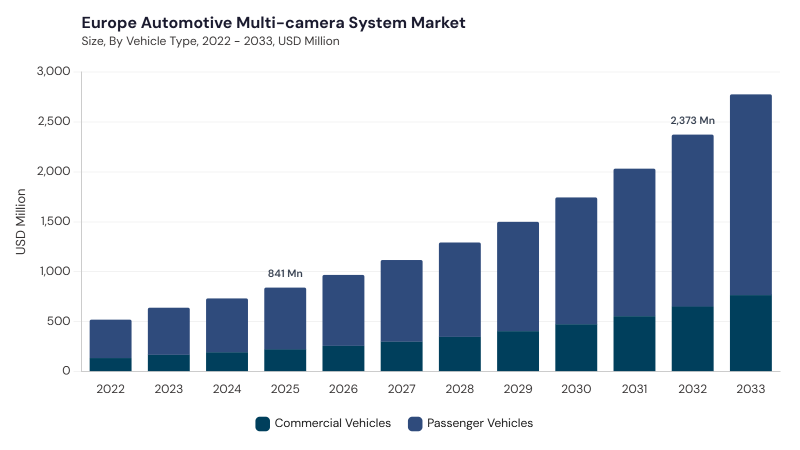
Based on Vehicle Type, the market is segmented into Passenger Vehicles and Commercial Vehicles. The Passenger Vehicles market dominated the Europe Automotive Multi-camera System Market by Vehicle Type in 2025, and would continue to be a dominant market till 2033; thereby, achieving a market value of USD 1477.5 million by 2031, growing at a CAGR of 16 % during the forecast period. The Commercial Vehicles market is expected to witness a CAGR of 16.9% during (2026 - 2033).
Passenger Vehicles use multi-camera systems for 360-degree surround view, low-speed maneuvering, collision avoidance, lane keeping, reversing assistance, and connected safety functions across entry-level, mid-range, premium, and electric models. Commercial Vehicles, including heavy-duty trucks, buses, delivery vans, and specialized vehicles, maintain a promising role due to the need for improved visibility, blind-spot mitigation, pedestrian safety, fleet telematics, driver monitoring, loading and unloading support, and regulatory compliance in dense urban, logistics, public transport, and construction environments.
Free Valuable Insights: The Worldwide Automotive Multi-camera System Market is projected to reach USD 10.4 Billion billion by 2033, at a CAGR of 16.5%
Based on Country, the market is segmented into Germany, UK, France, Russia, Spain, Italy, and Rest of Europe. The Germany market dominated the Europe Automotive Multi-camera System Market by Country in 2025, and would continue to be a dominant market till 2033; thereby, achieving a market value of USD 444.0 million by 2031, growing at a CAGR of 14.8 % during the forecast period. The UK market is expected to witness a CAGR of 15.1% during (2026 - 2033). Additionally, The France market is expected to witness a CAGR of 17% during (2026 - 2033).
Germany is shaped by advanced automation goals, Level 3 and Level 4 development, AI-enabled image recognition, regulatory compliance, and strong OEM-supplier collaboration. The UK reflects safety regulation alignment, ADAS integration, AI-driven object recognition, and growing demand for surround-view monitoring, lane-keeping, and parking automation. France is supported by EU safety protocols, AI-powered analytics, electric and hybrid vehicle integration, and localized R&D. Russia is influenced by harsh-weather requirements, domestic customization, AI-based visibility enhancement, and localized manufacturing. Spain is advancing through regulatory safety pressure, electrification, smart mobility, AR-based driver information, and connected vehicle experiences. Italy is supported by AI-powered environmental mapping, EV-specific camera adaptation, rearview and surround-view standardization, and compact modular camera solutions. Rest of Europe is developing through General Safety Regulation alignment, ADAS expansion, pedestrian detection, blind-spot monitoring, sensor fusion, modular camera platforms, and real-world testing across varied regional conditions.

By Vehicle Type
By View Type
By Application
By Country
Set to reach $2032.1 Million by 2031, growing at 16.2% CAGR during 2026-2033.
Germany leads with a market value of USD 444.0 million by 2031, growing at a CAGR of 14.8% during 2026-2033.
Passenger vehicles dominate with a market value of USD 1477.5 million by 2031, growing at 16% CAGR during 2026-2033.
The commercial vehicles segment is expected to witness a CAGR of 16.9% during 2026-2033.
The France market is expected to witness a CAGR of 17% during 2026-2033.
Our team of dedicated experts can provide you with attractive expansion opportunities for your business.




 Unique Offerings
