The sample copy of this report is available for access.
The LAMEA Automotive Multi-camera System Market is expected to reach USD 279.1 million by 2029, growing at a CAGR of 18.6% during (2026 - 2033).
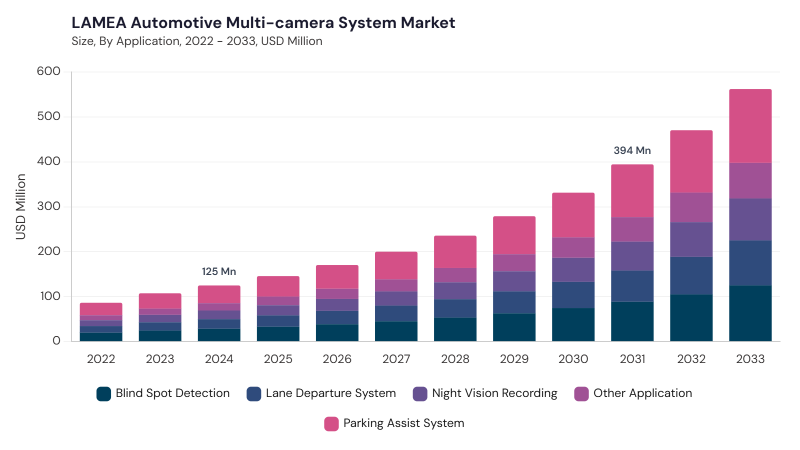
The LAMEA Automotive Multi-camera System Market originated from the gradual integration of advanced driver assistance technologies across Latin America, the Middle East, and Africa. Early adoption focused on basic rearview cameras for safety compliance and rear visibility, before image sensors, processing algorithms, display technologies, fisheye lenses, stitching software, HD cameras, and 4K camera modules enabled comprehensive surround-view systems. The market has moved from a luxury feature in high-end vehicles toward a broader safety enhancement across multiple vehicle categories.
Current market development is shaped by safety regulations, accident-reduction mandates, electric and autonomous vehicle adoption, and AI-powered image processing. Multi-camera systems are increasingly moving from optional accessories to standard safety equipment, supporting situational awareness, onboard sensor integration, ADAS modules, pedestrian detection, automated parking assistance, and real-time object detection. Suppliers are also adapting systems for LAMEA-specific climatic, regulatory, infrastructure, and vehicle conditions through localization, durable camera designs, and cost-effective integration.
Based on Application, the market is segmented into Parking Assist System, Blind Spot Detection, Lane Departure System, Night Vision Recording, and Other Application. Parking Assist System supports low-speed maneuvering in dense urban centers through rear, front, side, and surround-view cameras, along with automated or semi-automated parking guidance. Blind Spot Detection improves side visibility in mixed traffic and road infrastructure conditions through camera-assisted monitoring and alerts.
Lane Departure System supports lane-positioning interpretation and driver warnings as ADAS adoption gradually expands across premium and newer mass-market vehicles. Night Vision Recording improves nighttime and low-light visual awareness through infrared, thermal, and advanced imaging sensors, mainly in higher-specification vehicles. Other Application includes digital mirror systems, journey recording, security monitoring, remote visual access, pedestrian detection, traffic sign recognition, and driver monitoring systems.
Based on View Type, the market is segmented into 2D and 3D. 2D systems remain foundational due to lower cost, simpler integration, compatibility with established vehicle electronics, and suitability for entry-level, mid-tier, OEM, and aftermarket applications. These systems use multiple 2D cameras to provide stitched or panoramic views that improve driver awareness while supporting cost-sensitive adoption across Latin America and Africa.
3D systems are gaining relevance in premium and luxury vehicles by enabling depth perception, environmental mapping, augmented reality functions, automated parking, collision avoidance, pedestrian detection, and semi-autonomous driving support, although high system cost and complex integration limit broader penetration in mainstream vehicle segments.
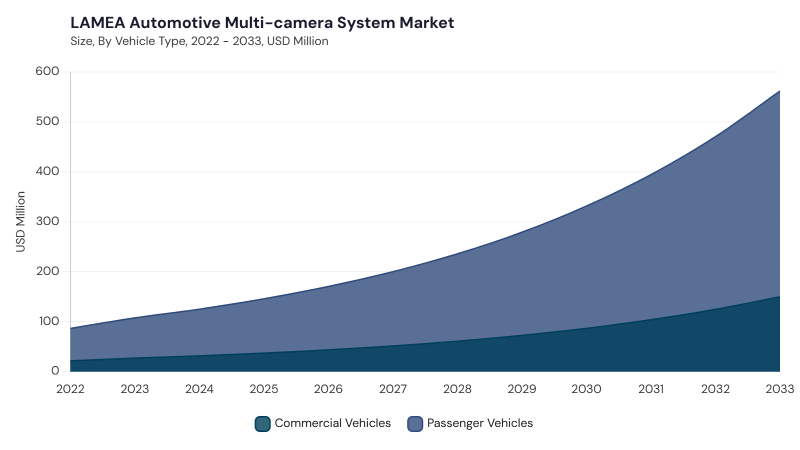
Based on Vehicle Type, the market is segmented into Passenger Vehicles and Commercial Vehicles. The Passenger Vehicles market dominated the LAMEA Automotive Multi-camera System Market by Vehicle Type in 2025, and would continue to be a dominant market till 2033; thereby, achieving a market value of USD 206.6 million by 2029, growing at a CAGR of 18.3 % during the forecast period. The Commercial Vehicles market is expected to witness a CAGR of 19.3% during (2026 - 2033).
Passenger Vehicles use multi-camera systems for 360-degree surround view, blind-spot detection, lane-keeping assistance, parking support, driver assistance, and convenience features across entry-level, mid-range, premium, connected, SUV, and newer-generation vehicle models. Commercial Vehicles, including heavy-duty trucks, buses, specialized commercial utility vehicles, trucks, and utility fleets, maintain a promising role due to logistics development, fleet renewal, public transport needs, blind-spot monitoring, improved rear and lateral visibility, telematics integration, fleet management, asset protection, and safer operation of large vehicles in congested or infrastructure-intensive environments.
Free Valuable Insights: Automotive Multi-camera System Market Size Worth USD 10.4 Billion billion by 2033
Based on Country, the market is segmented into Brazil, Argentina, UAE, Saudi Arabia, South Africa, Nigeria, and Rest of LAMEA. The Brazil market dominated the LAMEA Automotive Multi-camera System Market by Country in 2025, and would continue to be a dominant market till 2033; thereby, achieving a market value of USD 76.9 million by 2029, growing at a CAGR of 17.2 % during the forecast period. The Argentina market is expected to witness a CAGR of 20% during (2026 - 2033). Additionally, The UAE market is expected to witness a CAGR of 17.4% during (2026 - 2033).
Brazil is shaped by safety regulation, connected and autonomous vehicle prototypes, localization of automotive electronics, ADAS integration, and growing demand for surround-view monitoring. Argentina reflects ADAS integration, high-definition imaging, AI and machine learning analytics, safety awareness, and scalable camera modules for broader vehicle adoption. The UAE is driven by AI-powered image processing, modular camera platforms, road safety mandates, premium driving aids, and connected and autonomous vehicle technologies. Saudi Arabia is supported by smart mobility initiatives, connected vehicle ecosystems, 5G-enabled data processing, harsh-climate customization, and localized calibration for high temperatures and dust. South Africa is influenced by AI-based image recognition, V2X integration, advanced safety regulation, local road adaptation, and regional assembly support. Nigeria is developing through ADAS-linked camera adoption, local assembly, aftermarket retrofit demand, used-vehicle safety upgrades, and customized solutions for variable driving conditions. Rest of LAMEA is advancing through AI-enhanced situational awareness, modular architectures, regional localization, multi-sensor integration, and cost-optimized systems tailored to diverse regulatory, road, and climatic conditions.

By Vehicle Type
By View Type
By Application
By Country
Set to reach $279.1 Million by 2029, growing at 18.6% CAGR during 2026-2033.
Brazil leads with a market value of $76.9 million by 2029, at a CAGR of 17.2% during 2026-2033.
The dominance of passenger vehicles, reaching $206.6 million by 2029, is a key growth driver.
Passenger vehicles will achieve $206.6 million by 2029, growing at an 18.3% CAGR during 2026-2033.
The UAE market is expected to witness a CAGR of 17.4% during 2026-2033.
Argentina is expected to grow at a 20% CAGR during 2026-2033.
Our team of dedicated experts can provide you with attractive expansion opportunities for your business.




 Unique Offerings
