The sample copy of this report is available for access.
The Asia Pacific Automotive Multi-camera System Market is expected to reach USD 2537.9 million by 2030, growing at a CAGR of 16.9% during (2026 - 2033).
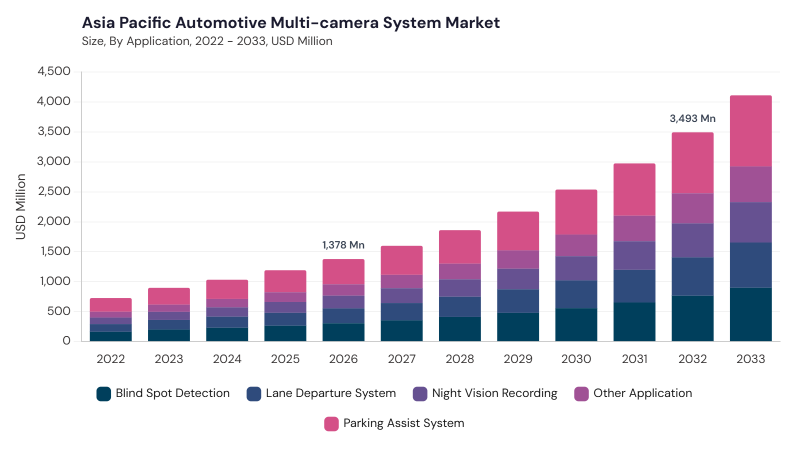
The Asia Pacific Automotive Multi-camera System Market originated from rising safety and driver assistance needs in the automotive sector, initially through basic rear-view cameras used for parking and reversing support. The market evolved as multiple cameras enabled 360-degree surround views, supported by improved imaging sensors, real-time image processing, and stronger automotive computing power. The shift toward ADAS accelerated the use of multi-camera setups for lane departure warning, pedestrian detection, blind-spot monitoring, and modern vehicle safety functions.
Current market development is shaped by tighter vehicle safety standards across China, Japan, and South Korea, along with the convergence of artificial intelligence and computer vision technologies. OEMs and suppliers are investing in AI-enabled camera systems for real-time recognition, predictive analytics, semi-autonomous functions, and improved driver assistance. Rising electric and autonomous vehicle adoption is also strengthening demand for higher-resolution cameras, enhanced connectivity, and integration with lidar, radar, software-defined vehicle platforms, and centralized electronics.
Based on Application, the market is segmented into Parking Assist System, Blind Spot Detection, Lane Departure System, Night Vision Recording, and Other Application. Parking Assist System remains a core application as wide-angle cameras, automated parking software, ultrasonic sensor integration, and real-time processing improve maneuvering in compact urban spaces across passenger cars, commercial vehicles, SUVs, and electric vehicles. Blind Spot Detection supports safer lane changes and side visibility in mixed traffic conditions involving motorcycles, bicycles, pedestrians, and passenger vehicles.
Lane Departure System benefits from ADAS expansion and better vision processors for road-boundary interpretation, while Night Vision Recording improves environmental perception during nighttime journeys and low-illumination road conditions. Other Application includes digital rear-view functions, driving-event recording, remote vehicle observation, intelligent visual monitoring, driver monitoring, traffic sign recognition, driver behavior analysis, and autonomous valet parking.
Based on View Type, the market is segmented into 2D and 3D. 2D systems remain foundational due to lower cost, established technology, ease of integration, and strong relevance across mid- to low-tier passenger vehicles in dense urban environments. Their adoption is supported by demand for affordable safety enhancements, rearview-camera requirements, better camera resolution, wireless connectivity, and infotainment integration, although limited depth perception restricts their use in advanced autonomous functions.
3D systems are gaining traction in premium passenger cars, electric vehicles, and commercial fleets by enabling depth perception, bird’s-eye views, augmented reality overlays, spatial awareness, automated parking, and collision avoidance, supported by AI analytics, sensor fusion, image processing, and smart mobility initiatives.
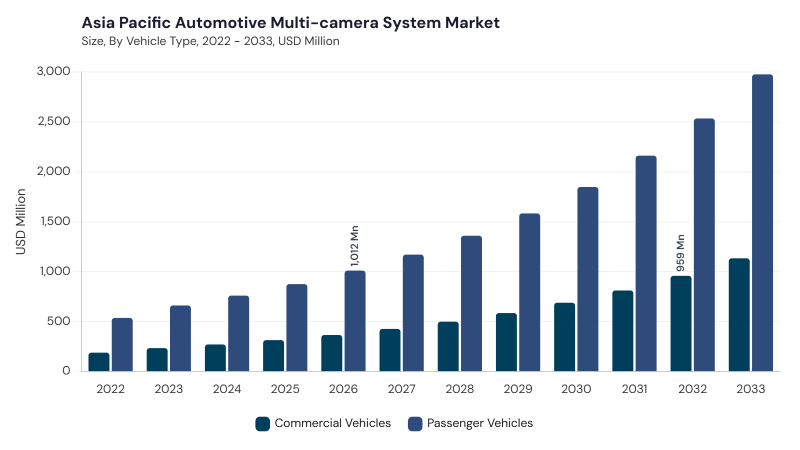
Based on Vehicle Type, the market is segmented into Passenger Vehicles and Commercial Vehicles. The Passenger Vehicles market dominated the Asia Pacific Automotive Multi-camera System Market by Vehicle Type in 2025, and would continue to be a dominant market till 2033; thereby, achieving a market value of USD 1848.5 million by 2030, growing at a CAGR of 16.7 % during the forecast period. The Commercial Vehicles market is expected to witness a CAGR of 17.5% during (2026 - 2033).
Passenger Vehicles use multi-camera systems for surround-view monitoring, blind spot detection, parking assistance, ADAS functions, infotainment integration, electric vehicle platforms, and centralized vehicle computing. Commercial Vehicles, including heavy-duty trucks, buses, light commercial vehicles, and delivery vans, maintain a promising presence due to demand for blind spot monitoring, lane departure warnings, driver fatigue detection support, rear and side visibility, fleet safety, telematics integration, and accident mitigation across logistics, public transport, and last-mile delivery operations.
Free Valuable Insights: Automotive Multi-camera System Market is Predicted to reach USD 10.4 Billion billion by 2033, at a CAGR of 16.5%
Based on Country, the market is segmented into China, Japan, India, South Korea, Singapore, Malaysia, and Rest of Asia Pacific. The China market dominated the Asia Pacific Automotive Multi-camera System Market by Country in 2025, and would continue to be a dominant market till 2033; thereby, achieving a market value of USD 874.2 million by 2030, growing at a CAGR of 15.2 % during the forecast period. The Japan market is expected to witness a CAGR of 16% during (2026 - 2033). Additionally, The India market is expected to witness a CAGR of 17.7% during (2026 - 2033).
China is shaped by electric vehicle growth, government safety emphasis, AI-enabled image processing, domestic innovation, localization, and cost-efficient system development for mid-range vehicles. Japan reflects strong safety expectations, high-resolution camera adoption, AI-based threat detection, local production, and advanced integration with vehicle control systems. India is advancing through safety regulation, ADAS adoption, AI-enhanced perception, connected vehicle technologies, localization, and systems tailored for complex road conditions. South Korea is supported by smart vehicle development, autonomous driving, high-resolution synchronized cameras, sensor fusion, and in-car experience features such as AR displays and 3D surround views. Singapore is driven by urban safety compliance, connected mobility, AI-based analytics, electric and autonomous vehicle needs, and customized systems for city driving. Malaysia is influenced by regulatory safety stringency, AI and machine learning convergence, EV-related compact camera design, localization, and cost-sensitive adoption. Rest of Asia Pacific is developing through AI-enabled perception, modular camera architectures, 4K imaging, 360-degree surround technology, smart city alignment, and scalable solutions for varied regional requirements.

By Vehicle Type
By View Type
By Application
By Country
Set to reach $2537.9 Million by 2030, growing at 16.9% CAGR during 2026-2033.
China leads with $874.2 million by 2030, growing at a 15.2% CAGR during 2026-2033.
Rising demand for passenger vehicles, expected to reach $1848.5 million by 2030, is a key driver.
Passenger vehicles segment to reach $1848.5 million by 2030, growing at a 16.7% CAGR during 2026-2033.
The India market is expected to witness a CAGR of 17.7% during 2026-2033.
The commercial vehicles market is expected to witness a 17.5% CAGR during 2026-2033.
Our team of dedicated experts can provide you with attractive expansion opportunities for your business.




 Unique Offerings
