The sample copy of this report is available for access.
The North America Automotive Engine Valve Market is expected to reach USD 1887.8 million by 2032, growing at a CAGR of 4.5% during (2026 - 2033).
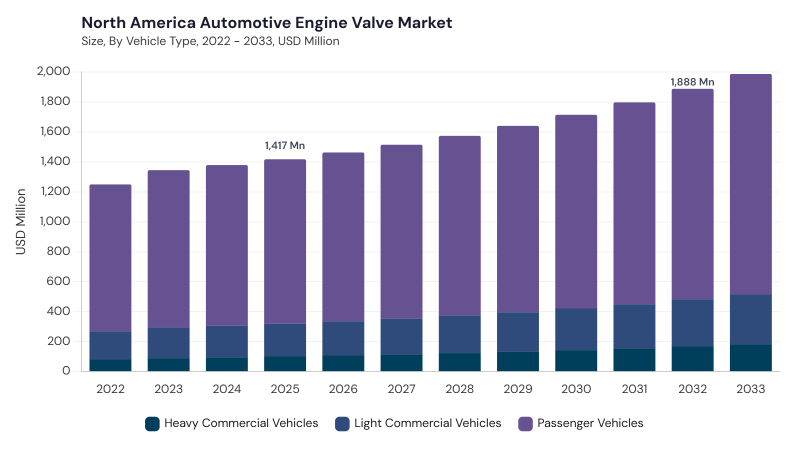
The North America Automotive Engine Valve Market originated with the early development of internal combustion engines, where mechanical valves controlled air-fuel mixture flow and exhaust gas expulsion. Early valves were relatively simple steel-alloy components, but advances in metallurgy and precision engineering gradually introduced more durable, heat-resistant materials such as titanium and sodium-filled valves. Over time, overhead camshaft configurations, multi-valve cylinder heads, variable valve timing systems, precision casting, CNC machining, and surface treatments transformed engine valves into highly engineered components aligned with fuel efficiency, emission control, performance, and durability requirements.
Current market growth is shaped by lightweight materials, smart valve technologies, sustainability, regulatory compliance, and alternative fuel compatibility. Manufacturers are increasingly developing valves using titanium, composite materials, advanced alloys, electronically controlled variable valve actuation, and surface treatments that improve corrosion resistance, thermal conductivity, weight reduction, and combustion efficiency. Demand is also rising for valve systems that support hybrid and mild-hybrid configurations, ethanol blends, compressed natural gas engines, downsized turbocharged engines, emission compliance, and localized production near North American automotive hubs.
Based on Distribution Channel, the market is segmented into OEMs and Aftermarket. The OEMs market dominated the North America Automotive Engine Valve Market by Distribution Channel in 2025, and would continue to be a dominant market till 2033; thereby, achieving a market value of USD 1272.4 million by 2032, growing at a CAGR of 4.1 % during the forecast period. The Aftermarket market is expected to witness a CAGR of 5.3% during (2026 - 2033).
OEMs remain the leading distribution channel as they require precision-engineered valves for newly manufactured vehicles, strict OEM specifications, compatibility with turbocharging, variable valve timing, engine downsizing, fuel efficiency targets, and emission compliance. Aftermarket maintains a promising presence through the region’s extensive installed vehicle base, aging vehicles, engine repair requirements, replacement of worn valvetrain components, service workshops, fleet operators, independent repair networks, and demand for cost-effective valves compatible with older models.
Based on Type, the market is segmented into Mono Metallic, Bimetallic, and Hollow. The Mono Metallic market dominated the North America Automotive Engine Valve Market by Type in 2025, and would continue to be a dominant market till 2033; thereby, achieving a market value of USD 689.1 million by 2032, growing at a CAGR of 3.8 % during the forecast period. The Bimetallic market is expected to witness a CAGR of 4.8% during (2026 - 2033). Additionally, The Hollow market is expected to witness highest CAGR of 4.9% during (2026 - 2033).
Mono Metallic valves remain the leading type as they offer reliable performance, cost-effective manufacturing, high-grade steel construction, wear resistance, durability, and suitability for mass-market passenger cars, light trucks, replacement markets, and conventional internal combustion engines. Bimetallic valves hold a substantial position through their combination of different material properties, improved thermal stability, corrosion resistance, valve seat recession protection, and suitability for turbocharged, high-performance, SUV, and heavy-duty applications. Hollow valves represent a promising presence through reduced reciprocating mass, improved heat dissipation, sodium-filled cooling designs, higher engine-speed support, enhanced thermal management, premium vehicle use, racing applications, and compatibility with advanced valve timing and lift technologies.
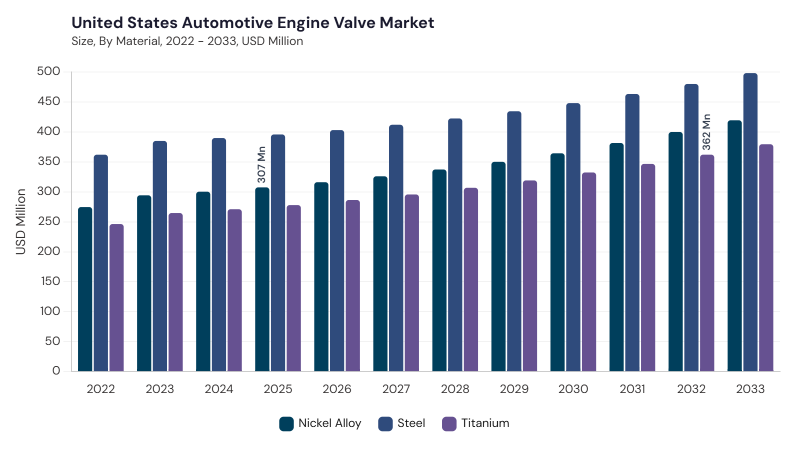
Based on Material, the market is segmented into Steel, Nickel Alloy, and Titanium. Steel remains the leading material as it supports intake and exhaust valve applications, strong tensile performance, wear resistance, fatigue resistance, heat-treatment improvements, coating compatibility, manufacturability, and widespread use across passenger cars, trucks, commercial vehicles, and aftermarket replacements.
Nickel Alloy holds a significant presence through high-temperature strength, corrosion resistance, thermal stability, exhaust-valve suitability, turbocharged engine use, heavy-duty truck applications, motorsport relevance, and durability under extreme combustion conditions. Titanium represents a promising foothold through low weight, high strength-to-weight characteristics, corrosion resistance, reduced valvetrain mass, faster valve response, performance-oriented applications, racing use, and premium engine designs where efficiency and responsiveness are priorities.
Based on Vehicle Type, the market is segmented into Passenger Vehicles, Light Commercial Vehicles, and Heavy Commercial Vehicles. Passenger Vehicles remain the leading vehicle type as they support high-volume demand for valves used in sedans, hatchbacks, SUVs, crossovers, gasoline engines, hybrid platforms, turbocharging, direct injection, variable valve timing, fuel economy improvement, and emission reduction.
Light Commercial Vehicles hold a substantial position through pickup trucks, vans, delivery fleets, service vehicles, frequent start-stop cycles, higher load stress, turbocharged gasoline and diesel engines, e-commerce delivery demand, and durable valve requirements. Heavy Commercial Vehicles represent a promising presence through freight transportation, construction, logistics, buses, vocational applications, high-displacement engines, long operating cycles, high thermal loads, nickel-chromium or cobalt-based materials, and alternative fuel engine requirements.
Free Valuable Insights: The Global Automotive Engine Valve Market will hit USD 8148.5 Million billion by 2033, at a CAGR of 4.9%
Based on Country, the market is segmented into US, Canada, Mexico, and Rest of North America. The US market dominated the North America Automotive Engine Valve Market by Country in 2025, and would continue to be a dominant market till 2033; thereby, achieving a market value of USD 1241.9 million by 2032, growing at a CAGR of 3.7 % during the forecast period. The Canada market is expected to witness a CAGR of 6% during (2026 - 2033). Additionally, The Mexico market is expected to witness a CAGR of 5.4% during (2026 - 2033).
The US is shaped by hybridization, electrification influence, titanium valves, Diamond-Like Carbon coatings, variable valve lift, variable valve timing, advanced CNC machining, additive manufacturing, and proximity to automotive clusters, while Canada reflects lightweight materials, high-strength alloys, ceramic composites, hybrid-compatible valve designs, Industry 4.0 manufacturing, automation, and localized R&D. Mexico is supported by fuel-efficiency regulation, emissions reduction, titanium materials, variable valve timing, CNC machining, additive manufacturing, automotive production localization, and supply-chain strengthening. Rest of North America is influenced by lightweight alloys, specialty steels, digital valve actuation, variable valve timing, sustainability, recyclability, precision machining, advanced coatings, and manufacturing localization near OEM hubs.

By Distribution Channel
By Type
By Material
By Vehicle Type
By Country
Set to reach $1887.8 Million by 2032, growing at 4.5% CAGR during 2026-2033.
The US leads with $1241.9 million by 2032, growing at a 3.7% CAGR during the forecast period.
OEMs will reach $1272.4 million by 2032, growing at a 4.1% CAGR during 2026-2033.
Canada is expected to witness a CAGR of 6% during 2026-2033.
The Hollow segment is expected to witness the highest CAGR of 4.9% during 2026-2033.
Our team of dedicated experts can provide you with attractive expansion opportunities for your business.




 Unique Offerings
