The sample copy of this report is available for access.
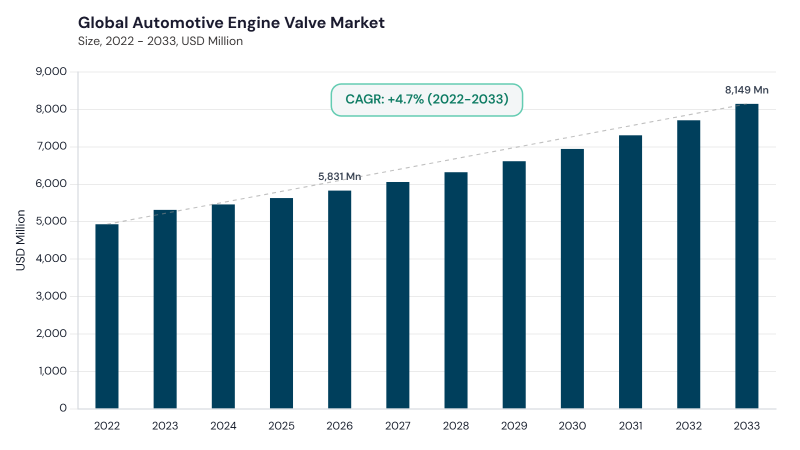
“Global Automotive Engine Valve Market to reach a market value of USD 8148.50 Million by 2033 growing at a CAGR of %”
The Global Automotive Engine Valve Market is expected to reach USD 8148.5 million by 2033, growing at a CAGR of 4.9% during (2026 - 2033).
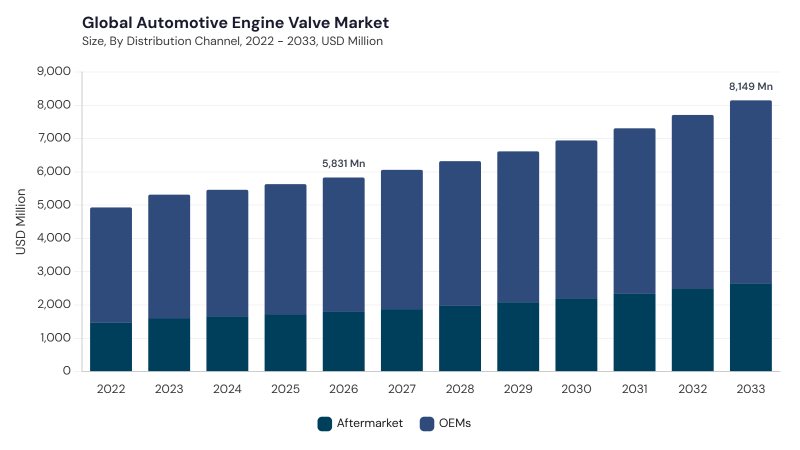
Automotive engine valve demand remains steady as efficient internal combustion engines, tighter emission standards, and fuel-economy requirements continue to influence passenger cars, commercial vehicles, and off-highway equipment. These valves play a key role in regulating intake and exhaust flow, improving combustion efficiency, maintaining thermal durability, and supporting overall engine performance. Market development is being supported by turbocharged engines, downsized powertrains, hybrid vehicles, advanced coatings, lightweight materials, and strong aftermarket demand for durable replacement components.
Increasing demand for fuel-efficient and low-emission powertrains is driving engine valve innovation across gasoline, diesel, hybrid, and alternative-fuel platforms. Engine downsizing and turbocharging are creating higher thermal and mechanical loads, increasing demand for heat-resistant alloys, coatings, hollow designs, and precision manufacturing. Emerging economies continue to support volume demand through passenger and commercial vehicle production, while mature markets sustain replacement demand through large vehicle fleets and aftermarket maintenance. Hybrid vehicles also extend the relevance of internal combustion components by combining electric propulsion with combustion engines. As emission regulations tighten, suppliers are improving valve durability, sealing, thermal management, and lightweight construction to support combustion efficiency and lifecycle reliability.
Competition in the automotive engine valve market is shaped by material innovation, precision engineering, OEM relationships, regional supply strength, and cost efficiency. Manufacturers differentiate through titanium valves, bimetallic designs, sodium-cooled hollow valves, advanced coatings, heat treatment, and designs compatible with turbocharged and hybrid engines. OEM supply requires strict quality control, dimensional accuracy, emission compliance, and long-term reliability, while aftermarket suppliers compete on availability, compatibility, and lifecycle value. Partnerships with automakers, technical collaborations, and localized production are important for securing high-volume programs. Electrification is pushing companies to focus on high-value combustion applications, hydrogen ICE, hybrid platforms, and performance-oriented valve technologies.
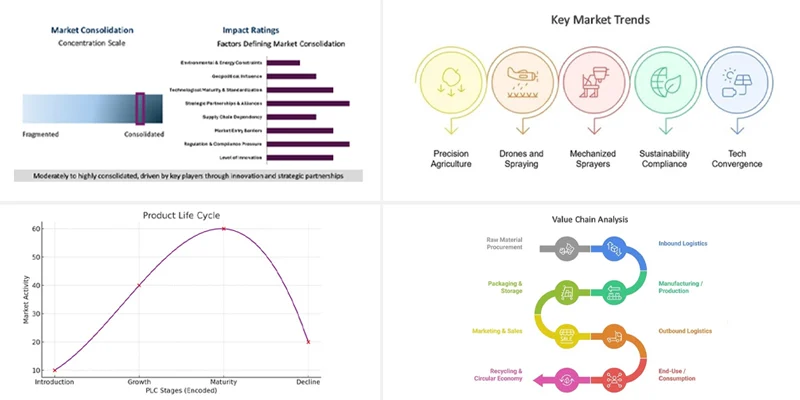


The Automotive Engine Valve market is moderately consolidated, with established component suppliers competing through engineering capability, material expertise, production scale, and OEM relationships. Eaton, NITTAN, MAHLE, Tenneco, FUJI OOZX, Aisan Industry, Rane, Shriram Pistons & Rings, Huaiji Dengyun Auto-parts, and Ferrea serve different parts of the market, ranging from high-volume OEM valves to performance, hollow, titanium, and aftermarket-oriented products. Larger suppliers benefit from global manufacturing networks, advanced testing, and integration with broader valvetrain or engine-component portfolios. Specialized companies compete through racing, heavy-duty, hollow-valve, or regional manufacturing expertise. Competition is increasingly shaped by thermal performance, alternative-fuel readiness, localized supply, and precision quality control.
Based on distribution channel, the market is segmented into OEMs and Aftermarket. The OEMs market dominated the Global Automotive Engine Valve Market by Distribution Channel in 2025, and would continue to be a dominant market till 2033; thereby, achieving a market value of USD 5506.3 million by 2033, growing at a CAGR of 4.5 % during the forecast period. The Aftermarket market is expected to witness a CAGR of 5.7% during (2026 - 2033).
OEMs represent the primary supply route for new vehicle and engine production, where valves must meet exact automaker specifications for dimensional accuracy, durability, heat resistance, and emission-related performance. This channel is strongly linked to global vehicle production, engine platform development, and manufacturer requirements for advanced materials and quality validation. Aftermarket demand is driven by replacement, repair, engine rebuilding, and maintenance needs across aging vehicle fleets. The aftermarket also serves performance upgrades and compatibility requirements across multiple engine models. Both channels are influenced by coating improvements, precision manufacturing, thermal durability, and demand for reliable valve performance over extended engine lifecycles.
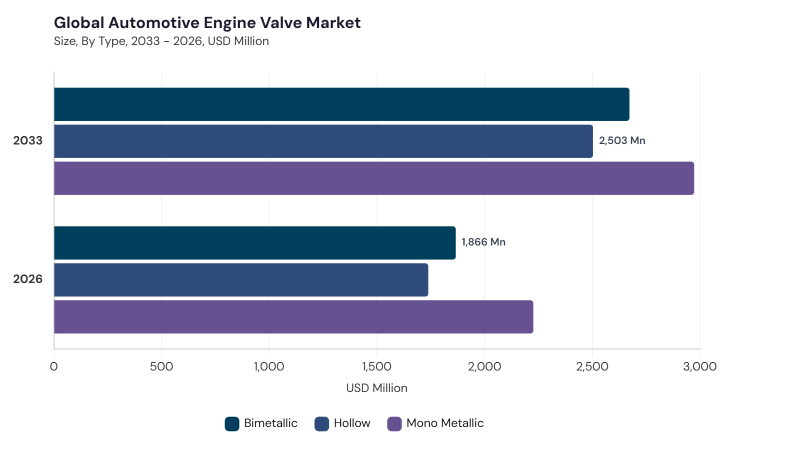
Based on type, the market is segmented into Mono Metallic, Bimetallic, and Hollow. The Mono Metallic market dominated the Global Automotive Engine Valve Market by Type in 2025, and would continue to be a dominant market till 2033; thereby, achieving a market value of USD 2972.9 million by 2033, growing at a CAGR of 4.2 % during the forecast period. The Bimetallic market is expected to witness a CAGR of 5.3% during (2026 - 2033). Additionally, The Hollow market is expected to witness highest CAGR of 5.3% during (2026 - 2033).
Mono metallic valves remain widely used in conventional engine applications because of their simpler construction, manufacturing efficiency, material consistency, and suitability for mass-market vehicles. Bimetallic valves address more demanding operating environments by combining material properties that improve thermal resistance, corrosion performance, and durability. Hollow valves are used where reduced reciprocating mass and better heat dissipation are important, especially in high-performance, turbocharged, racing, heavy-duty, and alternative-fuel engines. Sodium-filled and hollow-head designs are gaining relevance as engines operate at higher temperatures and pressures. These valve types reflect a balance between cost, durability, thermal management, and performance requirements across engine platforms.
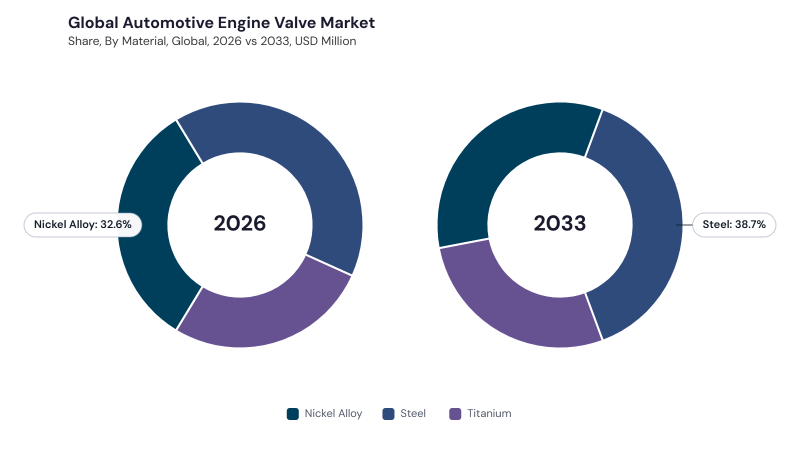
Based on material, the market is segmented into Steel, Nickel Alloy, and Titanium. The Steel market dominated the Global Automotive Engine Valve Market by Material in 2025, and would continue to be a dominant market till 2033; thereby, achieving a market value of USD 3156.3 million by 2033, growing at a CAGR of 4.3 % during the forecast period. The Nickel Alloy market is expected to witness a CAGR of 5.4% during (2026 - 2033). The Titanium market is expected to witness a CAGR of 5.3% during (2026 - 2033).
Steel remains a core material because it provides strength, heat resistance, manufacturability, and cost efficiency for high-volume engine valve production. Nickel alloys are important in applications exposed to elevated combustion temperatures, corrosive exhaust gases, turbocharged engines, and heavy-duty operating cycles where thermal durability is critical. Titanium is used in lightweight and performance-oriented valve designs where reduced mass can improve engine responsiveness and valvetrain dynamics. Material selection depends on engine load, combustion temperature, emission requirements, fuel type, and production economics. Advances in coatings, heat treatment, nitriding, chrome plating, and alloy development are improving valve life and supporting more efficient engine operation.
Based on vehicle type, the market is segmented into Passenger Vehicles, Light Commercial Vehicles, and Heavy Commercial Vehicles. The Passenger Vehicles market dominated the Global Automotive Engine Valve Market by Vehicle Type in 2025, and would continue to be a dominant market till 2033; thereby, achieving a market value of USD 6073.3 million by 2033, growing at a CAGR of 4.3 % during the forecast period. The Light Commercial Vehicles market is expected to witness a CAGR of 6.1% during (2026 - 2033). Additionally, The Heavy Commercial Vehicles market is expected to witness highest CAGR of 8.5% during (2026 - 2033).
Passenger vehicles generate broad demand due to large production volumes, extensive installed base, and continued use of internal combustion and hybrid engines across global markets. Light commercial vehicles require durable valves that can withstand frequent operating cycles, delivery use, logistics activity, and urban transport demands. Heavy commercial vehicles need high-strength and thermally stable valve solutions because engines operate under heavy loads, long mileage, and demanding duty cycles. Commercial categories also create substantial aftermarket replacement opportunities due to intensive use and maintenance requirements. Across all vehicle types, emission standards, fuel efficiency targets, turbocharging, and hybridization are driving improvements in valve materials and combustion-system design.
Free Valuable Insights: Automotive Engine Valve Market Size to reach $8148.5 Million by 2033
Region-wise, the Automotive Engine Valve Market is analyzed across North America, Europe, Asia Pacific, and LAMEA. The Asia Pacific market dominated the Global Automotive Engine Valve Market by Region in 2025, and would continue to be a dominant market till 2033; thereby, achieving a market value of USD 3514.4 million by 2033, growing at a CAGR of 5.3 % during the forecast period. The Europe market is expected to witness a CAGR of 4.2% during (2026 - 2033). Additionally, The North America market is expected to witness a CAGR of 4.5% during (2026 - 2033).
Asia Pacific leads demand due to large automotive manufacturing capacity, high vehicle production, established component supply chains, and continued internal combustion and hybrid vehicle output. Europe is shaped by strict emission standards, advanced engine technologies, high-performance valve materials, and ongoing hybrid and alternative-fuel engine development. North America benefits from passenger and commercial vehicle production, aftermarket demand from the established vehicle fleet, and heavy-duty engine applications. LAMEA demand is supported by vehicle maintenance, aftermarket activity, commercial transportation, and gradual development of automotive manufacturing and component supply networks. Regional adoption is influenced by engine technology, fuel standards, emission rules, vehicle parc, and local production capabilities.
| Report Attribute | Details |
|---|---|
| Market size value in 2026 | USD 5830.9 million |
| Market size forecast in 2033 | USD 8148.5 million |
| Base Year | 2025 |
| Historical Period | 2022 to 2024 |
| Forecast Period | 2026 to 2033 |
| Revenue Growth Rate | CAGR of 4.9% from 2026 to 2033 |
| Number of Pages | 584 |
| Tables | 480 |
| Report Coverage | Market Trends, Revenue Estimation and Forecast, Segmentation Analysis, Regional and Country Breakdown, Competitive Landscape, Market Share Analysis, Company Profiling, Companies Strategic Developments, SWOT Analysis, Product Life Cycle Analysis, Value Chain Analysis, Market Consolidation Analysis, Key Customer Criteria, Pandemic Impact Analysis, and Winning Imperatives |
| Segments Covered | Distribution Channel, Type, Material, Vehicle Type, and Geography |
| Country Scope |
|
| Companies Included | Eaton; NITTAN Corporation; MAHLE; Tenneco; FUJI OOZX Inc.; Aisan Industry; Rane; Shriram Pistons & Rings; Huaiji Dengyun Auto-parts; Ferrea Racing Components |
By Distribution Channel
By Type
By Material
By Vehicle Type
By Geography
Expected to reach USD 8148.5 million by 2033, growing at 4.9% CAGR during the forecast period (2026-2033).
Passenger vehicles dominate with increasing production in emerging economies.
Eaton, NITTAN Corporation, MAHLE, Tenneco, FUJI OOZX Inc., Aisan Industry, Rane, Shriram Pistons & Rings, Huaiji Dengyun Auto-parts, Ferrea Racing Components.
Asia Pacific shows strong growth with rising vehicle production and technological advancements.
Increasing demand for fuel-efficient and low-emission powertrains and rising vehicle production in emerging economies.
Advancements in valve materials and coatings are enhancing durability and performance.
Our team of dedicated experts can provide you with attractive expansion opportunities for your business.






 Unique Offerings
