The sample copy of this report is available for access.
The LAMEA Automotive Engine Valve Market is expected to reach USD 418.7 million by 2029, growing at a CAGR of 7.2% during (2026 - 2033).
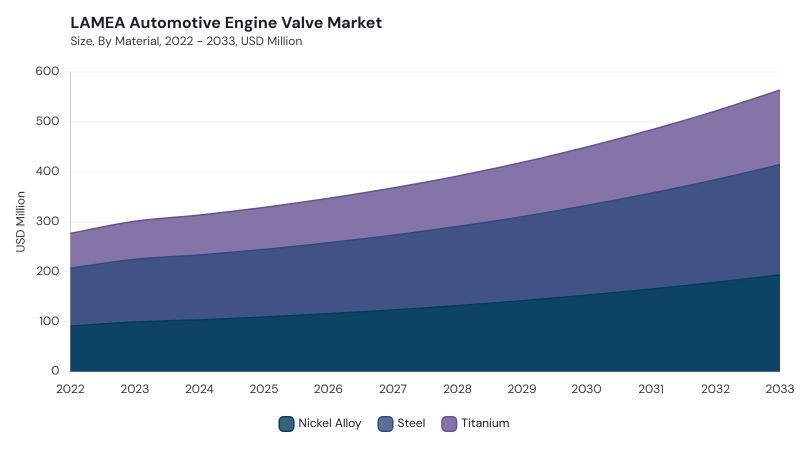
The LAMEA Automotive Engine Valve Market originated from the broader evolution of internal combustion engine components across Latin America, the Middle East, and Africa. Early regional demand centered on standardized metal valves for gasoline engines, supported by older engine designs, basic material compositions, and conventional manufacturing methods. Over time, higher automotive production, emission-compliance needs, hydraulic and variable valve timing systems, turbocharging, direct injection, advanced metallic alloys, surface treatments, and precision manufacturing shifted the market from basic volume-oriented valve supply toward durable, lightweight, and performance-focused valve systems suited to modern engines.
Current market growth is shaped by emission standards, hybrid powertrain requirements, regional manufacturing expansion, localization, and rising demand for durable engine components. Manufacturers are increasingly developing high-performance valve alloys, surface coatings, heat-treated components, precision-machined valves, and variable timing-compatible designs that support leaner combustion, higher operating cycles, fuel efficiency, and improved tolerance control. Demand is also rising for localized production, OEM collaboration, automation, digital manufacturing, and cost-efficient engine valve solutions suited to varied temperatures, fuel qualities, vehicle configurations, and operating environments across LAMEA.
Based on Distribution Channel, the market is segmented into OEMs and Aftermarket. The OEMs market dominated the LAMEA Automotive Engine Valve Market by Distribution Channel in 2025, and would continue to be a dominant market till 2033; thereby, achieving a market value of USD 290.5 million by 2029, growing at a CAGR of 6.8 % during the forecast period. The Aftermarket market is expected to witness a CAGR of 8.1% during (2026 - 2033).
OEMs remain the leading distribution channel as they support new vehicle production, precise engine specifications, emission compliance, fuel-efficient technologies, turbocharged and downsized engines, variable valve timing, factory-quality standards, and direct collaboration with automakers. Aftermarket holds a promising presence through extended vehicle ownership, maintenance-intensive fleets, independent service workshops, replacement demand, repair-driven markets, digitally connected service platforms, spare-parts retailers, and vehicle owners seeking cost-effective engine valve maintenance.
Based on Type, the market is segmented into Mono Metallic, Bimetallic, and Hollow. The Mono Metallic market dominated the LAMEA Automotive Engine Valve Market by Type in 2025, and would continue to be a dominant market till 2033; thereby, achieving a market value of USD 158.7 million by 2029, growing at a CAGR of 6.5 % during the forecast period. The Bimetallic market is expected to witness a CAGR of 7.5% during (2026 - 2033). Additionally, The Hollow market is expected to witness highest CAGR of 7.8% during (2026 - 2033).
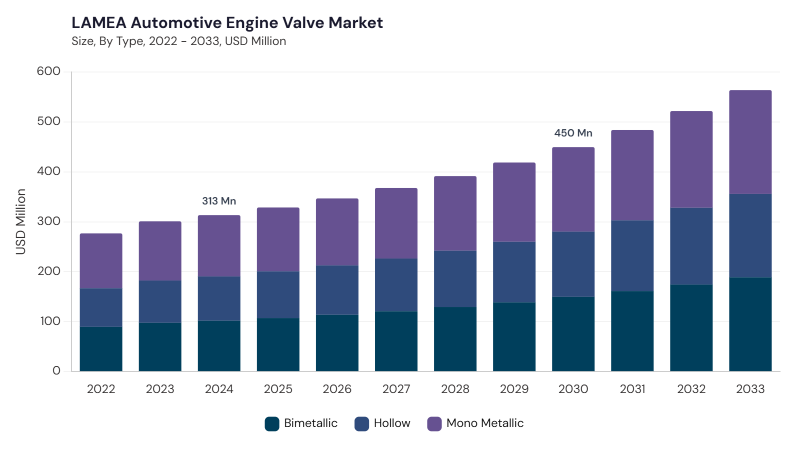
Mono Metallic valves remain the leading type as they offer stainless steel or alloy-based single-metal construction, durability, cost efficiency, straightforward manufacturing, reliable intake and exhaust performance, and suitability for compact to mid-sized engines across urban and semi-urban markets. Bimetallic valves hold a substantial standing through differentiated material characteristics, improved thermal stability, corrosion resistance, mechanical resilience, valve seat recession reduction, and relevance in diesel engines, high-displacement petrol engines, and commercial vehicles. Hollow valves represent an emerging foothold through reduced reciprocating mass, sodium or heat-conductive filling, superior cooling, lower component weight, higher engine-speed support, thermal management, and selective use in premium, performance, sports, and luxury vehicles.
Based on Material, the market is segmented into Steel, Nickel Alloy, and Titanium. Steel remains the leading material as it provides strength, manufacturability, cost efficiency, heat-treatment adaptability, wear resistance, fatigue strength, and broad use in intake and exhaust valves for passenger vehicles and commercial trucks.
Nickel Alloy maintains a significant presence through enhanced temperature resistance, oxidation protection, corrosion resistance, fatigue endurance, exhaust-valve suitability, turbocharged engine use, heavy-duty diesel relevance, and high-performance gasoline applications. Titanium represents a promising outlook through low valvetrain weight, high strength-to-weight characteristics, rapid engine response, thermal performance, fuel-efficiency support, premium vehicle use, sports engine relevance, and selective adoption in performance-oriented powertrains.
Based on Vehicle Type, the market is segmented into Passenger Vehicles, Light Commercial Vehicles, and Heavy Commercial Vehicles. Passenger Vehicles remain the leading vehicle type as they include compact cars, sedans, SUVs, petrol engines, hybrid models, small displacement turbocharged engines, lightweight alloys, valve coatings, nitriding surface treatments, fuel-efficiency improvements, and emission-compliant engine designs.
Light Commercial Vehicles hold a significant foothold through pickups, vans, small trucks, intra-city logistics, delivery services, agricultural use, frequent stop-start cycles, hardened surfaces, corrosion-resistant materials, and turbocharged diesel engine applications. Heavy Commercial Vehicles maintain a developing presence through trucks, buses, construction machinery, mining, oil and gas, freight operations, high-load engines, SCR and EGR-compatible valves, high-grade alloys, ceramic coatings, and natural gas-powered heavy vehicle requirements.
Free Valuable Insights: Automotive Engine Valve Market Size Worth USD 8148.5 Million billion by 2033
Based on Country, the market is segmented into Brazil, Argentina, UAE, Saudi Arabia, South Africa, Nigeria, and Rest of LAMEA. The Brazil market dominated the LAMEA Automotive Engine Valve Market by Country in 2025, and would continue to be a dominant market till 2033; thereby, achieving a market value of USD 112.8 million by 2029, growing at a CAGR of 5.9 % during the forecast period. The Argentina market is expected to witness a CAGR of 8.7% during (2026 - 2033). Additionally, The UAE market is expected to witness a CAGR of 4.3% during (2026 - 2033).
Brazil is shaped by lightweight materials, titanium-based designs, smart manufacturing, flexible-fuel and hybrid compatibility, electrically actuated valves, and local automotive hubs, while Argentina reflects high-performance materials, variable valve timing, electronic actuation, localization, supply-chain restructuring, and Industry 4.0 investment. The UAE is supported by advanced alloys, coated valves, Euro 5 and pending Euro 6 alignment, variable valve timing compatibility, turbocharged engine integration, and logistics-hub advantages, whereas Saudi Arabia is driven by fuel-efficient low-emission vehicles, local manufacturing, Industry 4.0, IoT-enabled production, lightweight titanium valves, and localization under industrial diversification priorities. South Africa is advancing through lightweight titanium or nickel alloys, CNC machining, laser surface treatment, smart manufacturing, local component production, and workforce skill development. Nigeria is influenced by advanced alloys, coatings, CNC machining, computer-aided design, cleaner combustion needs, local assembly, import substitution, and harsh-climate durability requirements, while Rest of LAMEA is shaped by fuel-efficiency regulation, turbocharged and downsized engines, advanced coatings, local production, regional OEM partnerships, stainless steel alloys, titanium materials, and precision manufacturing.

By Distribution Channel
By Type
By Material
By Vehicle Type
By Country
Set to reach $418.7 Million by 2029, growing at 7.2% CAGR during 2026-2033.
Brazil leads with $112.8 million by 2029, growing at 5.9% CAGR during the forecast period.
Rising demand in OEMs, projected to reach $290.5 million by 2029 at 6.8% CAGR during 2026-2033.
The Aftermarket segment is expected to witness a CAGR of 8.1% during 2026-2033.
The UAE market is expected to witness a CAGR of 4.3% during 2026-2033.
The Hollow segment is expected to witness the highest CAGR of 7.8% during 2026-2033.
Our team of dedicated experts can provide you with attractive expansion opportunities for your business.




 Unique Offerings
