The sample copy of this report is available for access.
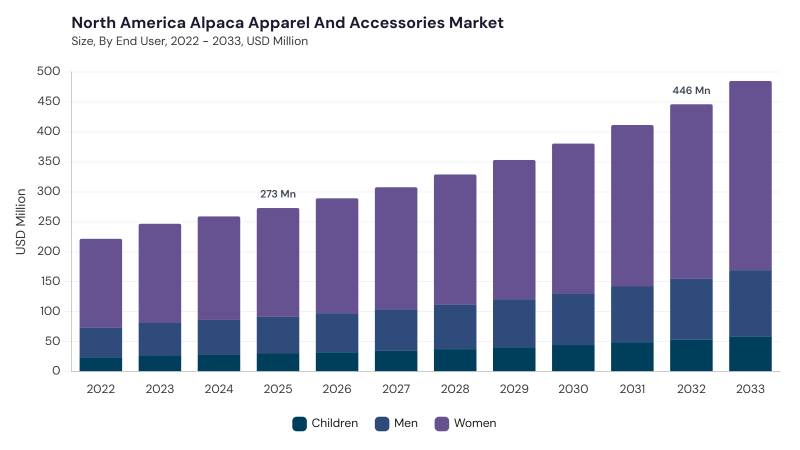
The North America Alpaca Apparel And Accessories Market is expected to reach USD 446.1 million by 2032, growing at a CAGR of 7.7% during (2026 - 2033).
The North America Alpaca Apparel And Accessories Market evolved from small-scale artisanal production and specialty boutiques toward a more structured premium textile industry supported by improved fiber processing, branded collections, and diversified retail channels. Early adoption centered on alpaca fiber’s softness, thermal insulation, durability, and hypoallergenic characteristics, while limited supply and premium pricing constrained broader penetration. Advances in spinning, weaving, fiber blending, automated processing, sustainable farming, and eco-responsible finishing gradually improved scalability and product consistency. The market now combines traditional craftsmanship with contemporary fashion design, sustainable sourcing, digital retail, and premium positioning across apparel and accessory categories.
Sustainability, ethical sourcing, luxury natural fibers, heritage craftsmanship, advanced textile technologies, and digital commerce are shaping current market development. Consumers increasingly favor biodegradable materials, transparent sourcing, cruelty-conscious production, durable apparel, and distinctive handcrafted designs, strengthening alpaca fiber’s appeal in premium fashion. Fiber blending, automated knitting and weaving, eco-friendly dyeing, functional finishes, e-commerce, virtual shopping tools, and direct-to-consumer models are broadening product accessibility and differentiation. However, high raw material and processing costs, limited fiber availability, supply-chain vulnerabilities, certification complexity, consumer awareness gaps, technological limitations, and premium pricing continue to constrain wider market penetration.
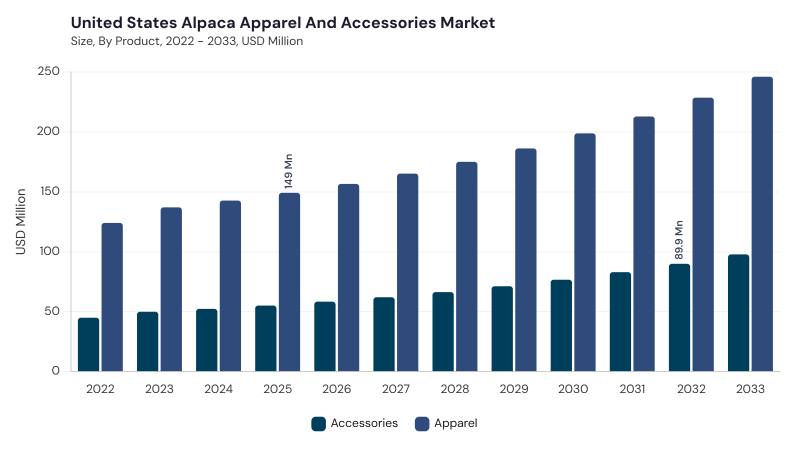
Based on Product, the market is segmented into Apparel and Accessories. The Apparel market dominated the North America Alpaca Apparel And Accessories Market by Product in 2025, and would continue to be a dominant market till 2033; thereby, achieving a market value of USD 320.8 million by 2032, growing at a CAGR of 7.4 % during the forecast period. The Accessories market is expected to witness a CAGR of 8.4% during (2026 - 2033).
Apparel represents the core product category, including sweaters, cardigans, coats, scarves, socks, outdoor garments, and luxury fashion items that utilize alpaca fiber for lightweight warmth, softness, moisture management, and comfort. Greater interest in sustainable fashion, premium natural fibers, and versatile cold-weather clothing is supporting product innovation through improved processing and blended yarns. Accessories include hats, gloves, scarves, shawls, bags, decorative trims, and other fashion additions that capitalize on alpaca fiber’s tactile quality, thermal properties, and artisanal appeal. This category supports product diversification, seasonal gifting, heritage-inspired design, and accessible entry into the premium alpaca segment, although price sensitivity and seasonal demand remain important considerations.
Based on End User, the market is segmented into Women, Men, and Children. The Women market dominated the North America Alpaca Apparel And Accessories Market by End User in 2025, and would continue to be a dominant market till 2033; thereby, achieving a market value of USD 291.2 million by 2032, growing at a CAGR of 7.4 % during the forecast period. The Men market is expected to witness a CAGR of 8% during (2026 - 2033).
Women represent an important end-user group for alpaca sweaters, coats, shawls, scarves, accessories, casual wear, formal clothing, and outdoor apparel, with demand influenced by premium styling, comfort, sustainability, and seasonal fashion. Men increasingly adopt alpaca sweaters, jackets, hats, gloves, and other functional products that combine insulation, durability, natural fibers, and understated design, particularly for outdoor and semi-formal applications. Children form a more specialized segment where alpaca fiber’s softness, lightweight warmth, and hypoallergenic characteristics support use in sweaters, cardigans, hats, mittens, and blankets. Across all groups, product development increasingly emphasizes comfort, durability, sustainable sourcing, improved fiber blends, and design adaptation to different lifestyle requirements.
Based on Distribution Channel, the market is segmented into Offline and Online. Offline distribution includes specialty boutiques, luxury department stores, dedicated alpaca outlets, and other physical retailers where consumers can directly evaluate softness, texture, craftsmanship, and product quality. These channels remain important for premium positioning, consumer education, provenance storytelling, personalized service, and seasonal product merchandising.
Online distribution includes brand websites, e-commerce platforms, and specialized digital marketplaces that broaden geographic reach and enable niche producers to connect directly with consumers. Digital marketing, social media, detailed product information, sustainability certifications, customization, virtual try-on technologies, customer reviews, and improved logistics are strengthening online engagement while encouraging brands to combine physical and digital channels through omnichannel strategies.
Free Valuable Insights: The Global Alpaca Apparel And Accessories Market will hit USD 1358.8 Million billion by 2033, at a CAGR of 8.2%
Based on Country, the market is segmented into US, Canada, Mexico, and Rest of North America. The US market dominated the North America Alpaca Apparel And Accessories Market by Country in 2025, and would continue to be a dominant market till 2033; thereby, achieving a market value of USD 318.5 million by 2032, growing at a CAGR of 6.9 % during the forecast period. The Canada market is expected to witness a CAGR of 9.5% during (2026 - 2033). Additionally, The Mexico market is expected to witness a CAGR of 8.9% during (2026 - 2033).
Across North America, market development is being influenced by sustainability, premium natural fibers, modern textile processing, heritage craftsmanship, and expanding digital retail. The US emphasizes sustainable sourcing, advanced fiber processing, boutique fashion, contemporary design, direct-to-consumer commerce, and stronger integration of artisanal heritage with modern production. Canada focuses on ethically sourced fibers, transparent supply chains, advanced spinning and weaving, performance-oriented alpaca blends, premium winter apparel, and digital customer experiences suited to local climatic conditions. Mexico combines traditional craftsmanship with modern textile techniques, sustainable natural fibers, heritage-inspired designs, e-commerce, and localized production, while Rest of North America increasingly emphasizes responsible sourcing, fiber blending, supply-chain improvement, digital engagement, and accessible premium apparel and accessories.

By Product
By End User
By Distribution Channel
By Country
Set to reach $446.1 Million by 2032, growing at 7.7% CAGR during 2026-2033.
The US leads with $318.5 million by 2032, growing at a CAGR of 6.9% during the forecast period.
The Apparel segment will reach $320.8 million by 2032, growing at a CAGR of 7.4% during 2026-2033.
The Women's market will achieve $291.2 million by 2032, growing at a CAGR of 7.4% during the forecast period.
The Canada market is expected to witness a CAGR of 9.5% during 2026-2033.
The Accessories market is expected to witness a CAGR of 8.4% during 2026-2033.
Our team of dedicated experts can provide you with attractive expansion opportunities for your business.




 Unique Offerings
