The sample copy of this report is available for access.
The Europe Alpaca Apparel And Accessories Market is expected to reach USD 357.8 million by 2031, growing at a CAGR of 8% during (2026 - 2033).
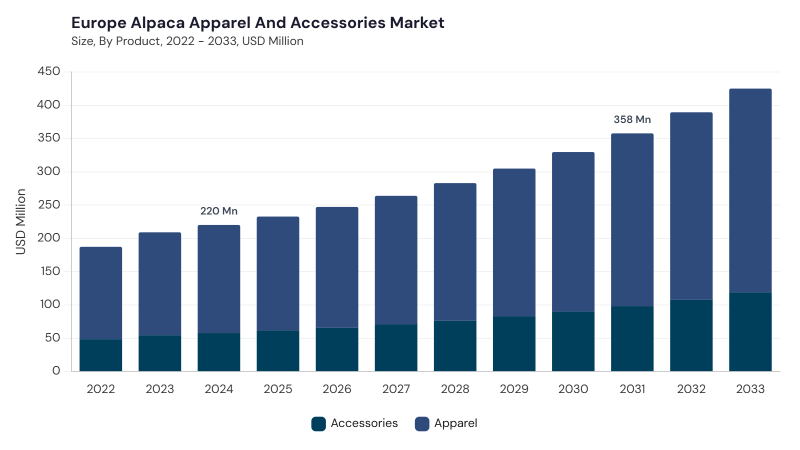
The Europe Alpaca Apparel And Accessories Market evolved from niche artisanal use of imported alpaca fiber toward a structured premium textile segment supported by formal supply chains, advanced processing, and broader fashion integration. Early adoption centered on alpaca fiber’s softness, durability, insulation, and natural appeal, while increasing demand for sustainable luxury encouraged wider incorporation into knitwear, outerwear, scarves, hats, and premium accessories. Improvements in spinning, weaving, blending, fiber refinement, and sustainable dyeing expanded product versatility and consistency. Current market development increasingly combines heritage craftsmanship, ethical sourcing, certified supply chains, modern textile technology, and curated fashion collections targeted at quality-conscious European consumers.
Sustainability, traceability, premiumization, advanced textile technologies, personalization, and digital commerce are shaping current market development. Consumers increasingly favor natural biodegradable fibers, ethically sourced materials, transparent supply chains, and durable products with strong craftsmanship narratives. Manufacturers are responding through performance-oriented alpaca blends, eco-friendly processing, improved fiber sorting, automated dehairing, digital design, smart manufacturing, and localized product development. E-commerce, direct-to-consumer models, data analytics, and digital storytelling are also expanding consumer reach. However, high raw material costs, import dependence, certification requirements, supply-chain complexity, limited mainstream awareness, and sustainability-reporting obligations continue to influence market scalability.
Based on Product, the market is segmented into Apparel and Accessories. The Apparel market dominated the Europe Alpaca Apparel And Accessories Market by Product in 2025, and would continue to be a dominant market till 2033; thereby, achieving a market value of USD 259.4 million by 2031, growing at a CAGR of 7.8 % during the forecast period. The Accessories market is expected to witness a CAGR of 8.8% during (2026 - 2033).
Apparel represents the principal product category in the provided content, covering sweaters, cardigans, outerwear, formal wear, casual garments, and other alpaca-based clothing designed for warmth, softness, breathability, and premium positioning. Growing interest in sustainable textiles, luxury natural fibers, and advanced blending is expanding alpaca use across both seasonal and everyday apparel. Accessories include scarves, shawls, gloves, hats, socks, and other premium items that capitalize on alpaca fiber’s tactile softness, thermal insulation, and artisanal appeal. This segment serves as an accessible entry point for consumers seeking luxury natural-fiber products and benefits from seasonal gifting, boutique retail, craftsmanship, and limited-edition design.
Based on End User, the market is segmented into Women, Men, and Children. The Women market dominated the Europe Alpaca Apparel And Accessories Market by End User in 2025, and would continue to be a dominant market till 2033; thereby, achieving a market value of USD 235.5 million by 2031, growing at a CAGR of 7.7 % during the forecast period. The Men market is expected to witness a CAGR of 8.4% during (2026 - 2033).
Women are characterized as the dominant end-user group in the provided content, supported by broad demand for sweaters, coats, scarves, shawls, gloves, hats, and other fashion-oriented alpaca products combining luxury, comfort, and sustainability. Men represent a growing segment focused on functional knitwear, outerwear, scarves, hats, and gloves that emphasize durability, thermal performance, natural fibers, and understated styling. Children constitute a specialized category where alpaca fiber’s softness, lightweight warmth, and hypoallergenic qualities support use in sweaters, cardigans, hats, mittens, and other cold-weather products. Across all groups, product development increasingly emphasizes sustainable sourcing, improved fiber blends, comfort, durability, modern styling, and adaptation to European climate conditions.
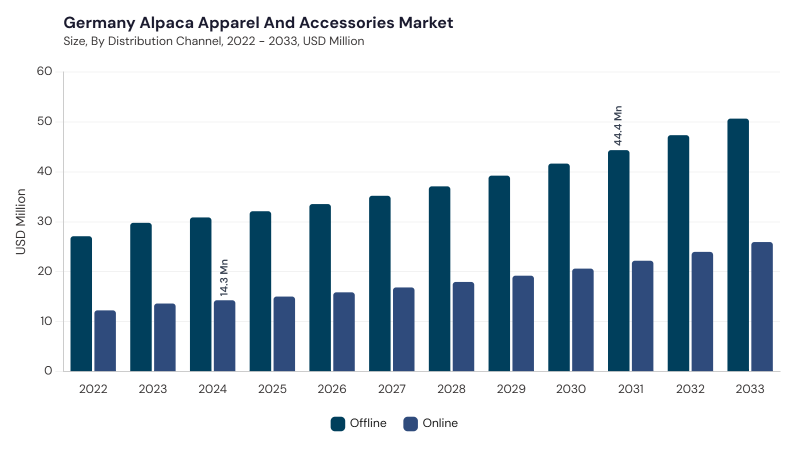
Based on Distribution Channel, the market is segmented into Offline and Online. Offline distribution remains highly important for premium alpaca products because specialty boutiques, department stores, and luxury fashion outlets allow consumers to assess softness, texture, craftsmanship, fit, and product quality directly. Physical retail also supports personalized service, heritage storytelling, consumer education, and premium brand positioning.
Online distribution is gaining strong traction through brand-owned websites, multi-brand platforms, sustainable fashion marketplaces, and direct-to-consumer channels that broaden geographic reach and product accessibility. Digital marketing, social media, detailed sustainability information, traceability narratives, augmented-reality fitting tools, AI-enabled personalization, and improved fulfillment networks are strengthening online engagement while encouraging omnichannel retail strategies.
Free Valuable Insights: The Worldwide Alpaca Apparel And Accessories Market is projected to reach USD 1358.8 Million billion by 2033, at a CAGR of 8.2%
Based on Country, the market is segmented into Germany, UK, France, Russia, Spain, Italy, and Rest of Europe. The Germany market dominated the Europe Alpaca Apparel And Accessories Market by Country in 2025, and would continue to be a dominant market till 2033; thereby, achieving a market value of USD 66.5 million by 2031, growing at a CAGR of 6.5 % during the forecast period. The UK market is expected to witness a CAGR of 6.9% during (2026 - 2033). Additionally, The France market is expected to witness a CAGR of 8.8% during (2026 - 2033).
Across Europe, market development is being shaped by sustainable sourcing, textile innovation, heritage craftsmanship, premium positioning, and expanding digital distribution. Germany emphasizes traceability, eco-conscious production, advanced fiber treatments, blending with complementary natural materials, local supply relationships, and e-commerce, while the UK focuses on domestically sourced alpaca fiber, transparency, bespoke production, sustainable luxury, digital retail, and British craftsmanship. France combines luxury fashion heritage, advanced fiber processing, experiential branding, customization, and sustainability-focused supply chains, whereas Russia emphasizes natural fibers, mechanized textile processing, digital design, local manufacturing capabilities, and contemporary fashion integration. Spain focuses on traceable sourcing, innovative blends, artisan collaboration, direct-to-consumer commerce, and sustainable textile production, while Italy leverages established luxury craftsmanship, advanced spinning and dyeing, bespoke design, sustainable premiumization, and collaboration with South American suppliers. Rest of Europe continues to develop regional sourcing, circularity, traceability technologies, eco-friendly processing, localized production, and premium natural-fiber positioning.

By Product
By End User
By Distribution Channel
By Country
Set to reach $357.8 Million by 2031, growing at 8% CAGR during 2026-2033.
Germany dominates with a market value of $66.5 million by 2031, growing at 6.5% CAGR during 2026-2033.
The Apparel segment leads with a market value of $259.4 million by 2031, growing at 7.8% CAGR during 2026-2033.
The Women segment will reach $235.5 million by 2031, growing at 7.7% CAGR during 2026-2033.
The France market is expected to witness a CAGR of 8.8% during 2026-2033.
The Accessories segment is expected to witness a CAGR of 8.8% during 2026-2033.
Our team of dedicated experts can provide you with attractive expansion opportunities for your business.




 Unique Offerings
