The sample copy of this report is available for access.
The LAMEA Alpaca Apparel And Accessories Market is expected to reach USD 73.7 million by 2029, growing at a CAGR of 9.6% during (2026 - 2033).
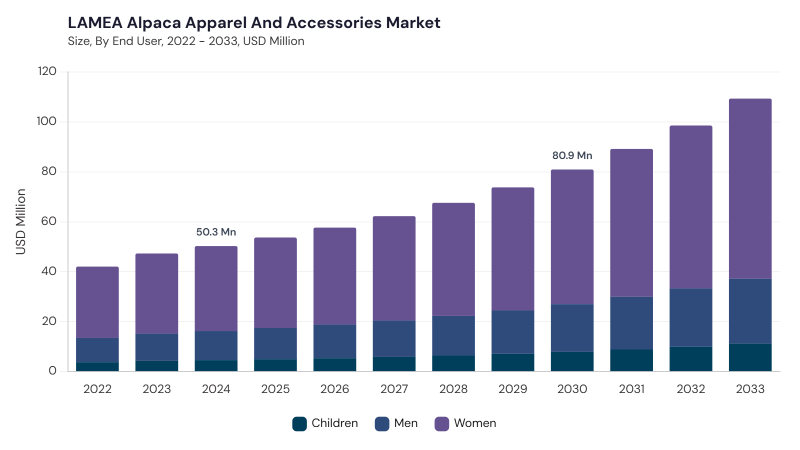
The LAMEA Alpaca Apparel And Accessories Market evolved from traditional artisanal alpaca-fiber utilization toward a more structured fashion and lifestyle segment supported by refined spinning, weaving, and textile-processing technologies. Early production relied heavily on indigenous knowledge and manual craftsmanship, while increasing international appreciation for alpaca fiber’s softness, warmth, durability, and hypoallergenic characteristics encouraged export-oriented production and wider commercialization. Advances in fiber processing progressively improved scalability, consistency, and product diversification across apparel and accessories. The market currently combines traditional craftsmanship with modern design, sustainable sourcing, digital commerce, and technology-enabled manufacturing to address evolving regional and international consumer preferences.
Sustainability, ethical sourcing, premium natural fibers, technological innovation, cultural craftsmanship, and digital commerce are shaping current market development. Consumers increasingly value biodegradable materials, responsible sourcing, traceability, natural comfort, and distinctive artisanal products, supporting alpaca’s positioning in premium fashion. Improved dehairing, eco-friendly dyeing, automated knitting, 3D design, advanced fiber blends, and performance treatments are expanding applications into functional and technical apparel. E-commerce, social media, digital marketing, and improving logistics are also broadening market accessibility. However, raw material availability, fragmented supply chains, high production costs, limited processing infrastructure, affordability constraints, consumer awareness gaps, and uneven technological capabilities continue to influence expansion.
Based on Product, the market is segmented into Apparel and Accessories. The Apparel market dominated the LAMEA Alpaca Apparel And Accessories Market by Product in 2025, and would continue to be a dominant market till 2033; thereby, achieving a market value of USD 54.2 million by 2029, growing at a CAGR of 9.3 % during the forecast period. The Accessories market is expected to witness a CAGR of 10.4% during (2026 - 2033).
Apparel includes sweaters, cardigans, shawls, coats, socks, and other garments that utilize alpaca fiber’s thermal insulation, lightweight comfort, softness, breathability, and moisture-management properties. Rising interest in sustainable textiles, contemporary design, performance-oriented blends, and premium natural fibers is expanding apparel applications across diverse consumer groups. Accessories comprise hats, gloves, scarves, bags, and other smaller alpaca-based products that combine functionality with artisanal and luxury appeal. These products broaden consumer exposure to alpaca fiber, support gifting and seasonal demand, and provide opportunities for small-scale producers and artisans to participate through differentiated, culturally influenced designs.
Based on End User, the market is segmented into Women, Men, and Children. The Women market dominated the LAMEA Alpaca Apparel And Accessories Market by End User in 2025, and would continue to be a dominant market till 2033; thereby, achieving a market value of USD 49.3 million by 2029, growing at a CAGR of 9.2 % during the forecast period. The Men market is expected to witness a CAGR of 9.9% during (2026 - 2033).
Women’s demand spans sweaters, scarves, shawls, bags, hats, and other apparel combining luxury, comfort, sustainable sourcing, and contemporary styling. Men represent a growing segment focused on sweaters, jackets, scarves, beanies, and other products that emphasize durability, thermal regulation, quality, and understated fashion, while Children constitute a more specialized category where softness, hypoallergenic characteristics, lightweight warmth, and comfort are especially important. Across these groups, product development increasingly reflects sustainability, regional design preferences, seasonal requirements, advanced fiber blends, and greater awareness of alpaca’s functional and natural attributes.
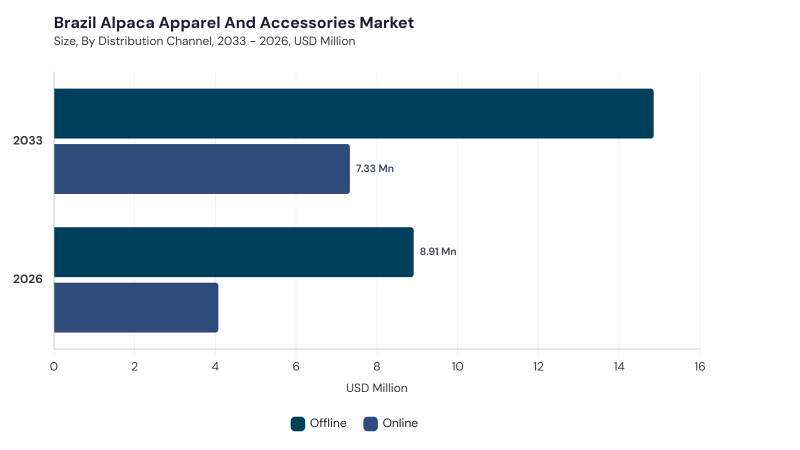
Based on Distribution Channel, the market is segmented into Offline and Online. Offline distribution includes specialty boutiques, department stores, traditional markets, trade fairs, and other physical outlets that enable tactile product assessment, personalized interaction, heritage storytelling, and direct engagement with artisanal producers.
Online distribution is expanding rapidly through e-commerce platforms, brand websites, social media, and digital marketplaces, enabling producers to reach urban, remote, and international consumers more efficiently. Digital channels support customization, sustainability storytelling, product education, targeted marketing, and direct-to-consumer business models, while improved payment systems, logistics, augmented-reality tools, and AI-driven personalization are strengthening online purchasing experiences.
Free Valuable Insights: Alpaca Apparel And Accessories Market Size Worth USD 1358.8 Million billion by 2033
Based on Country, the market is segmented into Brazil, Argentina, UAE, Saudi Arabia, South Africa, Nigeria, and Rest of LAMEA. The Brazil market dominated the LAMEA Alpaca Apparel And Accessories Market by Country in 2025, and would continue to be a dominant market till 2033; thereby, achieving a market value of USD 15.9 million by 2029, growing at a CAGR of 8 % during the forecast period. The Argentina market is expected to witness a CAGR of 10.4% during (2026 - 2033). Additionally, The UAE market is expected to witness a CAGR of 8.6% during (2026 - 2033).
Across LAMEA, market development reflects a combination of sustainable sourcing, luxury positioning, artisanal heritage, textile innovation, and expanding digital access. Brazil emphasizes eco-conscious apparel, digital knitting, automated quality control, customization, traceability, and hybrid textiles, while Argentina combines traditional Andean craftsmanship with advanced dyeing, performance treatments, design diversification, and value-added manufacturing. The UAE focuses on sustainable luxury, advanced fabric functionality, culturally adapted designs, premium retail, and digital consumer engagement, whereas Saudi Arabia emphasizes ethical sourcing, local design integration, modern textile processing, e-commerce, and premium natural-fiber positioning. South Africa is advancing traceable sourcing, luxury natural fibers, local design collaboration, digital retail, and modern processing, while Nigeria focuses on sustainable fiber use, local artisan participation, cultural storytelling, improved spinning and knitting, and digitally supported market outreach. Rest of LAMEA continues to develop sustainable production, modern fiber processing, direct-to-consumer models, cultural authenticity, and diversified apparel and accessory offerings.

By Product
By End User
By Distribution Channel
By Country
Set to reach $73.7 Million by 2029, growing at 9.6% CAGR during 2026-2033.
Brazil leads with $15.9 million by 2029, growing at 8% CAGR during the forecast period.
The Apparel segment will reach $54.2 million by 2029, growing at 9.3% CAGR during 2026-2033.
The Women segment will achieve $49.3 million by 2029, growing at 9.2% CAGR during the forecast period.
The UAE market is expected to witness a CAGR of 8.6% during 2026-2033.
The Accessories segment is expected to witness a CAGR of 10.4% during 2026-2033.
Our team of dedicated experts can provide you with attractive expansion opportunities for your business.




 Unique Offerings
