The sample copy of this report is available for access.
The North America Air Conditioning Systems Market is expected to reach USD 36.0 billion by 2032, growing at a CAGR of 5.9% during (2026 – 2033).
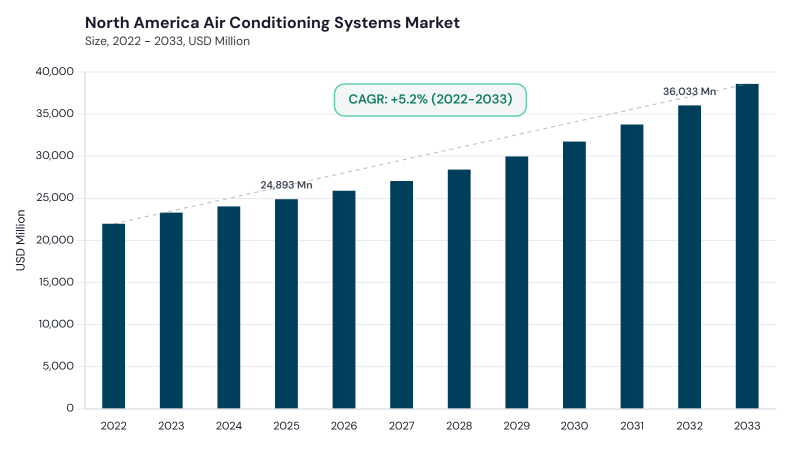
The North America Air Conditioning Systems Market developed from early mechanical refrigeration systems that were first used mainly in commercial and industrial buildings for indoor climate control. Over time, improvements in compressors, refrigerants, heat exchangers, electrical systems, and system design made air conditioning more compact, reliable, and suitable for residential use. Post-war housing expansion, suburban development, and rising household income helped accelerate wider installation across homes and commercial spaces. Later, digital controls, energy-efficiency standards, and refrigerant regulations reshaped product design and performance requirements.
The North America Air Conditioning Systems Market is being shaped by electrification, smart HVAC integration, refrigerant transition, retrofit activity, and demand for energy-efficient indoor comfort. Consumers and facility managers are adopting connected thermostats, IoT-enabled controls, predictive diagnostics, and building automation features to improve performance and reduce energy use. Regulatory pressure around low-GWP refrigerants and efficiency standards is encouraging manufacturers to redesign systems with sustainable components and advanced compressors. Replacement of aging units in homes, offices, retail spaces, healthcare facilities, and institutional buildings is also supporting steady demand.
Based on Technology, the market is segmented into Inverter and Non-Inverter. The Inverter market dominated the North America Air Conditioning Systems Market by Technology in 2025, and would continue to be a dominant market till 2033; thereby, achieving a market value of USD 23.8 billion by 2032, growing at a CAGR of 6 % during the forecast period. The Non-Inverter market is expected to witness a CAGR of 5.6% during (2026 - 2033).
Inverter systems lead because they adjust compressor speed according to cooling demand, helping reduce electricity consumption while improving temperature stability and comfort. These systems are increasingly preferred in residential, commercial, and institutional buildings where users value quiet operation, lower operating costs, variable-speed performance, and compatibility with smart HVAC controls. Their adoption is also supported by energy-efficiency regulations, utility rebates, green building standards, and consumer awareness of long-term savings. Non-Inverter systems remain relevant due to lower upfront cost, simpler installation, easier maintenance, and suitability for price-sensitive buyers or locations with limited cooling-hour requirements.
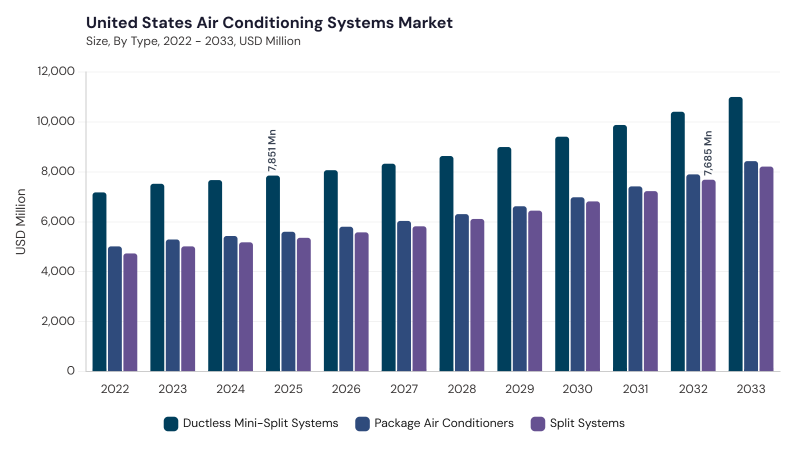
Based on Type, the market is segmented into Ductless Mini-Split Systems, Package Air Conditioners, and Split Systems. The Ductless Mini-Split Systems market dominated the North America Air Conditioning Systems Market by Type in 2025, and would continue to be a dominant market till 2033; thereby, achieving a market value of USD 14.5 billion by 2032, growing at a CAGR of 5.2 % during the forecast period. The Package Air Conditioners market is expected to witness a CAGR of 6.2% during (2026 - 2033). Additionally, The Split Systems market is expected to witness highest CAGR of 6.4% during (2026 - 2033).
Ductless Mini-Split Systems lead due to flexible installation, zoned cooling, compact design, energy efficiency, and suitability for homes, apartments, additions, small offices, and buildings without existing ductwork. These systems are gaining attention in retrofit projects because they allow targeted comfort control without major structural changes. Package Air Conditioners remain important for commercial buildings, retail outlets, schools, small offices, and light industrial facilities where a compact outdoor unit simplifies installation and service access. Split Systems continue to hold steady demand across residential and commercial spaces due to their familiar indoor-outdoor configuration, efficient cooling, and compatibility with established HVAC installation practices.
Based on End Use, the market is segmented into Residential, Commercial, and Industrial. Residential leads due to strong household cooling demand, home improvement activity, replacement of aging units, smart thermostat adoption, and rising focus on indoor comfort and energy savings. Consumers are increasingly choosing efficient air conditioning systems that offer lower electricity use, quiet operation, improved air quality, and remote control features.
Commercial demand is supported by offices, retail stores, hospitality spaces, healthcare facilities, schools, and institutional buildings requiring reliable cooling and air management. Industrial applications remain specialized, serving warehouses, manufacturing sites, processing facilities, data-related spaces, and controlled environments where temperature regulation supports equipment performance and operational continuity.
Free Valuable Insights: The Global Air Conditioning Systems Market will hit USD 176.4 Billion billion by 2033, at a CAGR of 7.0%
Based on Country, the market is segmented into US, Canada, Mexico, and Rest of North America. The US market dominated the North America Air Conditioning Systems Market by Country in 2025, and would continue to be a dominant market till 2033; thereby, achieving a market value of USD 26.0 billion by 2032, growing at a CAGR of 5.2 % during the forecast period. The Canada market is expected to witness a CAGR of 8.1% during (2026 - 2033). Additionally, The Mexico market is expected to witness a CAGR of 6.9% during (2026 - 2033).
The US leads due to high residential penetration, large replacement demand, smart HVAC adoption, strict efficiency requirements, refrigerant transition activity, and strong presence of major air conditioning manufacturers. Canada supports market growth through retrofitting of aging buildings, smart climate-control adoption, sustainability policies, heat pump integration, and demand for efficient systems suited to varied climates. Mexico is advancing through urban construction, industrial growth, local manufacturing, energy-efficient cooling adoption, and smart system integration. Rest of North America benefits from replacement cycles, sustainability-focused upgrades, climate-control demand, and growing use of connected HVAC solutions across residential and commercial buildings.

By Technology
By Type
By End Use
By Country
Set to reach USD 36.0 billion by 2033, growing at 5.9% CAGR during 2026-2033.
The US leads with USD 26.0 billion by 2032, growing at a 5.2% CAGR during the forecast period.
Inverter technology dominates, reaching USD 23.8 billion by 2032 at a 6% CAGR during 2026-2033.
Ductless mini-split systems will reach USD 14.5 billion by 2032, growing at a 5.2% CAGR during the forecast period.
Canada is expected to witness an 8.1% CAGR during 2026-2033.
Split systems are expected to witness the highest CAGR of 6.4% during 2026-2033.
Our team of dedicated experts can provide you with attractive expansion opportunities for your business.




 Unique Offerings