The sample copy of this report is available for access.
The LAMEA Air Conditioning Systems Market is expected to reach USD 13.9 billion by 2029, growing at a CAGR of 8.6% during (2026 – 2033).
The LAMEA Air Conditioning Systems Market developed from the rising need for cooling across hot-climate residential, commercial, and industrial environments in Latin America, the Middle East, and Africa. Early systems were mainly basic cooling units used in commercial buildings and premium residential properties, while access remained limited by cost, infrastructure, and import dependence. Over time, improvements in compressors, inverter systems, variable refrigerant flow technology, and localized service networks expanded the market’s practical reach. Regional manufacturing and assembly also helped suppliers adapt products to varied climates, power conditions, and customer affordability levels.
The LAMEA Air Conditioning Systems Market is being shaped by rising temperatures, rapid urbanization, energy-efficiency regulations, smart HVAC adoption, and sustainable construction practices. Consumers and businesses are increasingly selecting systems with inverter technology, eco-friendly refrigerants, remote control, predictive maintenance, and building management integration. Demand is supported by urban housing, hospitality projects, malls, offices, hospitals, education facilities, warehouses, factories, oil and gas sites, and public buildings. Affordability remains important in many markets, while premium commercial and institutional users are moving toward advanced, connected, and efficient systems.
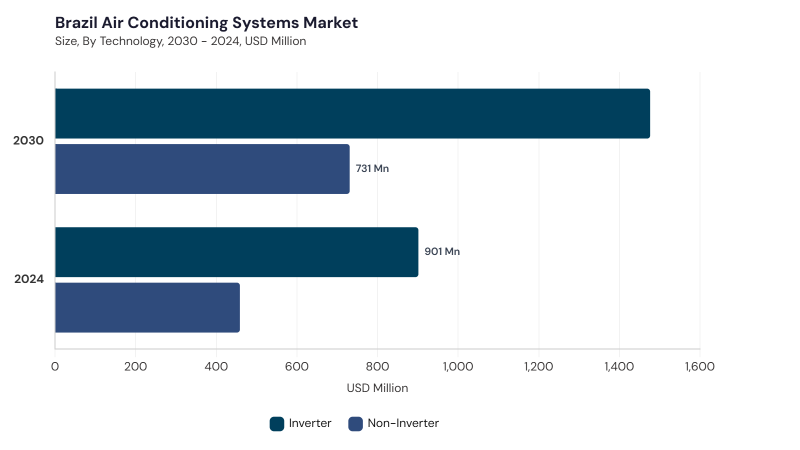
Based on Technology, the market is segmented into Inverter and Non-Inverter. The Inverter market dominated the LAMEA Air Conditioning Systems Market by Technology in 2025, and would continue to be a dominant market till 2033; thereby, achieving a market value of USD 9.3 billion by 2029, growing at a CAGR of 8.8 % during the forecast period. The Non-Inverter market is expected to witness a CAGR of 8.3% during (2026 - 2033).
Inverter systems lead because they offer controlled compressor speed, better energy management, steady cooling output, quieter operation, and suitability for long cooling seasons across hot and humid areas. These systems are gaining preference among households, businesses, hotels, institutions, and commercial facilities seeking lower electricity consumption and improved comfort. Their adoption is also supported by efficiency regulations, rising utility costs, and growing awareness of lifecycle savings. Non-Inverter systems continue to meet demand from price-sensitive residential and small commercial users due to lower purchase cost, familiar servicing, uncomplicated design, and suitability for basic or intermittent cooling needs.
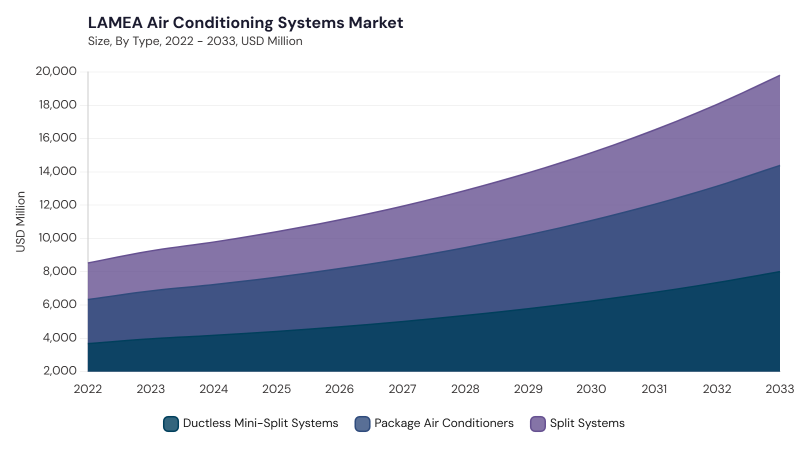
Based on Type, the market is segmented into Ductless Mini-Split Systems, Package Air Conditioners, and Split Systems. The Ductless Mini-Split Systems market dominated the LAMEA Air Conditioning Systems Market by Type in 2025, and would continue to be a dominant market till 2033; thereby, achieving a market value of USD 5.8 billion by 2029, growing at a CAGR of 7.9 % during the forecast period. The Package Air Conditioners market is expected to witness a CAGR of 9% during (2026 - 2033). Additionally, The Split Systems market is expected to witness highest CAGR of 9.2% during (2026 - 2033).
Ductless Mini-Split Systems lead due to installation convenience, room-wise cooling control, limited ductwork requirement, and strong suitability for apartments, villas, small shops, offices, and retrofit projects. Their flexibility makes them useful across diverse building types where compact cooling and energy efficiency are key priorities. Package Air Conditioners remain important across retail centers, hotels, schools, clinics, commercial buildings, and facilities requiring compact equipment placement with easier maintenance access. Split Systems sustain consistent adoption through household cooling, individual room comfort, familiar installation practices, and wide acceptance across warm-climate residential and commercial markets.
Based on End Use, the market is segmented into Residential, Commercial, and Industrial. Residential leads due to rising housing demand, apartment development, home comfort needs, replacement purchases, and growing consumer preference for efficient cooling appliances. Demand is strengthened by high-temperature conditions, improving living standards, and increasing adoption of split and inverter systems in urban households.
Commercial adoption is supported by offices, shopping centers, hotels, restaurants, hospitals, schools, and mixed-use developments that need dependable cooling for occupants and daily operations. Industrial applications remain focused across manufacturing plants, warehouses, logistics facilities, oil and gas sites, food processing units, and controlled workspaces where temperature regulation supports process stability and worker comfort.
Free Valuable Insights: The Global Air Conditioning Systems Market will hit USD 176.4 Billion billion by 2033, at a CAGR of 7.0%
Based on Country, the market is segmented into Brazil, Argentina, UAE, Saudi Arabia, South Africa, Nigeria, and Rest of LAMEA. The Saudi Arabia market dominated the LAMEA Air Conditioning Systems Market by Country in 2025, and would continue to be a dominant market till 2033; thereby, achieving a market value of USD 2.6 billion by 2029, growing at a CAGR of 6.7 % during the forecast period. The Argentina market is expected to witness a CAGR of 9.5% during (2026 - 2033). Additionally, The UAE market is expected to witness a CAGR of 7.5% during (2026 - 2033).
Brazil leads due to urban cooling demand, modular systems, energy-efficient compressors, smart HVAC adoption, and demand from residential and commercial buildings. Argentina supports growth through inverter technologies, natural refrigerants, smart controls, and broader cooling use across residential, institutional, and commercial settings. The UAE contributes through smart buildings, district cooling, inverter systems, VRF adoption, and sustainability-led construction. Saudi Arabia, South Africa, and Nigeria add demand through extreme heat, urban development, commercial projects, smart HVAC integration, and localization of service networks, while Rest of LAMEA benefits from rising cooling penetration and expanding infrastructure.

By Technology
By Type
By End Use
By Country
Set to reach USD 13.9 billion by 2033, growing at 8.6% CAGR during 2026-2033.
Saudi Arabia leads with USD 2.6 billion by 2029, growing at a 6.7% CAGR during 2026-2033.
Inverter technology dominates with USD 9.3 billion by 2029, at 8.8% CAGR during 2026-2033.
Ductless Mini-Split Systems will reach USD 5.8 billion by 2029, at a 7.9% CAGR during 2026-2033.
Argentina's market is expected to witness a 9.5% CAGR during 2026-2033.
Split Systems are expected to witness the highest CAGR of 9.2% during 2026-2033.
Our team of dedicated experts can provide you with attractive expansion opportunities for your business.




 Unique Offerings