The sample copy of this report is available for access.
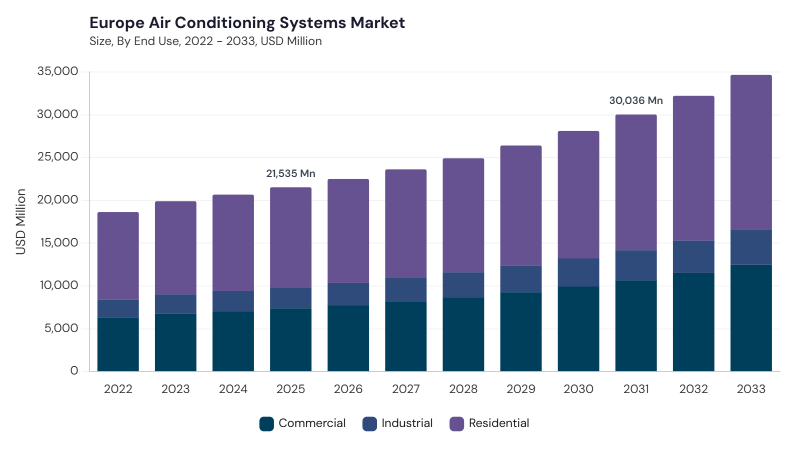
The Europe Air Conditioning Systems Market is expected to reach USD 30.0 billion by 2031, growing at a CAGR of 6.4% during (2026 – 2033).
The Europe Air Conditioning Systems Market evolved from limited industrial and commercial cooling applications into a broader residential, commercial, and institutional climate-control market. Early systems were mainly used in specialized settings and relied on conventional refrigerants, while later technological progress improved compressor performance, heat exchange efficiency, controls, and installation flexibility. Rising urbanization, warmer summers, and frequent heatwaves increased demand for cooling in countries where air conditioning was once less common. Europe’s strong environmental policy framework further pushed the market toward low-GWP refrigerants, efficient heat pumps, and inverter-based systems.
The Europe Air Conditioning Systems Market is currently being driven by heatwave-related cooling needs, building renovation programs, smart HVAC adoption, refrigerant transition, and the electrification of heating and cooling. Manufacturers are focusing on low-GWP refrigerants, VRF technology, IoT-enabled controls, predictive maintenance, indoor air quality monitoring, and heat pump integration. Building owners and consumers are increasingly selecting systems that reduce energy use, support compliance, and improve comfort across varied European climates. Demand is also rising from homes, offices, hospitality buildings, healthcare facilities, retail outlets, and light industrial spaces.
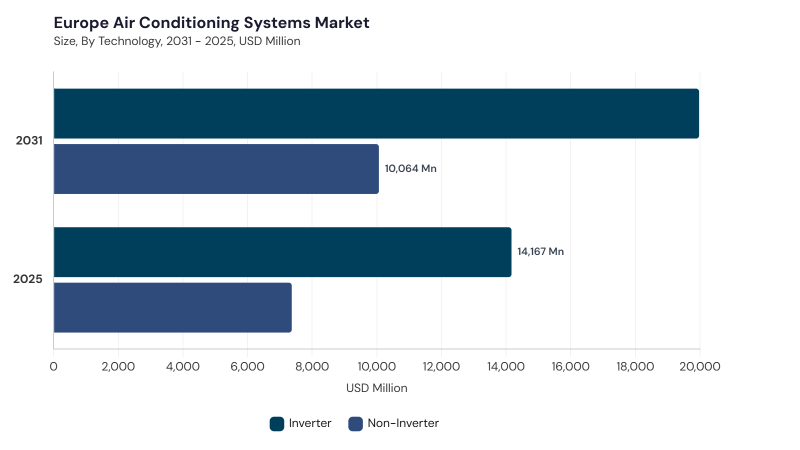
Based on Technology, the market is segmented into Inverter and Non-Inverter. The Inverter market dominated the Europe Air Conditioning Systems Market by Technology in 2025, and would continue to be a dominant market till 2033; thereby, achieving a market value of USD 20.0 billion by 2031, growing at a CAGR of 6.5 % during the forecast period. The Non-Inverter market is expected to witness a CAGR of 6% during (2026 - 2033).
Inverter systems lead because they offer variable-speed operation, lower power consumption, quieter performance, improved temperature stability, and stronger alignment with Europe’s energy-efficiency priorities. These systems are increasingly used in apartments, homes, offices, hotels, public buildings, and renovation projects where operating savings and environmental performance are important. Regulatory pressure, rising electricity costs, green building standards, and smart building integration are further supporting adoption. Non-Inverter systems continue to serve cost-sensitive installations, occasional-use spaces, and applications where lower upfront cost, simpler servicing, and basic cooling requirements remain key purchasing considerations.
Based on Type, the market is segmented into Ductless Mini-Split Systems, Package Air Conditioners, and Split Systems. The Ductless Mini-Split Systems market dominated the Europe Air Conditioning Systems Market by Type in 2025, and would continue to be a dominant market till 2033; thereby, achieving a market value of USD 12.2 billion by 2031, growing at a CAGR of 5.7 % during the forecast period. The Package Air Conditioners market is expected to witness a CAGR of 6.8% during (2026 - 2033). Additionally, The Split Systems market is expected to witness highest CAGR of 6.9% during (2026 - 2033).
Ductless Mini-Split Systems lead due to flexible installation, zoned comfort, compact design, and suitability for Europe’s older building stock where duct installation can be difficult or expensive. Their use is growing in apartments, residential retrofits, small offices, hospitality spaces, and buildings requiring efficient room-based climate control. Package Air Conditioners remain important in commercial properties, schools, hospitality buildings, small business facilities, and premises requiring compact equipment layouts with centralized service access. Split Systems continue to hold steady demand through residential cooling, room-based comfort, established installer familiarity, and compatibility with replacement and renovation projects.
Based on End Use, the market is segmented into Residential, Commercial, and Industrial. Residential leads due to rising household cooling needs, apartment retrofits, home renovation activity, warmer summer conditions, and consumer demand for comfortable indoor environments. Adoption is supported by compact split units, ductless mini-splits, inverter technology, smart thermostats, and energy-efficient replacements suited to both southern and increasingly heat-affected northern markets.
Commercial demand comes from offices, retail stores, hotels, restaurants, hospitals, schools, and public buildings that require dependable cooling and energy-conscious climate control. Industrial use remains specialized across warehouses, production facilities, workshops, laboratories, and controlled spaces where cooling supports equipment protection, process stability, and worker productivity.
Free Valuable Insights: The Global Air Conditioning Systems Market will hit USD 176.4 Billion billion by 2033, at a CAGR of 7.0%
Based on Country, the market is segmented into Germany, UK, France, Russia, Spain, Italy, and Rest of Europe. The Germany market dominated the Europe Air Conditioning Systems Market by Country in 2025, and would continue to be a dominant market till 2033; thereby, achieving a market value of USD 5.2 billion by 2031, growing at a CAGR of 4.7 % during the forecast period. The UK market is expected to witness a CAGR of 5.2% during (2026 - 2033). Additionally, The France market is expected to witness a CAGR of 7.1% during (2026 - 2033).
Germany leads due to rising heatwave exposure, smart HVAC adoption, strong energy-efficiency focus, heat pump integration, and demand for low-emission climate-control systems. The UK supports market growth through air-to-air heat pumps, digital HVAC monitoring, net-zero policies, energy-performance standards, and demand for systems that provide both heating and cooling. France contributes through natural refrigerant adoption, inverter technologies, climate-adaptive units, IoT-enabled controls, and sustainable cooling solutions. Russia, Spain, and Italy add demand through urban cooling needs, smart controls, heat pump adoption, refrigerant transition, and regional climate conditions, while Rest of Europe benefits from rising cooling penetration and demand for affordable, efficient systems.

By Technology
By Type
By End Use
By Country
Set to reach USD 30.0 billion by 2033, growing at 6.4% CAGR during 2026-2033.
Germany leads with USD 5.2 billion by 2031, growing at 4.7% CAGR during the forecast period.
Inverter technology dominates, reaching USD 20.0 billion by 2031 at 6.5% CAGR during the forecast period.
Ductless mini-split systems reach USD 12.2 billion by 2031, growing at 5.7% CAGR during the forecast period.
France is expected to witness a CAGR of 7.1% during 2026-2033.
Package air conditioners are expected to witness a CAGR of 6.8% during 2026-2033.
Our team of dedicated experts can provide you with attractive expansion opportunities for your business.




 Unique Offerings