The sample copy of this report is available for access.
“Global Air Conditioning Systems Market to reach a market value of USD 176,397.84 Million by 2033 growing at a CAGR of 7%”
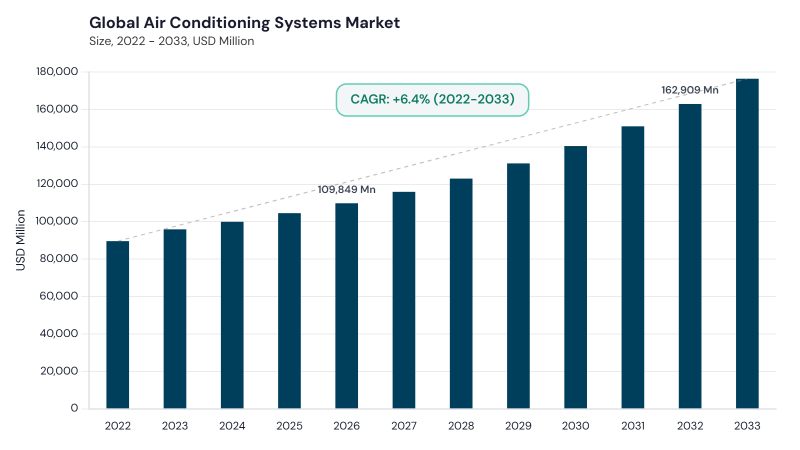
The Global Air Conditioning Systems Market is expected to reach USD 176.4 billion by 2033, growing at a CAGR of 7% during (2026 - 2033).
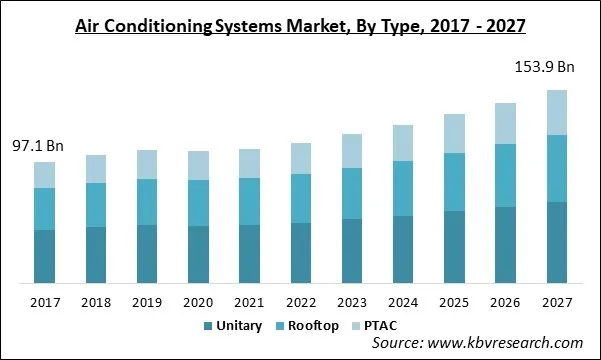
The Air Conditioning Systems Market is supported by increasing demand for energy-efficient cooling, improved indoor air quality, advanced climate control, lower electricity consumption, smart connectivity, and environmentally responsible cooling technologies. Demand is also rising due to urbanization, higher disposable incomes, commercial infrastructure expansion, inverter-based systems, low-GWP refrigerants, and smart HVAC solutions. The market originated in the early 20th century with mechanical refrigeration systems used mainly in industrial and commercial environments. Over time, compact designs, improved refrigerants, electrically powered compressors, and residential cooling demand expanded adoption.
The market is growing as customers increasingly prioritize comfort, energy savings, clean indoor air, connected climate control, and sustainable cooling technologies. Air conditioning systems are becoming more intelligent through IoT sensors, AI-enabled controls, real-time monitoring, predictive maintenance, and integration with building management platforms. Manufacturers are also focusing on inverter compressors, smart thermostats, filtration systems, compact designs, and low-environmental-impact refrigerants to support modern residential, commercial, and industrial cooling needs.
The competitive environment is moderately consolidated and manufacturing-scale-driven, shaped by global HVAC manufacturers, residential and commercial cooling specialists, diversified electronics companies, and building climate-control solution providers. Market players compete through energy efficiency, inverter technology, smart controls, refrigerant innovation, after-sales service, regional distribution strength, and sustainable product portfolios. Leading firms are also expanding service ecosystems, smart building partnerships, and localized manufacturing to improve competitiveness across developed and emerging markets.
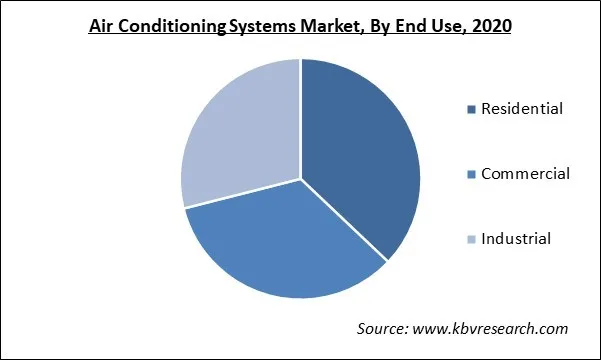
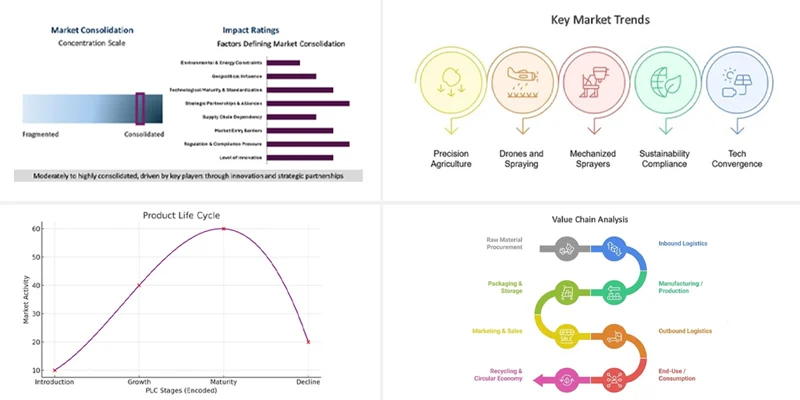

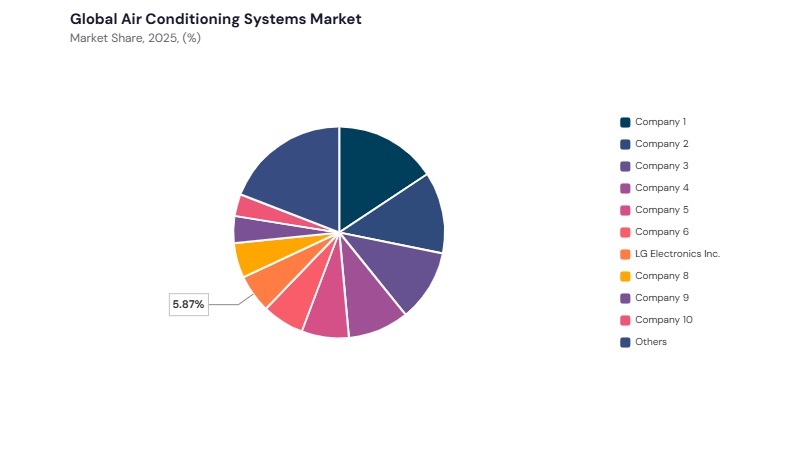
The Air Conditioning Systems Market reflects a moderately consolidated and manufacturing-driven competitive landscape led by global HVAC manufacturers and diversified electronics companies. Daikin, Midea, Gree, and Carrier maintain strong leadership through manufacturing scale, product breadth, inverter technologies, and global distribution capabilities. Johnson Controls, Trane, LG, and Mitsubishi Electric strengthen competition across commercial HVAC, building automation, smart systems, and premium climate-control solutions. Samsung and Panasonic add further competitive pressure through consumer brand strength, smart home integration, and energy-efficient cooling portfolios.
Based on Technology, the market is segmented into Inverter and Non-Inverter. The Inverter market dominated the Global Air Conditioning Systems Market by Technology in 2025, and would continue to be a dominant market till 2033; thereby, achieving a market value of $117.3 billion by 2033, growing at a CAGR of 7.2 % during the forecast period. The Non-Inverter market is expected to witness a CAGR of 6.7% during (2026 - 2033).
Non-Inverter systems continue to hold demand due to their lower initial cost, simpler installation, easier maintenance, and suitability for budget-focused customers. These systems remain relevant in price-sensitive markets and applications with limited operating hours. However, rising energy costs, efficiency regulations, and awareness of lifecycle savings are gradually shifting customer preference toward inverter-based systems.
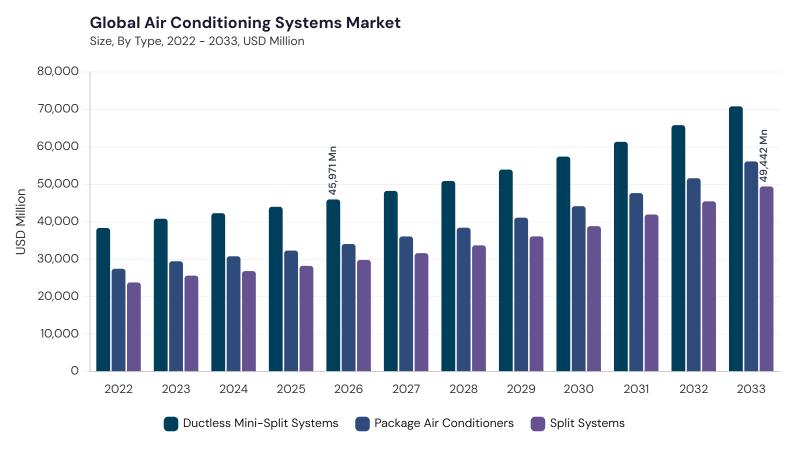
Based on Type, the market is segmented into Ductless Mini-Split Systems, Package Air Conditioners, and Split Systems. The Ductless Mini-Split Systems market dominated the Global Air Conditioning Systems Market by Type in 2025, and would continue to be a dominant market till 2033; thereby, achieving a market value of $70.8 billion by 2033, growing at a CAGR of 6.4 % during the forecast period. The Package Air Conditioners market is expected to witness a CAGR of 7.4% during (2026 - 2033). Additionally, The Split Systems market is expected to witness highest CAGR of 7.5% during (2026 - 2033).
Package Air Conditioners are widely used in commercial buildings, educational institutions, retail spaces, and industrial facilities due to centralized cooling and simplified maintenance. Split Systems continue to sustain strong adoption through reliable performance, cost-effectiveness, established installation practices, and wide availability. Improvements in compressor technologies, smart controls, and energy management are supporting demand across all system types.
Based on End Use, the market is segmented into Residential, Commercial, and Industrial. The Residential market dominated the Global Air Conditioning Systems Market by End Use in 2025, and would continue to be a dominant market till 2033; thereby, achieving a market value of $92.1 billion by 2033, growing at a CAGR of 6.5 % during the forecast period. The Commercial market is expected to witness a CAGR of 7.6% during (2026 - 2033). Additionally, The Industrial market is expected to witness highest CAGR of 7.3% during (2026 - 2033).
Commercial applications are supported by offices, retail stores, hospitality spaces, healthcare facilities, educational buildings, and institutional properties requiring dependable cooling and air management. Industrial demand remains specialized, supported by manufacturing facilities, warehouses, data centers, processing plants, and controlled environments where temperature regulation supports equipment protection, process stability, and operational continuity.
Free Valuable Insights: Air Conditioning Systems Market Size to reach $176.4 Billion by 2033
Region-wise, the Air Conditioning Systems Market is analyzed across North America, Europe, Asia Pacific, and LAMEA. The Asia Pacific market dominated the Global Air Conditioning Systems Market by Region in 2025, and would continue to be a dominant market till 2033; thereby, achieving a market value of $83.3 billion by 2033, growing at a CAGR of 7.5% during the forecast period. The North America market is expected to witness a CAGR of 5.9% during (2026 - 2033). Additionally, The Europe market is expected to witness a CAGR of 6.4% during (2026 - 2033).
Asia Pacific is gaining strong momentum due to rapid urban expansion, rising household income, hot and humid climates, residential construction growth, commercial real estate development, and broad adoption of cooling solutions. LAMEA is supported by infrastructure development, increasing climate variability, expanding urbanization, energy-efficiency regulations, and rising cooling requirements across residential, commercial, and industrial applications.
| Report Attribute | Details |
|---|---|
| Market size value in 2026 | USD 109.8 billion |
| Market size forecast in 2033 | USD 176.4 billion |
| Base Year | 2025 |
| Historical Period | 2022 to 2024 |
| Forecast Period | 2026 to 2033 |
| Revenue Growth Rate | CAGR of 7.0% from 2026 to 2033 |
| Number of Pages | 506 |
| Tables | 570 |
| Report Coverage | Market Trends, Revenue Estimation and Forecast, Segmentation Analysis, Regional and Country Breakdown, Competitive Landscape, Market Share Analysis, Company Profiling, Companies Strategic Developments, SWOT Analysis, Product Life Cycle Analysis, Value Chain Analysis, Market Consolidation Analysis, Key Customer Criteria, Pandemic Impact Analysis, and Winning Imperatives |
| Segments Covered | Technology, Type, End Use, and Geography |
| Country Scope |
|
| Companies Included | Daikin Industries, Ltd.; Midea Group Co., Ltd.; Gree Electric Appliances Inc.; Carrier Global Corporation; Johnson Controls International plc; Trane Technologies plc; LG Electronics Inc.; Mitsubishi Electric Corporation; Samsung Electronics Co., Ltd.; Panasonic Holdings Corporation |
By Technology
By Type
By End Use
By Geography
Expected to reach USD 176.4 billion by 2033, growing at 7.0% CAGR during 2026-2033.
Inverter technology leads, projected to reach USD 117.3 billion by 2033.
Daikin, Midea, Gree, Carrier, Johnson Controls, Trane, LG, Mitsubishi, Samsung, Panasonic dominate the market.
Ductless Mini-Split Systems dominate, expected to hit USD 70.8 billion by 2033.
North America leads, projected to reach USD 38.6 billion by 2033.
Residential demand hits USD 92.1 billion by 2033, driven by urban housing and energy-efficient appliances.
Our team of dedicated experts can provide you with attractive expansion opportunities for your business.








 Unique Offerings