The sample copy of this report is available for access.
The Asia Pacific Air Conditioning Systems Market is expected to reach USD 65.4 billion by 2030, growing at a CAGR of 7.5% during (2026 – 2033).
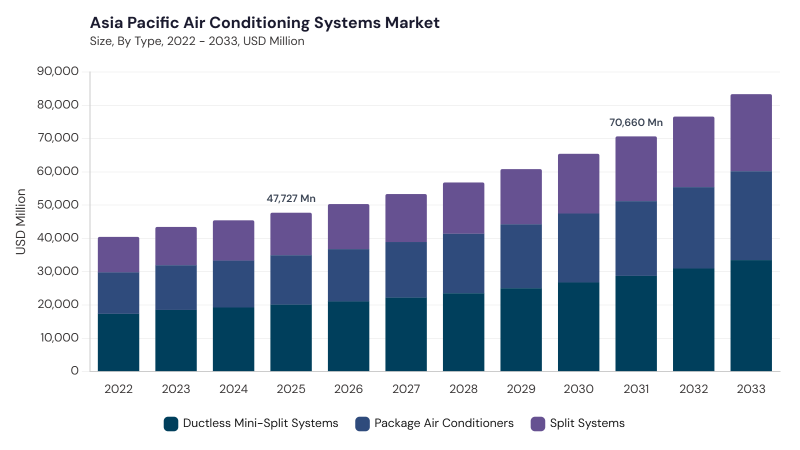
The Asia Pacific Air Conditioning Systems Market developed alongside rapid urbanization, industrial growth, and rising demand for indoor comfort across hot and humid climates. Early adoption relied on basic cooling and refrigeration systems used in homes, offices, and commercial facilities, while later improvements in compressors, refrigerants, and system architecture expanded product efficiency and application range. The shift from single-split units toward multi-split, centralized, and variable refrigerant flow systems helped address the needs of dense cities and large buildings. Environmental regulation also pushed manufacturers toward low-GWP refrigerants such as R32 and R290.
The Asia Pacific Air Conditioning Systems Market is advancing through smart HVAC integration, eco-friendly refrigerant adoption, rising residential penetration, infrastructure expansion, and energy-efficiency upgrades. Manufacturers are adding IoT sensors, AI-based controls, remote diagnostics, predictive maintenance, and modular cooling designs to improve system performance and reduce energy waste. Demand is supported by expanding housing, higher household income, commercial real estate growth, hotels, hospitals, factories, public infrastructure, and data centers. In emerging cities, affordability and durability remain important, while mature markets emphasize connected, quiet, and low-emission systems.
Based on Technology, the market is segmented into Inverter and Non-Inverter. The Inverter market dominated the Asia Pacific Air Conditioning Systems Market by Technology in 2025, and would continue to be a dominant market till 2033; thereby, achieving a market value of USD 43.4 billion by 2030, growing at a CAGR of 7.6 % during the forecast period. The Non-Inverter market is expected to witness a CAGR of 7.1% during (2026 - 2033).
Inverter systems lead due to adaptive compressor operation, reduced electricity consumption, quieter cooling, smoother temperature control, and stronger suitability for extended cooling periods across Asia Pacific climates. These systems are increasingly preferred in urban homes, apartments, offices, hotels, and commercial buildings where users seek comfort, lower utility bills, smart control compatibility, and long-term performance. Government efficiency standards, labeling programs, green building initiatives, and rising electricity costs are further strengthening adoption. Non-Inverter systems remain relevant among value-focused buyers due to economical pricing, simple operation, easier repair, and suitability for intermittent or basic cooling requirements.
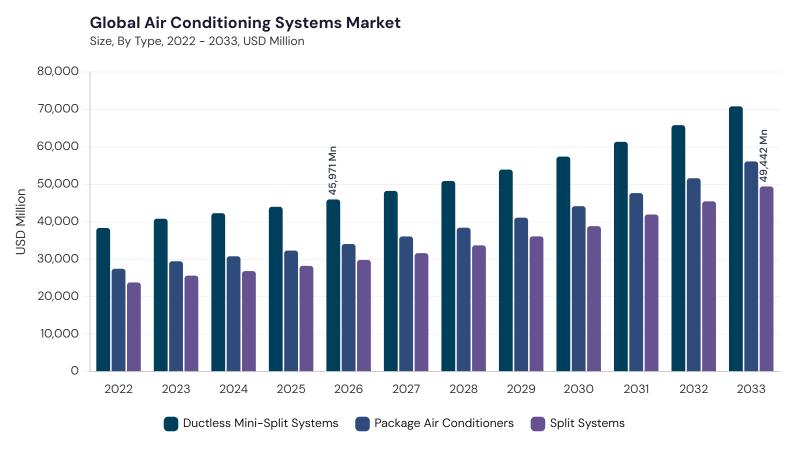
Based on Type, the market is segmented into Ductless Mini-Split Systems, Package Air Conditioners, and Split Systems. The Ductless Mini-Split Systems market dominated the Asia Pacific Air Conditioning Systems Market by Type in 2025, and would continue to be a dominant market till 2033; thereby, achieving a market value of USD 26.8 million by 2030, growing at a CAGR of 6.8 % during the forecast period. The Package Air Conditioners market is expected to witness a CAGR of 7.9% during (2026 - 2033). Additionally, The Split Systems market is expected to witness highest CAGR of 8% during (2026 - 2033).
Ductless Mini-Split Systems lead because they offer easy installation, zonal cooling, compact design, efficient room-level comfort, and strong suitability for apartments, compact homes, small offices, and buildings where duct installation is limited or costly. Their popularity is supported by dense urban housing, retrofit activity, smart controls, and inverter-based performance improvements. Package Air Conditioners remain important in commercial complexes, retail facilities, schools, hospitality buildings, and sites requiring compact equipment placement with simplified maintenance. Split Systems maintain steady adoption across households and small businesses due to their familiar indoor-outdoor configuration, efficient cooling, installer acceptance, and broad consumer familiarity.
Based on End Use, the market is segmented into Residential, Commercial, and Industrial. Residential leads due to rising urban housing demand, apartment cooling needs, home appliance upgrades, lifestyle improvement, smart home adoption, and growing consumer focus on indoor comfort. Demand is strong in countries with hot climates, growing middle-class populations, and increasing preference for energy-efficient home cooling solutions.
Commercial adoption is supported by offices, malls, hotels, restaurants, hospitals, airports, schools, and mixed-use developments that require dependable cooling and operational continuity. Industrial applications remain specialized across manufacturing plants, warehouses, cleanrooms, data centers, food processing sites, and production environments where temperature control supports equipment protection and process stability.
Free Valuable Insights: The Global Air Conditioning Systems Market will hit USD 176.4 Billion billion by 2033, at a CAGR of 7.0%
Based on Country, the market is segmented into China, Japan, India, South Korea, Singapore, Malaysia, and Rest of Asia Pacific. The China market dominated the Asia Pacific Air Conditioning Systems Market by Country in 2025, and would continue to be a dominant market till 2033; thereby, achieving a market value of USD 22.5 billion by 2030, growing at a CAGR of 6 % during the forecast period. The Japan market is expected to witness a CAGR of 6.6% during (2026 - 2033). Additionally, The India market is expected to witness a CAGR of 8.2% during (2026 - 2033).
China leads due to large residential demand, domestic manufacturing strength, smart AC adoption, energy-efficiency regulations, and growing demand from tier-2 and tier-3 cities. Japan supports the market through compact system design, inverter technology, heat pump integration, IoT-enabled controls, and strong focus on energy performance. India is growing through rapid urbanization, rising income levels, domestic manufacturing expansion, inverter adoption, smart cooling features, and demand from tier-2 and tier-3 cities. South Korea, Singapore, and Malaysia add momentum through smart buildings, efficient refrigerants, connected HVAC systems, tropical cooling demand, and commercial upgrades, while Rest of Asia Pacific benefits from urban expansion and rising cooling penetration.

By Technology
By Type
By End Use
By Country
Set to reach USD 65.4 billion by 2033, growing at 7.5% CAGR during 2026-2033.
China leads with USD 22.5 billion by 2030, growing at 6% CAGR during the forecast period.
The Inverter technology segment dominates, reaching USD 43.4 billion by 2030 at 7.6% CAGR during the forecast period.
Ductless Mini-Split Systems reach USD 26.8 million by 2030, growing at 6.8% CAGR during the forecast period.
The India market is expected to witness a CAGR of 8.2% during 2026-2033.
The Split Systems market is expected to witness the highest CAGR of 8% during 2026-2033.
Our team of dedicated experts can provide you with attractive expansion opportunities for your business.




 Unique Offerings