The LAMEA GPU Liquid Cooling Market is expected to reach USD 931.9 million by 2029, growing at a CAGR of 26.4% during (2026 – 2033).
GPU liquid cooling across LAMEA evolved from conventional air-based thermal management into specialized liquid cooling infrastructure supporting AI, HPC, cloud, and GPU-intensive computing. Rising GPU density and thermal output exposed the limitations of traditional cooling, encouraging adoption of direct-to-chip, immersion, and advanced liquid-loop systems. Regional climatic conditions, energy constraints, sovereign data requirements, and expanding AI workloads further accelerated this transition. The market is increasingly characterized by localized, scalable, energy-efficient cooling architectures designed for high-density computing environments.
Energy efficiency, sovereign computing, AI infrastructure expansion, and modular cooling are shaping current market development. Operators are adopting liquid cooling to reduce dependence on energy-intensive air conditioning while supporting increasingly dense GPU clusters. Data localization requirements are encouraging development of on-premise and regionally controlled GPU environments, while modular systems enable phased infrastructure expansion. Eco-friendly coolants, closed-loop designs, intelligent monitoring, and AI-driven thermal management are also strengthening reliability, sustainability, and operational efficiency across emerging regional data centers.
Based on Cooling Type, the market is segmented into Single-Phase and Two-Phase. The Single-Phase market dominated the LAMEA GPU Liquid Cooling Market by Cooling Type in 2025, and would continue to be a dominant market till 2033; thereby, achieving a market value of USD 700.1 million by 2029, growing at a CAGR of 26 % during the forecast period. The Two-Phase market is expected to witness a CAGR of 27.7% during (2026 - 2033).
Single-Phase cooling circulates coolant without phase change, offering relatively straightforward installation, maintenance, and integration across enterprise, edge, and data center environments. Modular cooling loops, improved pumps, advanced coolants, and corrosion-resistant materials are enhancing efficiency and reliability. Two-Phase cooling uses vaporization and condensation to achieve greater heat-transfer performance and lower thermal resistance. Its relevance is increasing for extremely dense AI clusters, hyperscale computing, and advanced HPC applications, although higher technical complexity and infrastructure requirements can limit broader adoption.
Based on Cooling Level, the market is segmented into Component-Level Cooling and Server Rack-Level Cooling. The Component-Level Cooling market dominated the LAMEA GPU Liquid Cooling Market by Cooling Level in 2025, and would continue to be a dominant market till 2033; thereby, achieving a market value of USD 587.1 million by 2029, growing at a CAGR of 26 % during the forecast period. The Server Rack-Level Cooling market is expected to witness a CAGR of 27.1% during (2026 - 2033).
Component-Level Cooling applies cold plates, direct-to-chip systems, and localized liquid loops directly to GPUs and related heat-intensive components, improving thermal stability and sustained performance. Its modular structure supports AI workstations, specialized computing nodes, edge installations, and smaller data centers. Server Rack-Level Cooling manages aggregated heat across multiple GPU servers through centralized coolant distribution, integrated loops, and immersion architectures. Expansion of purpose-built AI facilities and rack-scale computing is gradually increasing demand for scalable infrastructure-level liquid cooling.
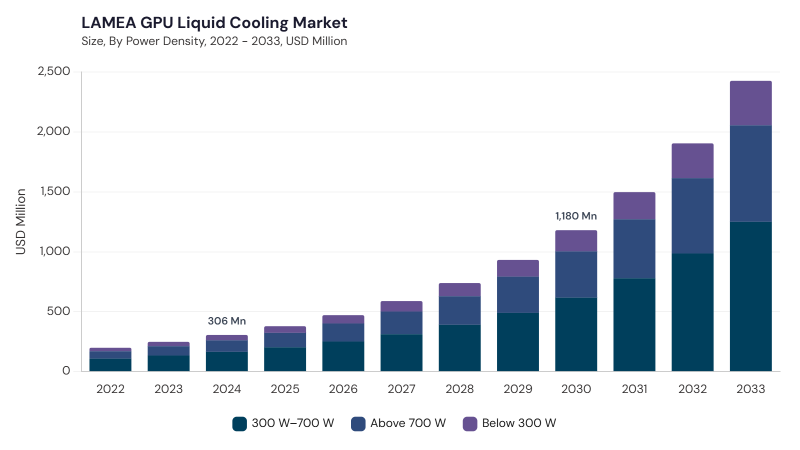
Based on Power Density, the market is segmented into 300 W–700 W, Above 700 W, and Below 300 W. The 300 W–700 W segment increasingly requires advanced direct liquid cooling to manage sustained GPU workloads without thermal throttling. Above 700 W addresses high-performance accelerators, AI training clusters, and advanced computational installations where immersion, two-phase, and high-capacity direct-to-chip systems become more important.
Below 300 W supports compact inference systems, visualization, gaming, edge applications, and localized GPU deployments where liquid cooling can improve reliability, acoustic performance, temperature stability, and energy efficiency.
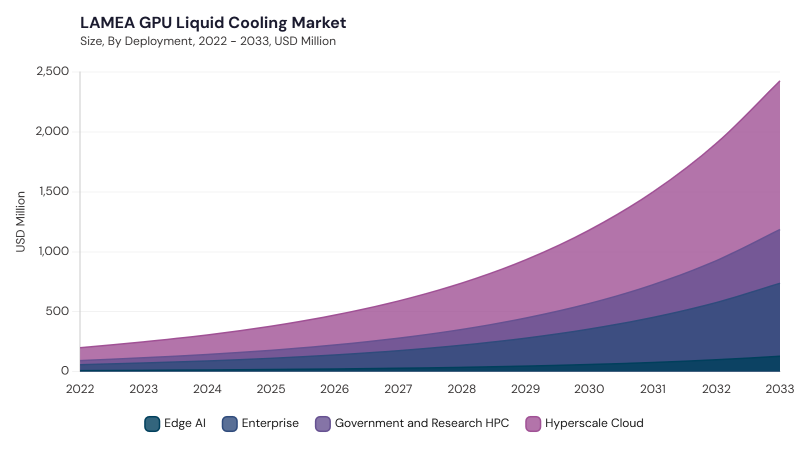
Based on Deployment, the market is segmented into Hyperscale Cloud, Enterprise, Government and Research HPC, and Edge AI. Hyperscale Cloud facilities require scalable liquid cooling for large GPU clusters supporting AI, cloud services, and high-performance workloads. Enterprise adoption is expanding across telecommunications, finance, energy, industrial automation, analytics, and private AI infrastructure.
Government and Research HPC utilizes advanced cooling for scientific modeling, petroleum exploration, climate research, academia, and public-sector computing programs. Edge AI remains an emerging segment requiring compact and resilient cooling for industrial sites, transportation, surveillance, mining, telecom nodes, and distributed real-time processing.
Free Valuable Insights: GPU Liquid Cooling Market Size Worth USD 37.2 Billion billion by 2033
Based on Country, the market is segmented into Brazil, Argentina, UAE, Saudi Arabia, South Africa, Nigeria, and Rest of LAMEA. The Brazil market dominated the LAMEA GPU Liquid Cooling Market by Country in 2025, and would continue to be a dominant market till 2033; thereby, achieving a market value of USD 241.1 million by 2029, growing at a CAGR of 24.8 % during the forecast period. The Argentina market is expected to witness a CAGR of 28.1% during (2026 - 2033). Additionally, The UAE market is expected to witness a CAGR of 25.4% during (2026 - 2033).
Across LAMEA, GPU liquid cooling adoption is advancing through AI infrastructure growth, sustainability requirements, localized engineering, and higher computing densities. Brazil is expanding direct-to-chip, two-phase, and energy-efficient cooling for AI and data centers, while Argentina emphasizes sustainable systems, intelligent monitoring, and modular architectures. The UAE is progressing through AI data centers, warm-water cooling, localized deployments, and advanced thermal controls, whereas Saudi Arabia is strengthening direct liquid cooling, sovereign AI infrastructure, and energy-efficient data centers. South Africa is modernizing facilities through direct-to-chip, immersion, and hybrid technologies, while Nigeria is developing scalable liquid cooling for AI, edge computing, and expanding digital infrastructure. Rest of LAMEA continues to adopt modular, eco-friendly, AI-managed, and regionally customized cooling systems.

By Cooling Type
By Cooling Level
By Power Density
By Deployment
By Country
Set to reach $931.9 Million by 2029, growing at 26.4% CAGR during (2026–2033).
Brazil leads with $241.1 million by 2029, growing at a CAGR of 24.8% during the forecast period.
Rising demand for advanced cooling technologies in high-performance computing drives growth.
Single-Phase segment to reach $700.1 million by 2029, growing at a CAGR of 26% during the forecast period.
The UAE market is expected to witness a CAGR of 25.4% during (2026–2033).
Component-Level Cooling to reach $587.1 million by 2029, growing at a CAGR of 26% during the forecast period.
Our team of dedicated experts can provide you with attractive expansion opportunities for your business.




 Unique Offerings