The sample copy of this report is available for access.
The Asia Pacific GPU Liquid Cooling Market is expected to reach USD 7.3 billion by 2030, growing at a CAGR of 25% during (2026 – 2033).
GPU liquid cooling across Asia Pacific evolved from niche HPC applications into essential infrastructure for AI, cloud computing, and GPU-intensive data centers. Rising processor density and thermal output exposed the limitations of conventional air cooling, accelerating direct-to-chip, immersion, and advanced liquid-loop adoption. Expansion of hyperscale facilities, AI infrastructure, and edge computing further strengthened demand. Improvements in coolant technology, modular architectures, monitoring systems, and localized engineering have moved liquid cooling toward broader commercial deployment across the region.
AI workload expansion, sustainability requirements, higher GPU densities, and modular infrastructure are shaping current market development. Direct-to-chip cooling is gaining adoption for localized heat removal, while immersion and two-phase systems are becoming relevant for extreme thermal loads. Closed-loop systems and advanced coolants support lower energy and water consumption, aligning with environmental objectives. Modular cooling architectures are also allowing operators to scale GPU capacity more flexibly, while intelligent monitoring and adaptive controls improve reliability, thermal efficiency, and lifecycle management.
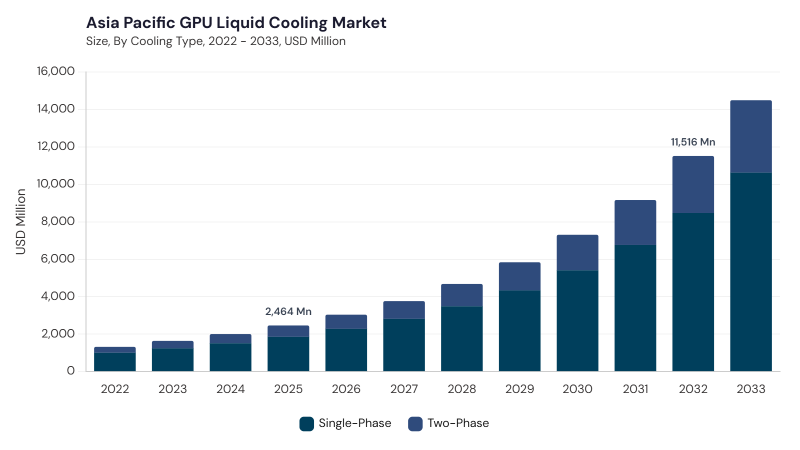
Based on Cooling Type, the market is segmented into Single-Phase and Two-Phase. The Single-Phase market dominated the Asia Pacific GPU Liquid Cooling Market by Cooling Type in 2025, and would continue to be a dominant market till 2033; thereby, achieving a market value of USD 5.4 billion by 2030, growing at a CAGR of 24.6 % during the forecast period. The Two-Phase market is expected to witness a CAGR of 26.2% during (2026 - 2033).
Single-Phase cooling circulates coolant without phase change and supports enterprise, cloud, and HPC environments requiring dependable thermal management with relatively simple maintenance. Direct-to-chip cold plates, improved coolant formulations, and modular designs strengthen integration with existing infrastructure. Two-Phase cooling uses phase-change heat transfer to manage substantially higher thermal loads with lower coolant-flow requirements. Its role is expanding in hyperscale AI facilities and advanced accelerator deployments where extreme GPU power densities demand compact, high-efficiency cooling architectures.
Based on Cooling Level, the market is segmented into Component-Level Cooling and Server Rack-Level Cooling. The Component-Level Cooling market dominated the Asia Pacific GPU Liquid Cooling Market by Cooling Level in 2025, and would continue to be a dominant market till 2033; thereby, achieving a market value of USD 4.5 billion by 2030, growing at a CAGR of 24.6 % during the forecast period. The Server Rack-Level Cooling market is expected to witness a CAGR of 25.6% during (2026 - 2033).
Component-Level Cooling applies cold plates, direct-to-chip systems, and other localized thermal solutions directly to GPUs and related heat-intensive components, improving temperature control and hardware reliability. It is particularly relevant for AI training nodes, HPC systems, and high-density compute environments. Server Rack-Level Cooling manages aggregated thermal loads across complete racks through integrated coolant distribution units, liquid loops, rear-door exchangers, or immersion systems. Growing deployment of prefabricated AI modules and dense GPU racks is strengthening demand for scalable rack-level infrastructure.
Based on Power Density, the market is segmented into 300 W–700 W, Above 700 W, and Below 300 W. The 300 W–700 W category represents a major application range for direct-to-chip and hybrid liquid cooling as AI and HPC workloads generate increasingly concentrated thermal loads.
Above 700 W serves next-generation GPUs, large language model training platforms, hyperscale clusters, and advanced scientific computing where immersion and high-capacity liquid cooling become increasingly important. Below 300 W supports specialized graphics, edge inference, compact servers, and lower-intensity computing applications where simpler liquid cooling can improve thermal stability, reliability, and energy efficiency.
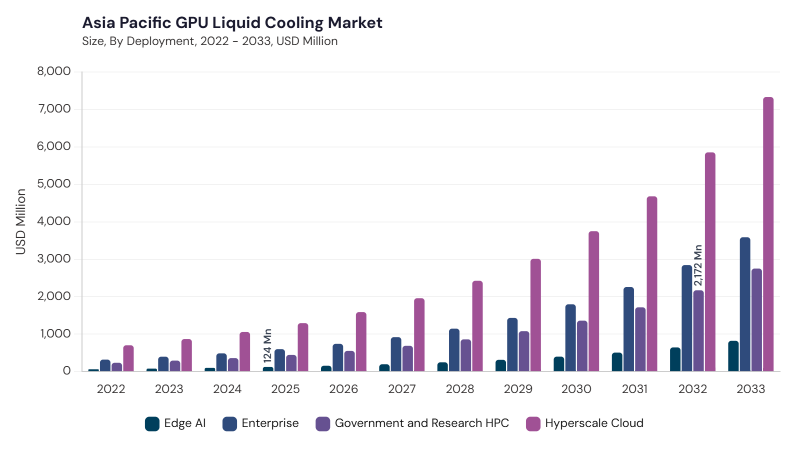
Based on Deployment, the market is segmented into Hyperscale Cloud, Enterprise, Government and Research HPC, and Edge AI. Hyperscale Cloud facilities require scalable direct-to-chip and immersion cooling to support massive GPU clusters while improving energy efficiency and hardware utilization. Enterprise deployments increasingly adopt modular solutions for AI development, analytics, automation, and specialized computing without complete infrastructure redesign.
Government and Research HPC facilities use precision liquid cooling for supercomputing, climate modeling, scientific research, and sovereign computing initiatives. Edge AI remains an emerging deployment area requiring compact and reliable cooling for smart factories, robotics, telecom nodes, surveillance, and real-time machine vision.
Free Valuable Insights: GPU Liquid Cooling Market is Predicted to reach USD 37.2 Billion billion by 2033, at a CAGR of 24.5%
Based on Country, the market is segmented into China, Japan, India, South Korea, Singapore, Taiwan, and Rest of Asia Pacific. The China market dominated the Asia Pacific GPU Liquid Cooling Market by Country in 2025, and would continue to be a dominant market till 2033; thereby, achieving a market value of USD 1.9 billion by 2030, growing at a CAGR of 22.8 % during the forecast period. The Japan market is expected to witness a CAGR of 24.1% during (2026 - 2033). Additionally, The India market is expected to witness a CAGR of 26.3% during (2026 - 2033).
Across Asia Pacific, GPU liquid cooling adoption is advancing through AI infrastructure expansion, sustainability programs, localization, and higher computing densities. China is progressing through direct-to-chip systems, immersion cooling, domestic GPU development, and high-density AI facilities, while Japan emphasizes scalable cooling, dielectric fluids, energy efficiency, and hardware-provider collaboration. India is expanding modular direct-to-chip systems for hyperscale and edge data centers, whereas South Korea is advancing hybrid architectures, high-density rack cooling, and next-generation thermal technologies. Singapore prioritizes energy-efficient AI data centers and scalable cooling, while Taiwan leverages its integrated semiconductor and server ecosystem to develop cold plates, CDUs, rack-scale platforms, immersion systems, and advanced phase-change technologies. Rest of Asia Pacific continues to expand modular, sustainable, and intelligent liquid cooling for increasingly diverse GPU-intensive applications.

By Cooling Type
By Cooling Level
By Power Density
By Deployment
By Country
Set to reach $7.3 Billion by 2030, growing at 25% CAGR during 2026-2033.
China leads with a market value of USD 1.9 billion by 2030, growing at 22.8% CAGR during the forecast period.
Rising demand for advanced cooling solutions in high-performance computing drives growth.
Single-Phase segment will reach USD 5.4 billion by 2030, growing at 24.6% CAGR during the forecast period.
India is expected to witness a CAGR of 26.3% during 2026-2033.
Component-Level Cooling will reach USD 4.5 billion by 2030, growing at 24.6% CAGR during the forecast period.
Our team of dedicated experts can provide you with attractive expansion opportunities for your business.




 Unique Offerings