The sample copy of this report is available for access.
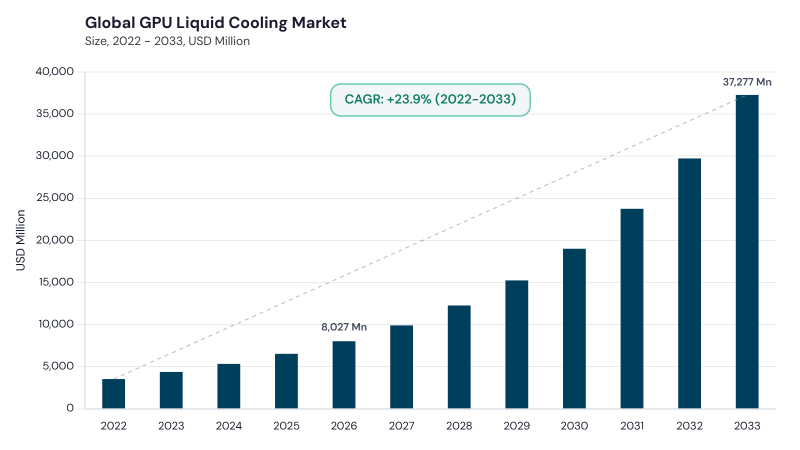
“Global GPU Liquid Cooling Market to reach a market value of USD 37,276.67 Million by 2033 growing at a CAGR of 24.5%”
The Global GPU Liquid Cooling Market is expected to reach USD 37.2 billion by 2033, growing at a CAGR of 24.5% during (2026 – 2033).
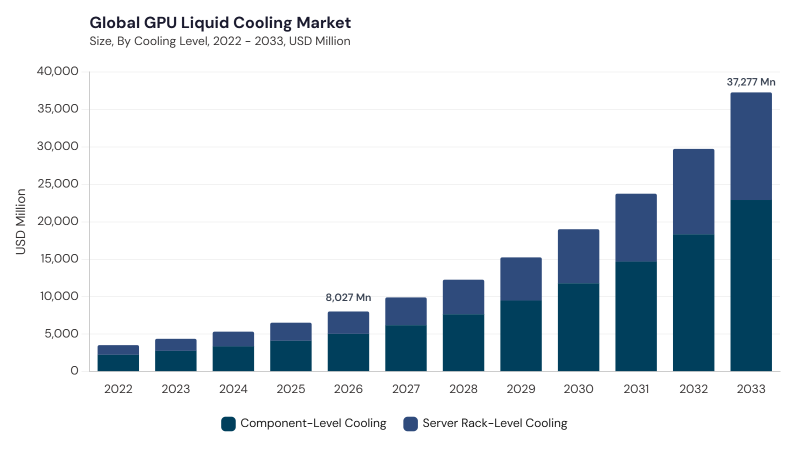
GPU liquid cooling market is witnessing growth supported by growing demand for higher computing density, efficient thermal management, reliable GPU performance, reduced operating temperatures, and lower energy consumption. Rising generative AI workloads, hyperscale data center expansion, rack-scale GPU deployments, and pressure to enhance power usage effectiveness are supporting market adoption. Market demand is accelerating for direct-to-chip cooling, coolant distribution units, immersion cooling, modular designs, leak detection, and energy-efficient thermal architectures. The market emerged as highly powerful GPUs created heat loads beyond the limits of conventional air-cooling systems. GPU infrastructure relied mainly on-air cooling for AI workloads, graphics processing, high-performance computing applications, and scientific simulations.
GPU liquid cooling market is experiencing strong expansion as HPC, AI, cloud, and enterprise workloads largely depend on dense GPU cluster that generate high thermal loads. Liquid cooling helps operators enhance hardware reliability, reduce thermal throttling, lower cooling-related power consumption, and support higher rack densities. Furthermore, the market growth is driven by the shift from retrofit cooling toward rack-scale designs, and integrated server, where CDUs, cold plates, monitoring systems, and facility-side heat rejection are planned together. Market is further benefiting from scalable and modular solutions that help new and existing data centers transition toward liquid-cooled GPU infrastructure.
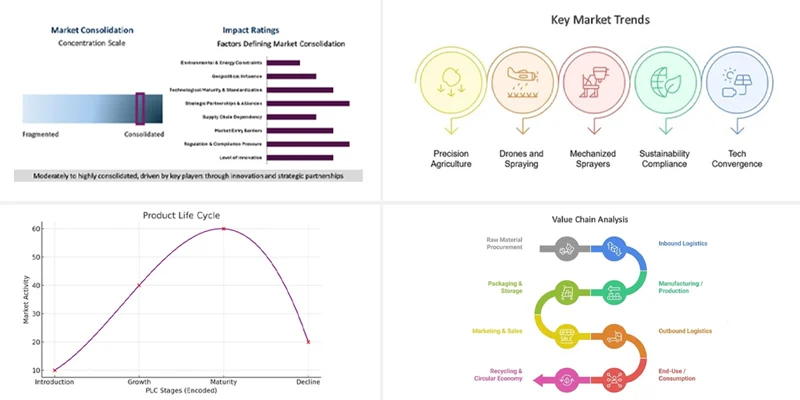
GPU liquid cooling market is innovation-driven and moderately fragmented with competition driven by liquid cooling specialists, thermal management providers, integrated server vendors, data center infrastructure companies, and rack-scale AI infrastructure suppliers. Market players compete through coolant distribution performance, cold plate efficiency, modularity, leak prevention, AI-driven monitoring, deployment support, direct-to-chip integration, compatibility with next-generation GPU platforms, and immersion capability. Market competition relies on advanced materials, complete cooling ecosystems, facility-level integration, scalable CDUs, energy optimization, and the capability to support largely powerful GPU architectures.

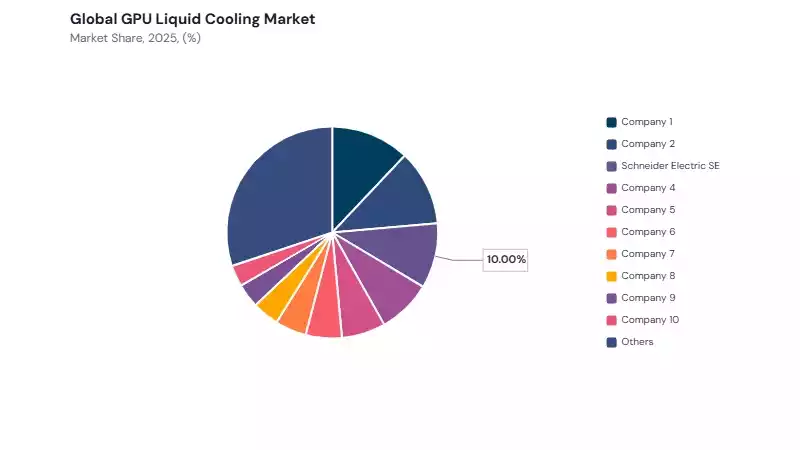
Competition in GPU liquid cooling market led by Schneider Electric, Vertiv Holdings, CoolIT Systems, Boyd Corporation, Super Micro Computer, and nVent Electric. Vertiv leads through end-to-end thermal infrastructure, while CoolIT holds a strong specialist position in direct-to-chip cooling, Schneider Electric support the market through liquid cooling, controls, power, and AI factory infrastructure. Boyd, Supermicro, Modine, Delta Electronics, Rittal, and LiquidStack further strengthens competition through cold plates, GPU server integration, immersion cooling, CDUs, high-density data center cooling solutions, and rack infrastructure.
Based on Cooling Type, the market is segmented into Single-Phase and Two-Phase. The Single-Phase market dominated the Global GPU Liquid Cooling Market by Cooling Type in 2025, and would continue to be a dominant market till 2033; thereby, achieving a market value of USD 27.2 billion by 2033, growing at a CAGR of 24.1 % during the forecast period. The Two-Phase market is expected to witness a CAGR of 25.7% during (2026 - 2033).
Single-Phase leads the market due to its mature cold-plate systems, relatively simple coolant circulation, easier serviceability, and compatibility with existing data center designs. It is widely used across AI, HPC, cloud, and enterprise GPU deployments where stable heat removal and operational reliability are essential. Two-Phase cooling is gaining attention as GPU power density rises and thermal loads become harder to manage through conventional approaches. Its stronger heat-transfer capability, phase-change mechanism, dielectric fluids, and evaporative cooling potential make it attractive for future high-density accelerator environments.
Based on Cooling Level, the market is segmented into Component-Level Cooling and Server Rack-Level Cooling. The Component-Level Cooling market dominated the Global GPU Liquid Cooling Market by Cooling Level in 2025, and would continue to be a dominant market till 2033; thereby, achieving a market value of USD 22.9 billion by 2033, growing at a CAGR of 24.2 % during the forecast period. The Server Rack-Level Cooling market is expected to witness a CAGR of 25.1% during (2026 - 2033).
Component-Level Cooling dominates the market as data center operators require direct heat extraction from GPUs, processors, memory, voltage regulators, and other high-heat components. Cold plates and targeted cooling technologies improve thermal efficiency and allow GPUs to operate more reliably under intense workloads. Server Rack-Level Cooling is expanding as AI and HPC deployments increase rack power density. Integrated coolant distribution units, liquid loops, manifolds, and rack-scale cooling systems are becoming important as operators reduce dependence on conventional air cooling and prepare infrastructure for higher-density GPU clusters.
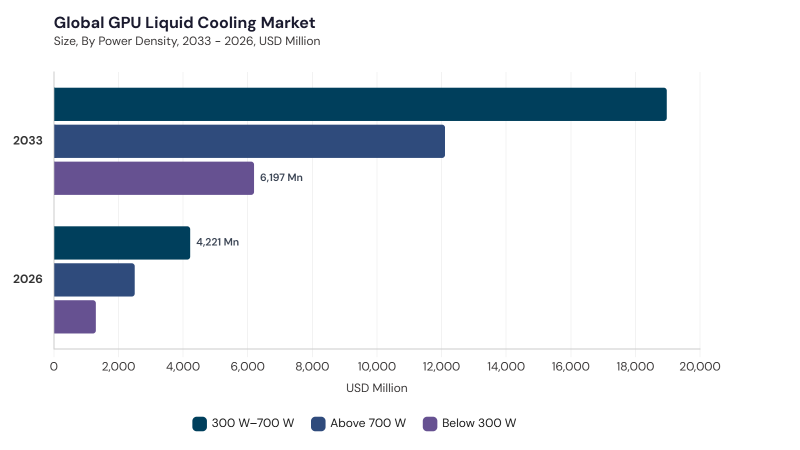
Based on Power Density, the market is segmented into 300 W–700 W, Above 700 W, and Below 300 W. The 300 W–700 W market dominated the Global GPU Liquid Cooling Market by Power Density in 2025, and would continue to be a dominant market till 2033; thereby, achieving a market value of USD 18.9 billion by 2033, growing at a CAGR of 23.9 % during the forecast period. The Above 700 W market is expected to witness a CAGR of 25.2% during (2026 - 2033). Additionally, The Below 300 W market is expected to witness highest CAGR of 25% during (2026 - 2033).
The 300 W–700 W segment leads the market due to the widespread use of high-performance GPUs across AI training, inference, visualization, rendering, and HPC workloads. These deployments require better thermal control than air cooling can provide while still allowing practical liquid-cooling integration. Above 700 W is gaining strong demand as next-generation accelerators, high-density AI servers, and large GPU clusters generate substantially higher heat loads. Below 300 W remains smaller because air cooling continues to be economically viable for many lower-density GPU installations, though liquid cooling can still support stability and noise reduction in specialized use cases.
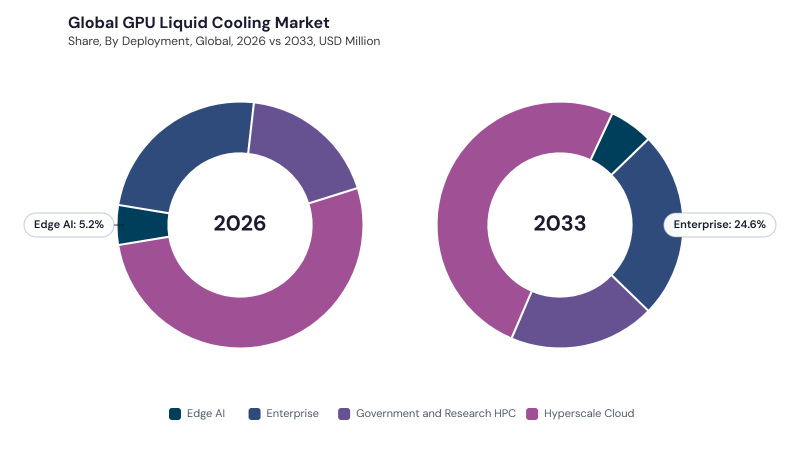
Based on Deployment, the market is segmented into Hyperscale Cloud, Enterprise, Government and Research HPC, and Edge AI. The Hyperscale Cloud market dominated the Global GPU Liquid Cooling Market by Deployment in 2025, and would continue to be a dominant market till 2033; thereby, achieving a market value of USD 18.8 billion by 2033, growing at a CAGR of 23.9 % during the forecast period. The Enterprise market is expected to witness a CAGR of 24.8% during (2026 - 2033). Additionally, The Government and Research HPC market is expected to witness highest CAGR of 25.3% during (2026 - 2033).
Hyperscale Cloud dominates the market due to rapid AI infrastructure expansion, large GPU clusters, and pressure to improve power usage effectiveness while managing rising thermal loads. Enterprise demand is increasing as organizations deploy private AI infrastructure, accelerated computing, analytics, and GPU-based workloads. Government and Research HPC remains important due to supercomputing, simulations, weather modeling, scientific research, and computational workloads requiring high-density GPU environments. Edge AI is emerging as localized inference, robotics, smart factories, telecom edge nodes, and real-time analytics create demand for compact GPU thermal management.
Free Valuable Insights: GPU Liquid Cooling Market Size to reach $37.2 Billion by 2033
Region-wise, the GPU Liquid Cooling Market is analyzed across North America, Europe, Asia Pacific, and LAMEA. In 2025, the North America dominated the GPU liquid cooling market and is estimated to remain dominant till 2033, by gathering a market value of USD 11.3 billion by 2033, expanding at a CAGR of 23.8%. The Europe market is predicted to grow at a CAGR of 24.3% during the forecast period. Moreover, the APAC market is predicted to grow at a CAGR of 25% in the upcoming years.
APAC led the market because of the expanding data center capacity, semiconductor ecosystems, AI computing infrastructure, and investments in high-density HPC and cloud facilities. North America is driven by accelerated computing deployments, hyperscale cloud providers, AI infrastructure expansion, and strong demand for rack-scale GPU cooling. Europe further benefits from data center efficiency needs, HPC investments, sustainability initiatives, and adoption of advanced thermal management technologies. LAMEA is experiencing growth through emerging data center projects, cloud infrastructure development, and rising AI and high-performance computing adoption.
| Report Attribute | Details |
|---|---|
| Market size value in 2026 | USD 8.0 billion |
| Market size forecast in 2033 | USD 37.2 billion |
| Base Year | 2025 |
| Historical Period | 2022 to 2024 |
| Forecast Period | 2026 to 2033 |
| Revenue Growth Rate | CAGR of 24.5% from 2026 to 2033 |
| Number of Pages | 612 |
| Tables | 690 |
| Report Coverage | Market Trends, Revenue Estimation and Forecast, Segmentation Analysis, Regional and Country Breakdown, Competitive Landscape, Market Share Analysis, Company Profiling, Companies Strategic Developments, SWOT Analysis, Product Life Cycle Analysis, Value Chain Analysis, Market Consolidation Analysis, Key Customer Criteria, Pandemic Impact Analysis, and Winning Imperatives |
| Segments Covered | Cooling Type, Cooling Level, Power Density, Deployment, Region |
| Country Scope |
|
| Companies Included | Vertiv Holdings Co., CoolIT Systems Inc., Schneider Electric SE, Super Micro Computer, Inc., Boyd Corporation, nVent Electric plc, Delta Electronics, Inc., Modine Manufacturing Company, LiquidStack, and Rittal GmbH & Co. KG |
By Cooling Type
By Cooling Level
By Power Density
By Deployment
By Geography
Expected to reach USD 37.2 billion by 2033, growing at 24.5% CAGR during 2026-2033.
Single-Phase cooling leads, projected to hit USD 27.2 billion by 2033.
Vertiv Holdings Co., CoolIT Systems Inc., Schneider Electric SE, and Super Micro Computer, Inc.
Asia Pacific leads with a market value of USD 14.4 billion by 2033.
Increasing computational demands from AI and shift towards energy-efficient data center operations.
Hyperscale Cloud segment leads, reaching USD 18.8 billion by 2033.
Our team of dedicated experts can provide you with attractive expansion opportunities for your business.








 Unique Offerings