The sample copy of this report is available for access.
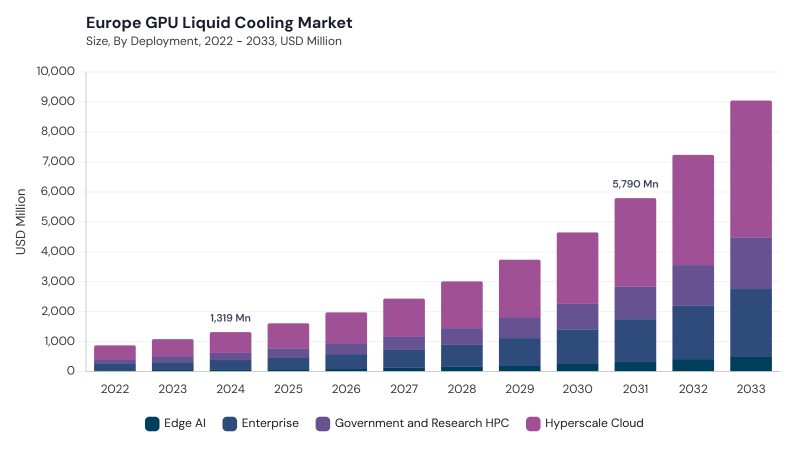
The Europe GPU Liquid Cooling Market is expected to reach USD 5.7 billion by 2031, growing at a CAGR of 24.3% during (2026 – 2033).
GPU liquid cooling across Europe evolved from niche use in scientific computing and telecom facilities into a core thermal-management technology for AI, HPC, and high-density data centers. Rising GPU power densities exposed the limitations of conventional air cooling, accelerating adoption of direct-to-chip and immersion systems. Advances in coolant formulations, heat exchangers, monitoring systems, and modular architectures improved reliability and integration. Increasing regulatory emphasis on energy efficiency and sustainability further supported the transition toward mainstream liquid-cooled GPU infrastructure.
AI workloads, sustainability targets, higher rack densities, and technological advances are reshaping market development. Direct-to-chip cooling is gaining prominence for precise GPU heat removal, while immersion and two-phase technologies are expanding options for extreme thermal loads. Modular and scalable cooling architectures are supporting both new facilities and retrofit deployments. European operators are also prioritizing reduced power consumption, lower cooling footprints, heat reuse potential, and compliance with stringent environmental standards, strengthening liquid cooling’s role across cloud, enterprise, HPC, and edge environments.
Based on Cooling Type, the market is segmented into Single-Phase and Two-Phase. The Single-Phase market dominated the Europe GPU Liquid Cooling Market by Cooling Type in 2025, and would continue to be a dominant market till 2033; thereby, achieving a market value of USD 4.2 billion by 2031, growing at a CAGR of 23.9 % during the forecast period. The Two-Phase market is expected to witness a CAGR of 25.4% during (2026 - 2033).
Single-Phase cooling circulates coolant without phase change, providing stable heat removal, easier maintenance, and compatibility with existing infrastructure. It is widely suited to AI clusters, enterprise systems, and data centers seeking incremental liquid-cooling upgrades. Two-Phase cooling uses coolant evaporation to achieve greater heat-transfer efficiency and compact thermal architectures. Its relevance is increasing for high-flux GPUs, hyperscale AI workloads, and advanced HPC systems, although higher design complexity, coolant considerations, and maintenance requirements can moderate adoption.
Based on Cooling Level, the market is segmented into Component-Level Cooling and Server Rack-Level Cooling. The Component-Level Cooling market dominated the Europe GPU Liquid Cooling Market by Cooling Level in 2025, and would continue to be a dominant market till 2033; thereby, achieving a market value of USD 3.5 billion by 2031, growing at a CAGR of 23.9 % during the forecast period. The Server Rack-Level Cooling market is expected to witness a CAGR of 24.9% during (2026 - 2033).
Component-Level Cooling applies liquid directly to GPUs, processors, memory, and other heat-intensive components using cold plates, cooling blocks, and microchannel designs. This approach reduces hotspots and supports higher performance in AI and HPC systems. Server Rack-Level Cooling manages aggregated thermal loads across multiple GPU servers using coolant distribution units, integrated loops, rear-door heat exchangers, or immersion architectures. Growing rack densities and modular data center designs are increasing demand for scalable rack-level thermal management.
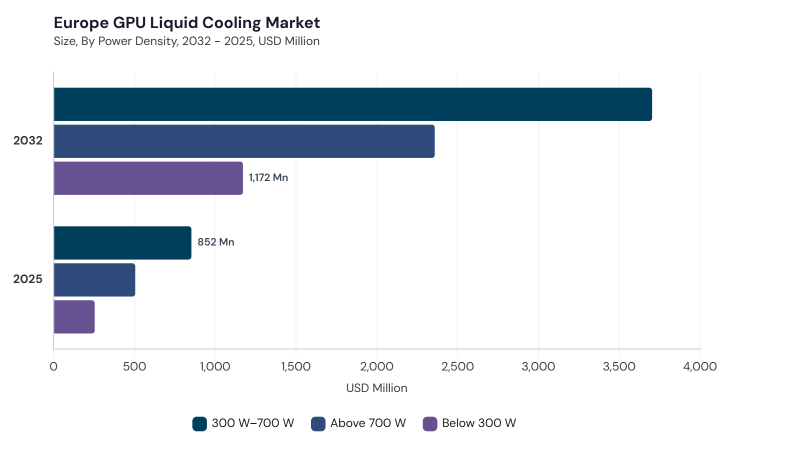
Based on Power Density, the market is segmented into 300 W–700 W, Above 700 W, and Below 300 W. The 300 W–700 W segment increasingly relies on direct-to-chip and hybrid liquid cooling as air-based systems become less effective at managing concentrated heat loads.
Above 700 W represents advanced AI accelerators, supercomputing, and densely packed compute nodes where immersion or high-capacity direct liquid cooling becomes increasingly essential. Below 300 W supports inference hardware, visualization systems, edge computing, and moderate GPU applications where localized liquid cooling can enhance stability, energy efficiency, noise reduction, and compact system design.
Based on Deployment, the market is segmented into Hyperscale Cloud, Enterprise, Government and Research HPC, and Edge AI. Hyperscale Cloud facilities require scalable liquid cooling for large GPU clusters supporting AI, machine learning, cloud services, and high-performance analytics. Enterprise deployments increasingly use modular and retrofit-friendly systems for AI inference, visualization, analytics, and computational workloads.
Government and Research HPC facilities depend on precise thermal management for climate modeling, scientific research, simulations, and supercomputing. Edge AI remains an emerging segment requiring compact, reliable cooling for telecom infrastructure, industrial automation, machine vision, and localized real-time processing.
Free Valuable Insights: The Worldwide GPU Liquid Cooling Market is projected to reach USD 37.2 Billion billion by 2033, at a CAGR of 24.5%
Based on Country, the market is segmented into Germany, UK, France, Russia, Spain, Italy, and Rest of Europe. The Germany market dominated the Europe GPU Liquid Cooling Market by Country in 2025, and would continue to be a dominant market till 2033; thereby, achieving a market value of USD 1.1 billion by 2031, growing at a CAGR of 22.6 % during the forecast period. The UK market is expected to witness a CAGR of 23.2% during (2026 - 2033). Additionally, The France market is expected to witness a CAGR of 25.1% during (2026 - 2033).
Across Europe, GPU liquid cooling adoption is being shaped by AI infrastructure, sustainability mandates, advanced cooling technologies, and rising computing density. Germany is progressing through direct-to-chip systems, intelligent thermal management, modular designs, and energy-efficient data centers, while the UK emphasizes AI workloads, retrofit-friendly systems, sustainable coolants, and scalable cooling architectures. France is advancing sovereign AI infrastructure, immersion cooling, smart monitoring, and energy-efficient data centers, whereas Russia is focusing on localized production, two-phase technologies, AI-based monitoring, and domestic cooling capabilities. Spain is expanding modular direct-to-chip and immersion systems, while Italy is strengthening high-density AI cooling, infrastructure retrofits, automation, and sustainable thermal management. Rest of Europe continues to develop standardized, modular, direct-to-chip, immersion, and scalable cooling systems for AI and high-performance computing.

By Cooling Type
By Cooling Level
By Power Density
By Deployment
By Country
Set to reach $5.7 Billion by 2031, growing at 24.3% CAGR during 2026-2033.
Germany leads with a market value of USD 1.1 billion by 2031, growing at a CAGR of 22.6% during the forecast period.
Rising enterprise cloud adoption and AI-driven workloads are the main catalysts.
Single-Phase segment to reach USD 4.2 billion by 2031, growing at a CAGR of 23.9% during the forecast period.
The France market is expected to witness a CAGR of 25.1% during 2026-2033.
Component-Level Cooling to reach USD 3.5 billion by 2031, growing at a CAGR of 23.9% during the forecast period.
Our team of dedicated experts can provide you with attractive expansion opportunities for your business.




 Unique Offerings