The next phase of digital commerce is beginning to take shape around a fundamental change in how consumers interact with online marketplaces. Instead of simply using search engines, product filters and recommendation systems to find products, consumers are increasingly gaining access to artificial intelligence systems capable of understanding intent, evaluating alternatives and taking actions on their behalf.
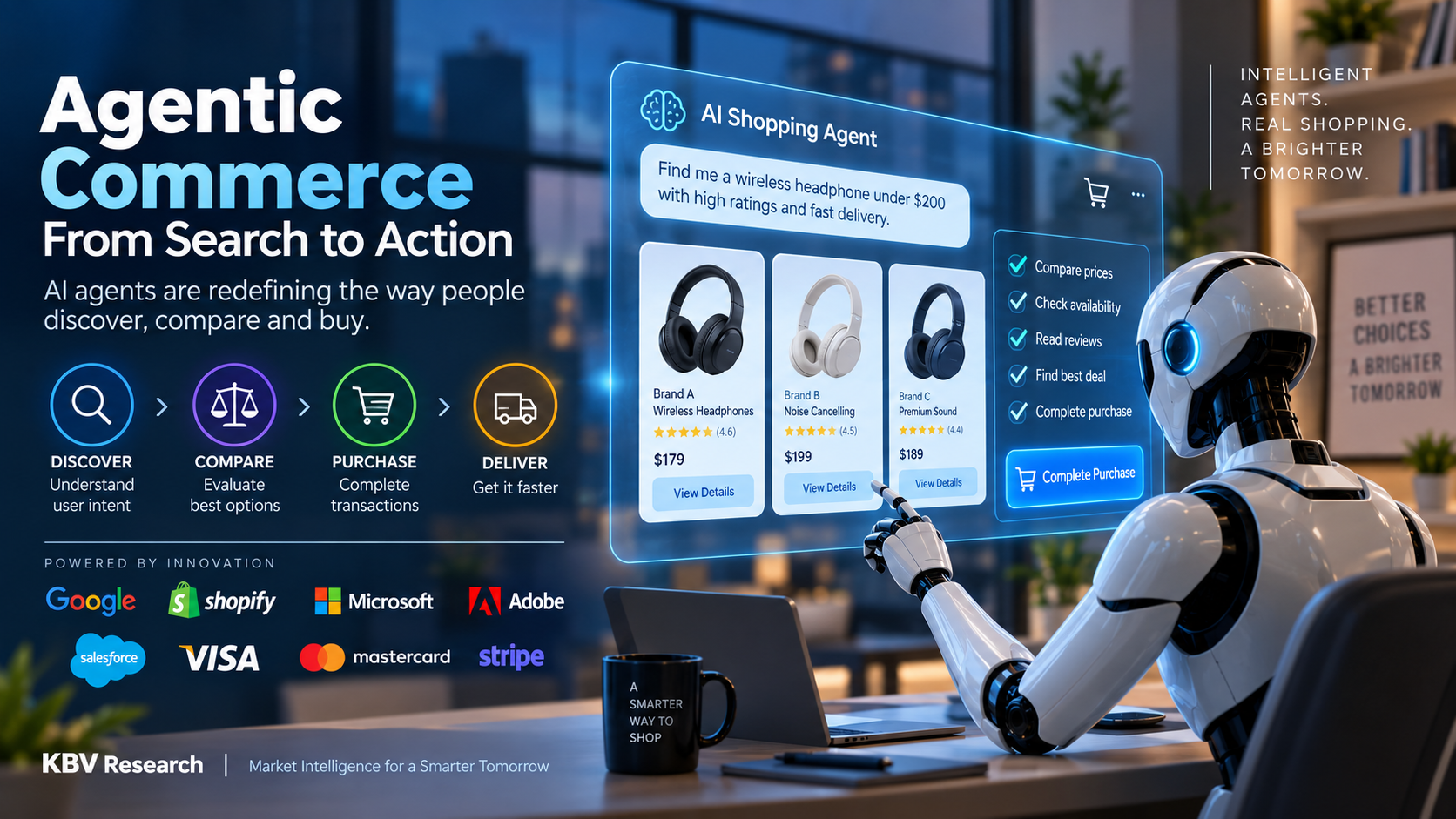
This transition is giving rise to agentic commerce, an emerging model in which autonomous or semi-autonomous AI agents can participate across multiple stages of the purchasing journey. An AI shopping agent could potentially interpret a consumer's requirements, discover relevant products, compare prices and specifications, evaluate availability and delivery conditions, and—with appropriate authorization—participate in completing the transaction.
What makes the development particularly important in 2026 is the speed at which the technological infrastructure surrounding agentic commerce is advancing. AI models are becoming more capable, product information is becoming increasingly machine-readable, new interoperability standards are connecting agents with merchants, and payment companies are developing mechanisms for trusted agent-initiated transactions.
These developments are also intensifying competition among technology, commerce and payment leaders. According to KBV Research's Agentic Commerce Market analysis, the convergence of these technologies is creating a new competitive environment in which technological advancement could become one of the most important strategies for market leadership.
Artificial intelligence is not new to e-commerce. Recommendation engines, predictive analytics, dynamic pricing, fraud detection and automated customer service have been used for years.
Agentic AI introduces a fundamentally different capability: action.
Traditional recommendation systems generally analyze data and suggest products. Generative AI made the interaction more conversational, allowing shoppers to describe requirements in natural language and receive more contextual responses.
AI agents can potentially take the process further by executing multiple steps toward an objective.
Consider a shopper asking an AI system:
"Find a lightweight laptop suitable for business travel, with strong battery life and at least 16 GB of memory, below $1,200, that can arrive before Friday."
A conventional search engine would return links. An e-commerce marketplace might provide filters. A generative AI assistant could recommend several products.
An advanced shopping agent could potentially interpret all of those conditions, search available merchants, compare specifications and prices, check inventory and delivery information, evaluate suitable alternatives and present the strongest choices. When sufficient permissions and payment infrastructure are available, it could move closer to completing the transaction.
The technological evolution can therefore be viewed as:
Search → Recommendation → Conversation → Decision Support → Authorized Action
This transition from assisting decisions to executing them is one of the defining characteristics of agentic commerce.
One of the biggest barriers to large-scale agentic commerce is fragmentation.
AI agents cannot efficiently transact across the digital economy if every merchant, marketplace and agent requires a completely different integration. This makes interoperability an increasingly important competitive battleground.
Google took a significant step in January 2026 with the introduction of the Universal Commerce Protocol (UCP), an open standard co-developed with Shopify and other industry participants.
The protocol is intended to provide common infrastructure through which agents and commerce systems can interact throughout the shopping journey.
Google continued expanding UCP during 2026. New capabilities announced in March included a Cart function allowing agents to work with multiple items from a retailer and a Catalog capability that can retrieve real-time information such as product variants, inventory and pricing.
The strategy demonstrates how agentic commerce is moving beyond AI models themselves. The companies establishing the protocols connecting agents, consumers and merchants could occupy strategically important positions within the emerging ecosystem.
Shopify's strategy illustrates the merchant side of the same transformation.
The company has been positioning its commerce infrastructure so merchants can participate wherever AI-driven product discovery occurs rather than relying exclusively on consumers visiting individual online stores.
In June 2026, Shopify announced that its agentic commerce infrastructure had become self-service for developers. Through UCP and its Catalog API, developers can build agentic experiences spanning product discovery through checkout.
This is strategically important because an AI agent needs structured, reliable commerce information.
Product specifications, variants, prices, availability and other commercial information must be understandable by machines if agents are expected to evaluate competing products accurately.
This introduces a potentially important new dimension to e-commerce optimization.
For years, businesses have invested heavily in SEO to make webpages discoverable and understandable to search engines.
The agentic-commerce era could create a parallel requirement: making products, catalogs and commerce capabilities discoverable and actionable by AI agents.
Businesses with incomplete, inconsistent or inaccessible product information could therefore face a disadvantage even when their products themselves are competitive.
Product discovery represents only part of the agentic-commerce opportunity.
The more transformative development occurs when an AI agent can move from recommending a product to participating in payment.
That requires a completely different level of trust.
Payment systems need to establish whether the AI agent is legitimate, whether the consumer has authorized it, what the agent is allowed to purchase, how much it can spend and whether a particular transaction falls within established permissions.
Recent developments show substantial progress.
In June 2026, Worldline, ING and Mastercard announced a live end-to-end agentic payment transaction in production in Europe. Mastercard subsequently introduced Agent Pay for Machines, designed for permissioned, programmatic transactions executed between systems.
Stripe is also developing infrastructure around agentic transactions. Its Shared Payment Tokens allow agents to initiate authorized payments without exposing underlying payment credentials, while support has been expanded across additional agentic payment methods.
Visa is similarly investing heavily in agentic commerce and payment infrastructure. Recent Visa research also illustrates why trust will remain central to adoption: only 23% of surveyed U.S. consumers said they trusted generative AI itself to handle payment transactions on their behalf, while trust increased substantially when established payment brands were involved.
The implication is significant.
The race in agentic commerce will not be won solely by building the smartest AI agent. It will also require building the most trusted infrastructure around that agent.
Agentic commerce is also moving beyond consumer shopping.
Salesforce is extending Agentforce Commerce around conversational and autonomous commerce experiences, including contextual search capabilities designed to understand natural-language intent rather than relying solely on traditional keywords.
This development points toward a much larger opportunity.
Businesses themselves could become users of commerce agents.
A procurement agent might identify a requirement, evaluate approved suppliers, compare prices, check inventory, confirm purchasing policies and initiate the appropriate procurement workflow.
A merchandising agent could monitor products and market conditions.
Customer-service agents could handle product questions, orders and post-purchase processes.
This creates a progression from Consumer-to-Agent (C2A) interactions toward Business-to-Agent (B2A) and eventually Agent-to-Agent (A2A) commerce.
As enterprise agents become increasingly connected to procurement, inventory, payments and supply chains, agentic commerce could extend well beyond the traditional definition of e-commerce.
Another important competitive strategy is emerging around protocol independence.
Adobe Commerce announced support in 2026 for emerging agentic-commerce standards including UCP and the Agentic Commerce Protocol, building on its support for agent-payment standards.
The strategic significance is that the future commerce environment is unlikely to consist of one AI assistant interacting with one marketplace.
Consumers could use multiple AI systems. Enterprises could operate specialized agents. Merchants could participate across several commerce ecosystems.
Brands therefore need infrastructure that can expose accurate product information and commerce capabilities across different AI environments while maintaining control over customer relationships and commercial data.
Adobe's approach illustrates how interoperability itself is becoming a product capability.
One of the biggest long-term consequences of agentic commerce may occur before checkout—at the product-discovery stage.
Traditional e-commerce competition revolves heavily around human attention.
Retailers invest in search-engine optimization, paid advertising, marketplace rankings, social media, influencer marketing and visually optimized storefronts to attract consumers.
AI shopping agents introduce another decision layer.
Suppose a consumer asks:
"Find the best washing machine under $700 for a family of five, prioritizing energy efficiency, reliability and low operating cost."
The consumer may never manually examine dozens of product pages.
Instead, an AI agent could evaluate structured information across multiple sellers and narrow the market to a few options.
That means retailers could increasingly compete to ensure their products are understood and selected by machines as well as humans.
Accurate specifications, real-time pricing, inventory, delivery information, warranties, return policies, product identifiers and customer feedback could consequently become increasingly important competitive assets.
The emerging competitive landscape shows why the Agentic Commerce Market cannot be viewed simply as another AI software category.
Competition is developing across multiple technological layers.
Google and Shopify are addressing commerce interoperability and merchant connectivity.
Salesforce and Adobe are embedding agentic capabilities into enterprise and digital-commerce infrastructure.
Visa, Mastercard and Stripe are addressing authorization, trust and payments.
Retailers and marketplaces are adapting catalogs and customer experiences for AI-mediated product discovery.
Meanwhile, advances in foundation models, cloud infrastructure, APIs, real-time data and identity technologies continue to strengthen the underlying capabilities available to the entire ecosystem.
The competitive advantage may therefore belong to companies that can connect these layers most effectively rather than those dominating any single component.
Agentic commerce has the potential to change several fundamental aspects of the existing e-commerce model.
Consumers may increasingly describe an objective rather than searching repeatedly using keywords and filters.
AI agents could continuously apply information about budgets, preferences, previous purchases and delivery requirements when evaluating products.
Agents could compare offers across merchants in real time, potentially increasing price transparency and competition.
For routine purchases within predefined permissions, consumers may eventually allow trusted agents to complete transactions without manually navigating every checkout screen.
If agents become major intermediaries in product discovery, retailers may need to invest in agent visibility alongside conventional SEO, advertising and marketplace optimization.
Agents could monitor requirements, inventory levels or prices and initiate commercial actions when predefined conditions are satisfied rather than waiting for a consumer to begin a shopping session.
The strategic question for e-commerce businesses is therefore changing.
Historically, companies asked:
How do we get consumers to discover our website?
Then:
How do we convert those visitors into customers?
Agentic commerce introduces another question:
How do we make sure an AI agent considers and selects our product when acting for the consumer?
This does not mean traditional SEO, branding or customer experience will disappear. Human consumers will remain central to commerce.
However, businesses may increasingly operate in a hybrid environment in which both people and intelligent agents participate in purchasing decisions.
That means product data needs to serve humans and machines. Commerce infrastructure needs to accommodate traditional shoppers and autonomous agents. Payment systems need to support consumer-initiated and agent-initiated transactions.
Companies preparing for both environments could establish an important advantage.
Technological capability alone will not determine adoption.
Consumers need confidence that an AI agent will follow instructions, respect spending limits, protect personal information and select products in their interests rather than being manipulated by hidden commercial incentives.
Merchants need confidence that an agent represents a legitimate customer.
Payment providers need reliable authorization.
Regulators will increasingly examine accountability, privacy, transparency and consumer protection.
Consequently, trust infrastructure could become as important to agentic commerce as AI intelligence itself.
Companies capable of combining sophisticated agents with transparent decision-making, strong authentication and reliable payment controls could be better positioned as the market matures.
The developments taking place across Google, Shopify, Salesforce, Adobe, Visa, Mastercard, Stripe and the wider commerce ecosystem suggest that agentic commerce is moving from experimentation toward increasingly practical infrastructure.
The transformation will not occur overnight.
Initially, AI agents are likely to remain strongest in discovery, research, comparison and transaction preparation. Routine, low-risk purchases could then become increasingly automated as consumers become comfortable defining permissions.
More complex transactions will continue to require greater human involvement.
Over time, however, the interface of commerce itself could change.
Instead of navigating websites, searching marketplaces and comparing products manually, consumers may increasingly express an intention and allow intelligent systems to coordinate much of the journey.
That represents a shift from search-driven commerce toward intent-driven commerce and eventually from assisted commerce toward increasingly autonomous commerce.
For businesses, technological advancement is therefore becoming more than an innovation initiative. It is becoming a competitive strategy.
The companies that make their product information agent-ready, embrace interoperability, establish trusted payment mechanisms and integrate AI throughout the commerce value chain could be best positioned for the next stage of digital commerce.
The competition is no longer simply about who builds the best online store.
It is increasingly about who builds the commerce infrastructure that AI agents choose to interact with.
For detailed market sizing, segmentation, regional analysis, competitive landscape and future growth opportunities, explore the Agentic Commerce Market research from KBV Research.