The sample copy of this report is available for access.
“Global Agentic Commerce Market to reach a market value of USD 60,018.44 Million by 2033 growing at a CAGR of 33.9%”
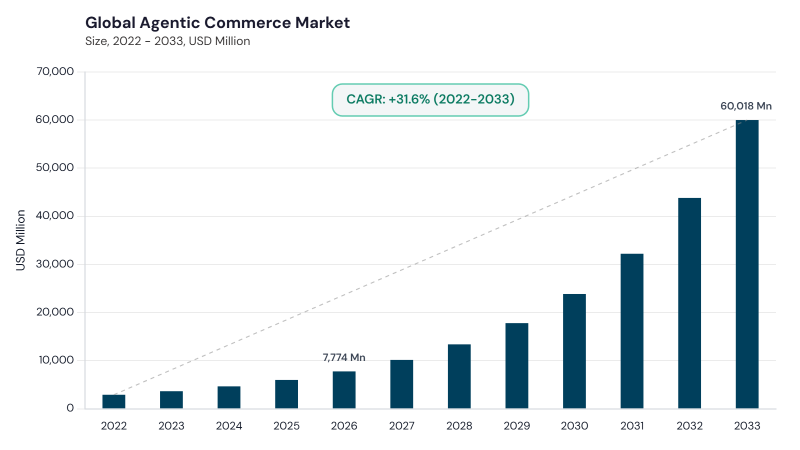
The Global Agentic Commerce Market is expected to reach USD 60.0 billion by 2033, growing at a CAGR of 33.9% during (2026 - 2033).
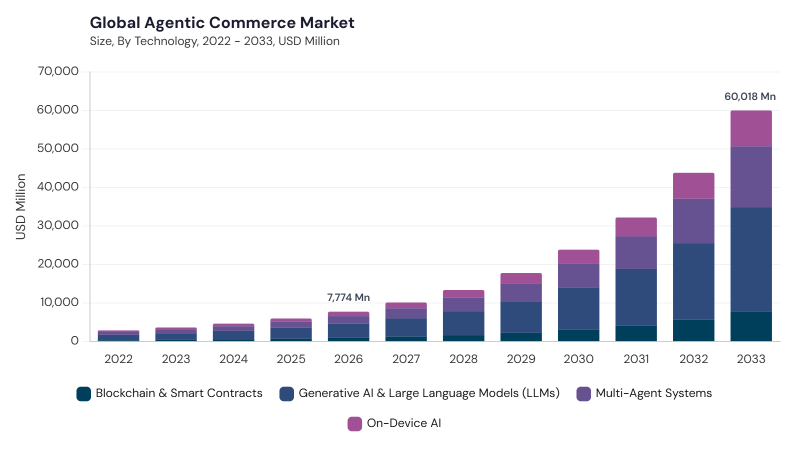
The agentic commerce market is driven by rising adoption of autonomous AI agents across digital payments, online shopping, procurement, customer service, customized commerce applications. Demand is also surging as businesses focus on faster transactions, automated decision-making, secure AI-enabled payments customized product recommendations, and improved customer engagement. The market evolved from the convergence of AI advancements and digital retail innovation. Natural language processing, machine learning, smart payment systems, and generative AI enabled AI agents to decide, understand, and act more independently.
Global market is rising as businesses witness transformation from passive recommendation engines toward proactive AI agents with capabilities of managing end-to-end commerce workflows. These systems enhance transaction efficiency, speed, personalization, and customer engagement across payments, retail, travel, customer support, and procurement. The adoption of interoperable platforms, secure AI agents, smart payment infrastructure, and real-time data analytics is supporting the market expansion.
Competitive environment is segmented and platform-driven, driven by consumer AI assistants, e-commerce marketplaces, cloud providers, specialized transaction infrastructure companies, and enterprise commerce platforms, and payment networks. Market participants compete through agent reliability, payment security, AI autonomy, merchant ecosystem access, compliance capabilities, checkout integration, user experience, and compliance capabilities. Moreover, the market competition is predicted to depend on complete agent-driven journeys from product discovery to post-purchase support.
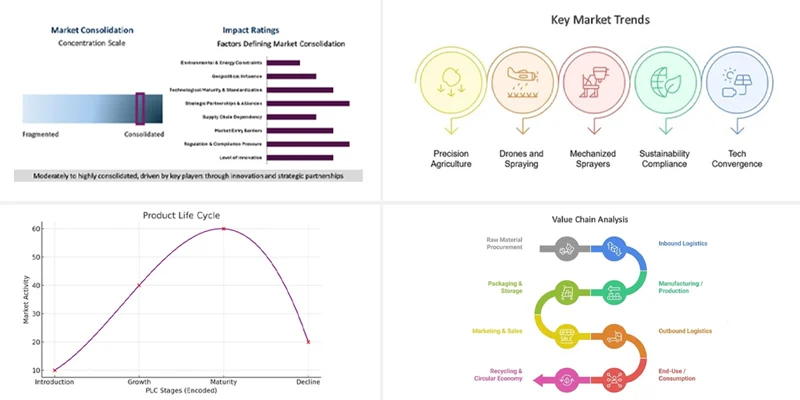

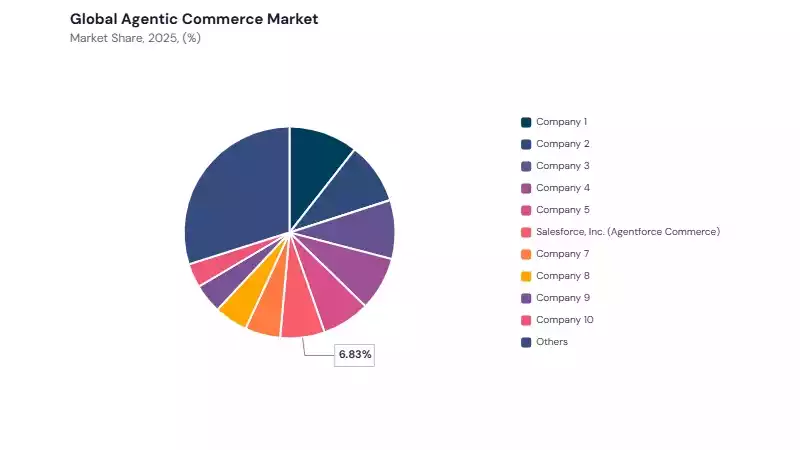
Agentic commerce market represents a moderately consolidated, rapidly evolving, and platform-driven competitive landscape led by AI assistant providers, e-commerce marketplaces, payment infrastructure companies, cloud platforms, and enterprise commerce vendors. Microsoft, OpenAI, Amazon, and Alphabet form the leading competitive market through product discovery interfaces, consumer-facing AI assistants, and agentic transaction capabilities. Salesforce, Stripe, Shopify, Mastercard, Visa, and commerce tools further support market competition through checkout infrastructure, merchant enablement, commerce orchestration, tokenization, payment authentication and enterprise-grade agent connectivity.
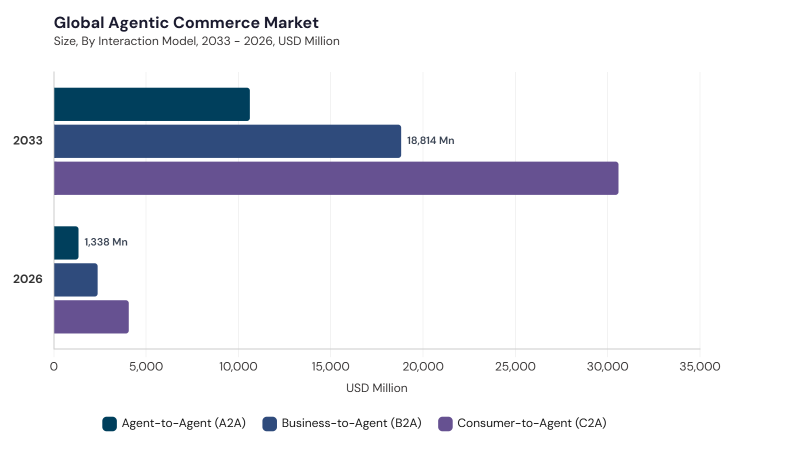
Based on Interaction Model, the market is segmented into Consumer-to-Agent (C2A), Business-to-Agent (B2A), and Agent-to-Agent (A2A). The Consumer-to-Agent (C2A) market dominated the Global Agentic Commerce Market by Interaction Model in 2025, and would continue to be a dominant market till 2033; thereby, achieving a market value of USD 30.6 billion by 2033, growing at a CAGR of 33.4 % during the forecast period. The Business-to-Agent (B2A) market is expected to witness a CAGR of 34.4% during (2026 - 2033). The Agent-to-Agent (A2A) market is expected to witness a CAGR of 34.4% during (2026 - 2033).
Business-to-Agent is gaining adoption as enterprises deploy agentic AI for procurement automation, customer engagement, supplier management, workflow optimization, and operational decision support. Agent-to-Agent remains an emerging model where autonomous agents communicate, negotiate, validate information, and execute transactions across commerce ecosystems. Together, these interaction models show how agentic commerce is moving from consumer assistance toward broader autonomous commercial coordination.
Based on Technology, the market is segmented into Generative AI & Large Language Models (LLMs), Multi-Agent Systems, On-Device AI, and Blockchain & Smart Contracts. The Generative AI & Large Language Models (LLMs) market dominated the Global Agentic Commerce Market by Technology in 2025, and would continue to be a dominant market till 2033; thereby, achieving a market value of USD 27.1 billion by 2033, growing at a CAGR of 33.2 % during the forecast period. The Multi-Agent Systems market is expected to witness a CAGR of 34.2% during (2026 - 2033). Additionally, The On-Device AI market is expected to witness highest CAGR of 34.9% during (2026 - 2033).
Multi-Agent Systems support coordinated decision-making where multiple autonomous agents work together across procurement, supply chain, pricing, and transaction workflows. On-Device AI supports low-latency processing, privacy-focused decision-making, and edge-based personalization. Blockchain & Smart Contracts provide secure, transparent, and automated transaction execution, especially where trust, auditability, identity validation, and decentralized commerce workflows are important.
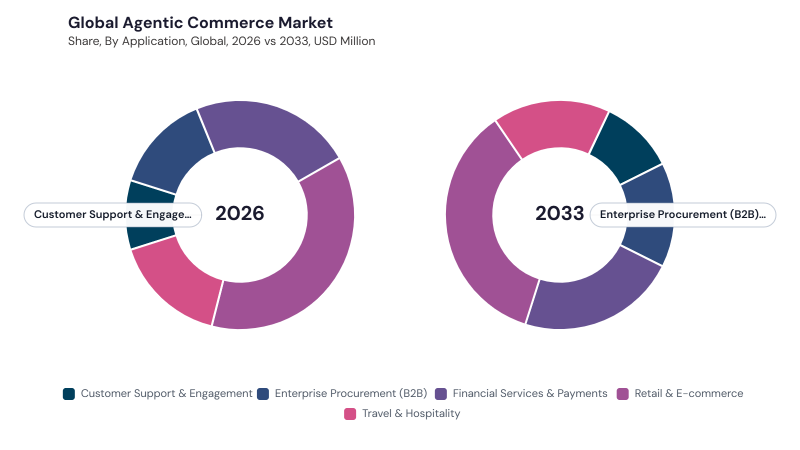
Based on Application, the market is segmented into Retail & E-commerce, Financial Services & Payments, Travel & Hospitality, Enterprise Procurement (B2B), and Customer Support & Engagement. The Retail & E-commerce market dominated the Global Agentic Commerce Market by Application in 2025, and would continue to be a dominant market till 2033; thereby, achieving a market value of USD 21.3 billion by 2033, growing at a CAGR of 33 % during the forecast period. The Financial Services & Payments market is expected to witness a CAGR of 33.6% during (2026 - 2033). Additionally, The Travel & Hospitality market is expected to witness highest CAGR of 34.5% during (2026 - 2033).
Financial Services & Payments are gaining traction as agentic systems support secure transaction execution, payment automation, fraud detection, and real-time risk assessment. Travel & Hospitality uses AI agents for itinerary planning, booking assistance, dynamic pricing, and customer service. Enterprise Procurement benefits from autonomous sourcing, supplier interaction, contract management, and purchasing optimization. Customer Support & Engagement continues growing through conversational AI, virtual assistants, automated query resolution, and proactive customer interaction.
Free Valuable Insights: Agentic Commerce Market Size to reach $60.0 Billion by 2033
Region-wise, the Agentic Commerce Market is analyzed across North America, Europe, Asia Pacific, and LAMEA. The agentic commerce market held the largest share in North America region in 2025, and is predicted to remain dominant during the forecast period with a market value of USD 22.2 billion by 2033, rising at a CAGR of 33.3%. Further, Europe market is projected to grow at a CAGR of 33.7%. Also, Asia Pacific is expected to witness a CAGR of 34.6%.
Europe region is driven by responsible AI frameworks, digital transformation, secure payment infrastructure, online retail growth, and enterprise automation. Asia Pacific region is gaining traction through fintech adoption, e-commerce expansion, smart automation, mobile commerce, and increasing investment in AI-powered consumer applications. LAMEA is developing largely through rising fintech ecosystems, enhancing digital infrastructure, increasing awareness of AI-enabled commerce solutions, and expanding online retail platforms.
| Report Attribute | Details |
|---|---|
| Market size value in 2026 | USD 7.8 billion |
| Market size forecast in 2033 | USD 60.0 billion |
| Base Year | 2025 |
| Historical Period | 2022 to 2024 |
| Forecast Period | 2026 to 2033 |
| Revenue Growth Rate | CAGR of 33.9% from 2026 to 2033 |
| Number of Pages | 591 |
| Tables | 610 |
| Report Coverage | Market Trends, Revenue Estimation and Forecast, Segmentation Analysis, Regional and Country Breakdown, Competitive Landscape, Market Share Analysis, Company Profiling, Companies Strategic Developments, SWOT Analysis, Product Life Cycle Analysis, Value Chain Analysis, Market Consolidation Analysis, Key Customer Criteria, Pandemic Impact Analysis, and Winning Imperatives |
| Segments Covered | Interaction Model, Technology, Application, and Geography |
| Country Scope |
|
| Companies Included | Amazon.com, Inc.; Microsoft Corporation; Google LLC; OpenAI, L.L.C.; Shopify Inc.; Salesforce, Inc.; Visa Inc.; SAP SE; Stripe, Inc.; Adobe Inc. |
By Interaction Model
By Technology
By Application
By Geography
The market is projected to reach USD 60.0 billion by 2033, growing at 33.9% CAGR during 2026-2033.
The Consumer-to-Agent (C2A) segment leads, expected to reach USD 30.6 billion by 2033.
Amazon, Microsoft, Google, OpenAI, Shopify, Salesforce, Visa, SAP, Stripe, and Adobe are key players.
Generative AI & Large Language Models (LLMs) lead, projected to reach USD 27.1 billion by 2033.
North America leads with a projected market value of USD 22.2 billion by 2033.
Autonomous operational efficiency and workflow optimization are key growth drivers.
Our team of dedicated experts can provide you with attractive expansion opportunities for your business.








 Unique Offerings