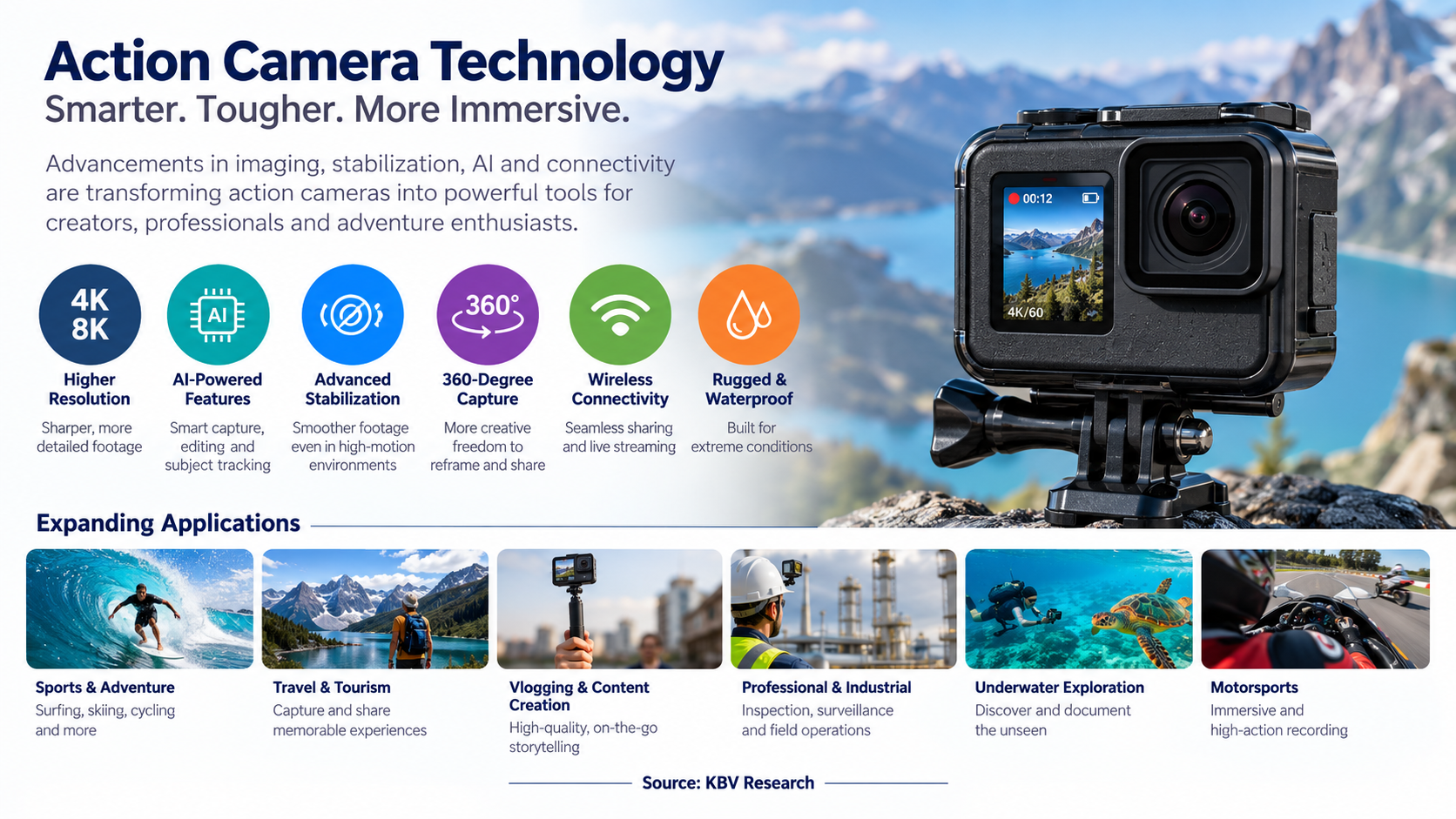
AI-powered imaging, advanced stabilization, immersive 360-degree capture and connected creator ecosystems are changing the competitive dynamics of the action camera industry. As technology becomes the principal differentiator, market leaders are using innovation not simply to improve cameras, but to reshape the entire content creation experience.
The action camera has undergone a significant transformation. What began as a compact, rugged device primarily associated with extreme sports has evolved into an increasingly sophisticated imaging platform serving travelers, content creators, motorsports enthusiasts, professional users and specialized commercial applications.
Technology has been central to this transition. Improvements in imaging sensors, processors, battery technology, stabilization and wireless connectivity have progressively expanded what can be achieved with a device small enough to mount on a helmet, vehicle, bicycle or handheld grip.
The next phase of development is going further. Artificial intelligence (AI), computational imaging, 360-degree capture, automated editing and connected applications are beginning to shift competition away from the camera alone and toward the broader user experience.
According to KBV Research, the global Action Camera Market is projected to reach USD 17.7 billion by 2033, expanding at a CAGR of 11.8% during 2026–2033. The market is being supported by growing participation in travel, adventure sports, motorsports, digital storytelling and content creation, alongside demand for better stabilization, resolution, durability and connectivity.
For years, resolution provided an easily understood measure of camera progress. HD gave way to Full HD, followed by 4K and increasingly sophisticated ultra-high-resolution recording.
Resolution remains important, but it no longer tells the entire story.
The competitive frontier is increasingly defined by the interaction of sensors, processors, software and connectivity. This combination determines whether a camera can maintain stable footage during rapid movement, perform effectively in difficult lighting conditions, recognize subjects, reframe footage or transfer content quickly into a creator's editing workflow.
This is changing how manufacturers think about product development.
AI represents one of the most significant areas of opportunity.
Its role can extend from scene recognition and subject tracking to intelligent reframing, highlight identification and automated editing. The strategic value is straightforward: recording footage is increasingly easy, but reviewing and editing hours of video remains time-consuming.
Reducing that friction could become an important competitive advantage.
Instead of requiring users to capture footage, transfer it, manually identify the strongest moments and then edit them separately, intelligent software can increasingly assist across several stages of that process.
The camera is therefore evolving from a recording device into an intelligent content-creation tool.
Action cameras operate in precisely the environments where conventional cameras struggle—rapid movement, vibration, changing orientations and unpredictable conditions.
This has made stabilization one of the industry's most strategically important technologies.
Modern electronic stabilization combines sensor information, processing power and software algorithms to compensate for movement and maintain smoother footage. Horizon-leveling capabilities can further help preserve a natural viewing orientation even when the camera rotates significantly.
The significance goes beyond visual quality.
Better stabilization reduces the need for additional equipment and makes professional-looking footage accessible to a much wider group of users. Activities such as mountain biking, skiing, running, motorcycling and surfing can increasingly be recorded with fewer compromises between portability and footage quality.
Perhaps the most fundamental change in the way action footage is captured comes from 360-degree imaging.
A traditional camera requires the creator to decide where to point the lens before recording. A 360-degree camera can capture the surrounding environment and allow the creator to determine the final viewing perspective later.
That changes the workflow from “frame and capture” to “capture and reframe.”
For travel creators, sports users and immersive-content producers, this provides considerable creative flexibility. A single recording can potentially generate multiple perspectives, conventional clips and immersive sequences.
The importance of this format is reflected in the broader market structure. KBV Research identifies 360-degree cameras as a distinct action-camera product category, alongside box, cube, bullet and other specialized formats.
Connectivity is another area in which the definition of an action camera is expanding.
Wi-Fi, Bluetooth, mobile applications and cloud-based services increasingly connect the camera to the smartphone and the wider content ecosystem.
This matters because the value of footage increasingly depends on how quickly it can move from capture to consumption.
Creators want to preview footage, control cameras remotely, transfer clips, edit content and distribute it across digital platforms with as little friction as possible.
As this workflow becomes more integrated, the mobile application may become nearly as important to customer satisfaction as the camera itself.
Technology leadership in the action camera market is not following a single path.
GoPro, DJI and Insta360 illustrate three approaches to competition. While all participate in advanced imaging, their strategic strengths increasingly extend beyond conventional camera specifications.
GoPro remains closely associated with the modern action-camera category, and its competitive strategy increasingly extends across cameras, mounting systems, accessories and creator software.
Its strength lies in turning the camera into part of a broader ecosystem.
This is strategically important because accessories and software can deepen the relationship between a user and the platform. Once creators have invested in mounts, batteries, workflows and editing tools, the purchasing decision for their next camera can become about compatibility and familiarity as much as specifications.
GoPro is therefore competing not simply for the next camera purchase, but for a longer-term position within the creator's workflow.
DJI approaches the market from a different position.
Its capabilities span drones, gimbals and handheld imaging devices, creating opportunities to apply expertise in stabilization, imaging and creator hardware across multiple product categories.
For action cameras, this can translate into increasingly sophisticated stabilization, image processing and integration with other creator-oriented devices.
The strategic advantage is technology transfer: capabilities developed in one imaging category can potentially strengthen another.
Insta360 has helped accelerate another important competitive shift—the increasing importance of what happens after the footage is recorded.
360-degree imaging allows creators to capture a much broader visual environment and select perspectives later. Software, reframing and intelligent editing therefore become integral parts of the product proposition.
This represents a different philosophy of camera design.
Instead of expecting the user to make every creative decision while recording, technology can preserve more of the surrounding scene and move some of those decisions into post-production.
The result is a closer relationship between camera hardware and creative software.
This technological progress creates an interesting competitive challenge.
Individual features become easier to replicate over time.
A higher resolution can eventually be matched. Stabilization improves across competing platforms. Sensor technology advances. Features that initially differentiate premium products gradually spread through the market.
Consequently, sustainable differentiation increasingly depends on the combination of technologies and experiences a manufacturer can provide.
The competitive question is moving from:
“Which camera has the best specifications?”
to:
“Which platform provides the best experience from capturing the moment to sharing the finished content?”
This distinction is becoming increasingly important.
Hardware remains fundamental, but software interfaces, automated editing, accessory compatibility, cloud connectivity and mobile integration can collectively influence the purchasing decision.
The competitive landscape consequently includes established imaging companies, specialist action-camera brands, 360-degree camera manufacturers and value-focused challengers. KBV Research identifies GoPro, DJI, Insta360, AKASO, SJCAM, Sony, Ricoh, Drift Innovation, Kandao and YI Technology among the companies participating in the market.
Technology is also widening the addressable market.
Sports and adventure remain central applications, with action cameras extensively used for skiing, cycling, surfing, hiking and motorsports. However, their capabilities increasingly support applications beyond recreational recording.
Travel and tourism provide one clear example. Compact form factors, high-resolution recording and stabilization make these cameras attractive for destination storytelling and travel vlogging.
Automotive applications are another developing area, particularly for road trips, motorsports and incident documentation.
Emergency services, security and specialized professional applications can benefit from rugged construction, portability and first-person recording.
The implication is significant: technology is not simply improving the existing action-camera market; it is helping expand the range of situations in which these cameras can create value.
AI is likely to become increasingly embedded throughout the imaging process—from recognizing subjects and optimizing scenes to selecting highlights and assisting with editing.
Higher-quality 360-degree recording, better stitching and easier reframing could bring immersive content creation to a broader user base.
As hardware capabilities converge, manufacturers may increasingly differentiate through applications, editing workflows and intelligent features.
Wearable, modular, underwater and application-specific devices could help manufacturers address professional and niche requirements beyond conventional sports recording.
The long-term competitive battle may increasingly encompass the camera, accessories, mobile application, editing environment and connected services as one integrated proposition.
The technological evolution of action cameras points toward a broader transformation in consumer imaging.
Resolution and ruggedness helped establish the category. Stabilization made action footage more watchable. Wireless connectivity simplified sharing. 360-degree technology changed how scenes could be captured. AI is now beginning to influence how footage is selected, processed and transformed into finished content.
The next competitive advantage is therefore unlikely to come from any single feature.
It will come from how effectively manufacturers combine hardware, software, intelligence and connectivity into a seamless experience.
For consumers, this could mean cameras that require less technical expertise to produce sophisticated content.
For manufacturers, it raises the competitive threshold. A strong sensor or rugged camera body may no longer be sufficient; companies increasingly need an ecosystem capable of supporting the entire journey from capture to creation.
And for the wider market, that convergence could help action cameras continue moving beyond their extreme-sports origins toward a much broader role in digital content creation, professional imaging and connected visual experiences.
For deeper quantitative analysis across product types, resolution, applications and regional markets, explore the Action Camera Market data and segment analysis from KBV Research.