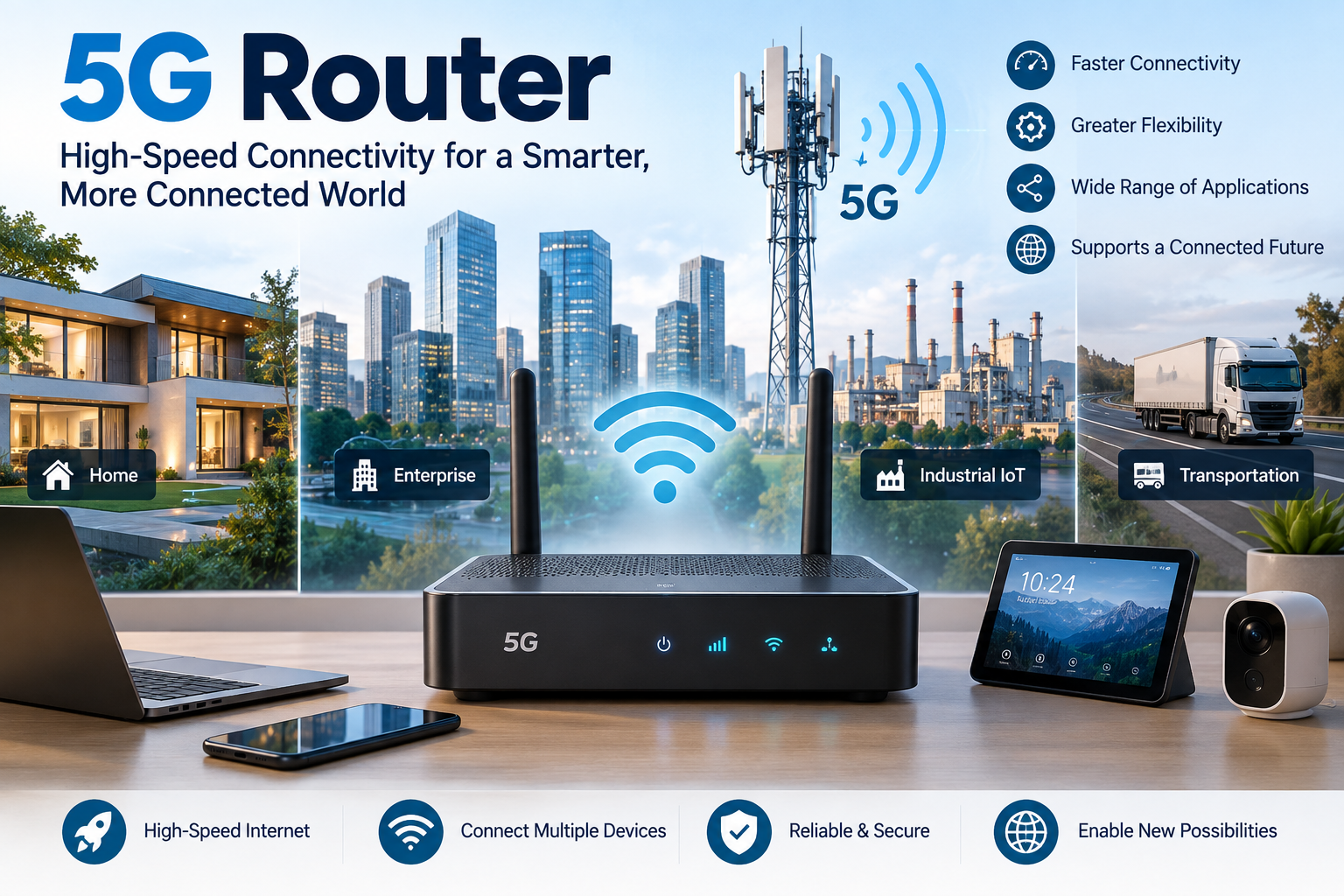
The rapid expansion of 5G networks is changing how homes, businesses and industrial facilities access high-speed connectivity. While fiber, cable and other fixed broadband technologies remain fundamental to global communications infrastructure, 5G is creating a more flexible wireless alternative for locations and applications where mobility, rapid deployment and network resilience are important. At the center of this transition is the 5G router, a device capable of connecting to a cellular 5G network and distributing that connection to multiple devices through Wi-Fi, Ethernet or other networking interfaces.
The significance of 5G routers extends well beyond residential internet access. Enterprises are adopting cellular connectivity for branch offices, backup networks and temporary locations, while manufacturers are connecting machinery, sensors and industrial systems through increasingly sophisticated wireless networks. Transportation, retail, smart infrastructure and private 5G deployments are creating additional use cases. These developments are also expanding opportunities across the 5G Router Market as cellular connectivity becomes more deeply integrated into modern network architecture.
A 5G router is a networking device that uses a fifth-generation cellular network as its internet connection and then makes that connectivity available to other devices. Unlike a conventional Wi-Fi router, which generally receives internet access through fiber, cable or DSL, a 5G router contains cellular modem functionality that enables it to communicate directly with a compatible mobile network. Once connected, the router can distribute internet access through Wi-Fi, Ethernet or a combination of networking technologies.
This architecture also explains why the terms 5G and Wi-Fi should not be treated as direct alternatives. 5G provides wide-area cellular connectivity, whereas Wi-Fi typically connects devices within a home, office or other local environment. A 5G WiFi router effectively combines the two: 5G provides the external network connection while Wi-Fi distributes that connection locally to laptops, smartphones, televisions, sensors and other connected equipment.
Modern 5G routers can also incorporate capabilities far beyond basic connectivity. Depending on the intended market, devices may include multiple Ethernet ports, advanced antenna systems, network security, remote management, automatic failover and support for multiple WAN connections. Enterprise and industrial products can provide additional functionality for managing distributed networks, making the router an increasingly important gateway between cellular infrastructure and business applications.
The distinction between a 5G modem and a 5G router is another area that can cause confusion. A modem primarily establishes the connection between a network and an internet service provider or cellular network, whereas a router manages traffic and allows multiple devices to share that connection. Many modern 5G routers integrate both functions into a single device, eliminating the need for separate equipment in many deployments.
A traditional Wi-Fi router performs a similar local networking role but usually depends on a fixed broadband connection for internet access. A 5G router can instead use cellular connectivity as its primary connection or, in enterprise environments, as a secondary connection for redundancy. This provides businesses with greater deployment flexibility because network access does not necessarily depend on having fiber or cable infrastructure installed at every location.
This distinction is particularly important for organizations operating temporary sites, remote facilities, construction projects, pop-up stores or distributed branches. A cellular router can potentially establish connectivity much faster than waiting for a new fixed connection to be provisioned. In other environments, organizations can maintain their existing fixed broadband service while using 5G as a backup connection to improve network resilience.
One of the strongest factors supporting 5G router adoption is the expansion of fixed wireless access (FWA). Instead of connecting every premises directly through a physical broadband line, operators can use cellular infrastructure to deliver broadband to compatible customer equipment. A 5G router or gateway receives the cellular signal and distributes connectivity throughout the premises, providing another broadband option for homes and businesses.
Enterprise connectivity requirements are creating another significant opportunity. Businesses increasingly depend on cloud applications, video communications, digital platforms and connected devices, making reliable internet access essential to everyday operations. 5G routers can provide primary connectivity in suitable environments, but their role as a secondary or failover connection can be equally important. Branch offices, temporary facilities and remote operations can particularly benefit from connectivity that does not depend entirely on fixed infrastructure.
Industrial digitalization is further broadening the potential application base. Manufacturing facilities, warehouses and utilities increasingly rely on connected sensors, cameras, machines and automated equipment. Cellular routers can help connect these systems with local networks, edge infrastructure and cloud platforms, supporting applications such as equipment monitoring, predictive maintenance and real-time data collection. The development of private 5G networks can extend these possibilities further by allowing organizations to create dedicated cellular environments for factories, logistics facilities, campuses and other operational sites.
Residential broadband remains one of the most visible applications of 5G routers. In locations with suitable network coverage, consumers can use a 5G router to provide internet access throughout the home without relying exclusively on a conventional wired broadband connection. Actual 5G router speed can vary considerably depending on network capacity, spectrum availability, signal strength, congestion, router hardware and location, so the user experience cannot be defined by a single speed figure.
In the enterprise segment, 5G routers can support branch connectivity, temporary offices, retail outlets, events and remote operations. Businesses may also use cellular networking as part of a wider wireless WAN strategy, combining fixed and cellular connections to improve flexibility and redundancy. As organizations distribute applications and workloads across cloud and edge environments, the ability to establish secure connectivity across diverse locations becomes increasingly important.
Industrial and transportation applications introduce another set of requirements. Manufacturing facilities can use cellular connectivity to support connected equipment and IoT deployments, while buses, trains, commercial fleets and other mobile environments can use routers to maintain communications while moving between locations. Such connectivity can support fleet management, passenger services, telemetry, monitoring and data exchange between vehicles and centralized platforms.
As applications diversify, 5G router designs are becoming increasingly specialized. Indoor routers primarily serve homes, offices and other enclosed environments, where they can combine cellular broadband with Wi-Fi coverage for multiple users and devices. Ease of installation, Wi-Fi performance and compatibility with operator networks are particularly important considerations in this category.
Outdoor routers address different requirements. Placing cellular equipment externally can improve signal reception in certain environments, while industrial and remote installations may require equipment capable of operating under demanding weather or operating conditions. Outdoor products can therefore be relevant to factories, infrastructure, construction sites, utilities and locations where conventional indoor networking equipment is unsuitable.
Portable 5G routers emphasize mobility and convenience. They can provide connectivity for travelers, field workers, temporary operations and teams moving between different locations. Together, indoor, outdoor and portable product categories demonstrate how the 5G router is evolving from a relatively narrow networking product into a broader connectivity platform serving multiple environments.
The evolution of the 5G router market is being influenced by more than the geographical expansion of 5G coverage. One important development is the convergence of cellular connectivity with increasingly capable Wi-Fi technologies. Faster local wireless networks allow routers to distribute the performance available from cellular connections more effectively across multiple devices, making the combination of 5G and advanced Wi-Fi particularly relevant for homes and enterprises.
Enterprise wireless networking is another important trend. Organizations are increasingly looking for infrastructure capable of supporting cloud applications, distributed workforces, IoT devices and geographically dispersed operations. This is expanding the role of cellular connectivity within broader WAN strategies rather than positioning it solely as an alternative to fixed broadband. At the same time, standalone 5G, private networks and edge computing are creating new possibilities for low-latency and mission-specific applications.
Security and network management are also becoming important areas of differentiation. As routers connect increasingly valuable business systems and larger numbers of devices, organizations require centralized administration, traffic visibility, access controls and protection against network threats. Consequently, competition is gradually shifting from basic connectivity toward integrated platforms that combine cellular performance with networking, security and management capabilities.
The competitive landscape includes telecommunications equipment companies, wireless infrastructure providers and networking technology specialists. Companies covered within KBV Research's industry analysis include Ericsson, Huawei Technologies Co., Ltd., Nokia Corporation, CommScope Holding Company, Inc., Samsung Electronics Co., Ltd., ZTE Corporation, Airspan Networks Holdings LLC, Comba Telecom Systems Holdings Ltd., JMA Wireless and SOLiD, Inc.
Competition is increasingly shaped by capabilities extending beyond basic 5G connectivity. Network performance, antenna technology, advanced Wi-Fi integration, private-network compatibility, cloud-based management, cybersecurity and edge readiness are becoming important considerations as manufacturers address more sophisticated enterprise and industrial requirements. Organizations evaluating the broader competitive environment can explore detailed 5G router market trends and competitive analysis covering market segmentation, regional developments and industry participants.
The future of 5G routers will depend partly on continued network deployment, but the larger opportunity lies in how cellular connectivity becomes integrated into everyday digital infrastructure. Fixed wireless access can increase the role of mobile networks in broadband delivery, while enterprise wireless WAN can provide organizations with greater flexibility and resilience. Private 5G networks, industrial IoT and connected transportation can create specialized requirements that extend the technology well beyond residential internet access.
The convergence of 5G with advanced Wi-Fi, cloud-managed networking and edge computing could further increase the capabilities expected from routers. Rather than simply moving data between a cellular network and connected devices, future platforms may increasingly participate in security, application management, network optimization and distributed computing architectures. This evolution could make 5G routers strategically important components of connectivity infrastructure across residential, commercial and industrial environments.
A 5G router can be worthwhile where reliable 5G coverage is available and users require flexible high-speed connectivity, mobility or an alternative or backup to fixed broadband. The suitability of a 5G router depends on factors such as network coverage, service costs, signal quality, required performance and the intended application.
In suitable locations, a 5G router can potentially provide an alternative to conventional home broadband through fixed wireless access. However, performance depends on network coverage, capacity, signal strength, congestion and the service offered by the network operator. For some households it can function as the primary connection, while others may use it as a complementary or backup service.
5G and Wi-Fi perform different functions, so one is not inherently better than the other. 5G provides wide-area cellular connectivity, while Wi-Fi generally provides local connectivity between a router and nearby devices. A 5G WiFi router combines both technologies by receiving internet access through 5G and distributing it locally through Wi-Fi.
5G router speed can be influenced by network coverage, spectrum, signal strength, distance from cellular infrastructure, network congestion, router hardware, antenna configuration and the capabilities of the operator's network. Real-world performance can therefore vary substantially between locations and service providers.
5G routers sit at the intersection of several major changes in global connectivity. The continued expansion of cellular networks is increasing the availability of high-speed wireless broadband, while fixed wireless access is creating additional alternatives to conventional wired connections. At the same time, enterprises are looking for more flexible network architectures, manufacturers are connecting growing numbers of machines and sensors, and transportation systems increasingly depend on continuous data connectivity.
These developments suggest that the role of the 5G router will continue to broaden. As 5G, Wi-Fi, private networks, IoT, cloud networking and edge computing converge, routers can increasingly function as intelligent gateways connecting users, devices and applications across diverse environments. For detailed market sizing, segmentation, regional analysis, growth opportunities and competitive insights, explore the Global 5G Router Market Research Report from KBV Research.