Air conditioning is undergoing one of its most significant technological transitions in decades. What was once largely a mechanical product designed to maintain indoor temperature is increasingly becoming an intelligent climate-management system capable of adjusting energy consumption, monitoring operating conditions, communicating with other building systems and responding dynamically to user requirements.
This transformation is occurring at a time when cooling demand is expanding across homes, commercial buildings, industrial facilities and digital infrastructure. At the same time, electricity costs, environmental regulations and sustainability targets are putting pressure on manufacturers to deliver more cooling with less energy and lower environmental impact.
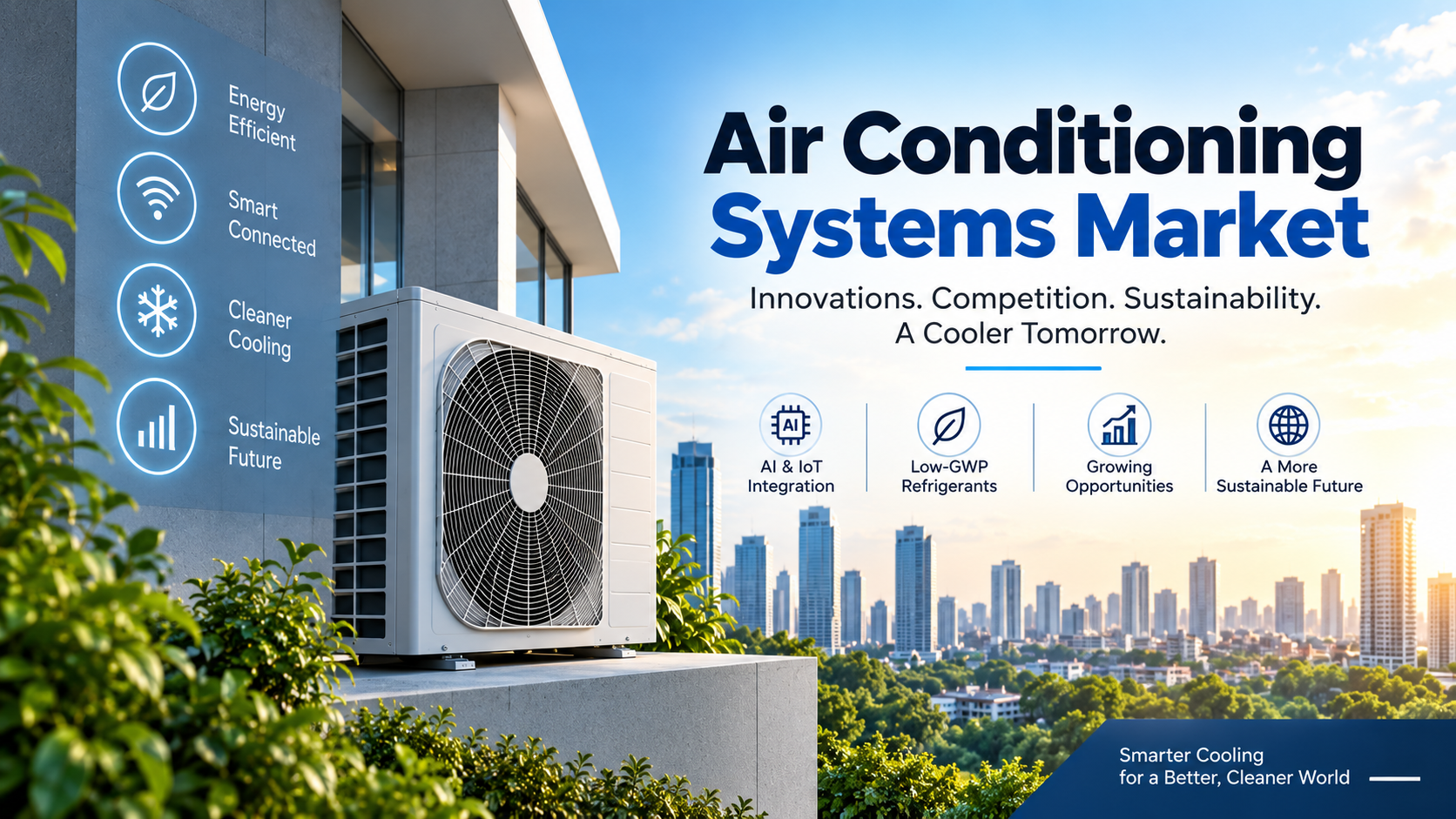
The result is a market in which technology is becoming an increasingly important competitive differentiator. Inverter compressors, AI-enabled controls, IoT connectivity, low-GWP refrigerants and advanced thermal-management solutions are changing both the capabilities of air conditioning systems and the strategies of leading manufacturers.
According to KBV Research, the Global Air Conditioning Systems Market is projected to reach approximately USD 176.4 billion by 2033, expanding at a CAGR of 7.0% during 2026–2033. Growing emphasis on energy efficiency, smart connectivity and environmentally responsible cooling technologies is expected to remain central to market development.
One of the clearest changes in air conditioning technology is the shift from fixed operation toward adaptive cooling. Inverter technology has played an important role in this transition by allowing compressors to vary their operating speed according to actual cooling requirements rather than repeatedly switching between full operation and shutdown. The benefits extend beyond electricity consumption. Variable operation can support more stable indoor temperatures, quieter performance and more responsive climate control.
However, the next technological step goes considerably further. Sensors, connected thermostats and increasingly sophisticated control software are allowing air conditioning systems to understand their operating environment and make more intelligent decisions. Instead of responding only to a temperature setting, future systems can increasingly account for occupancy, humidity, usage patterns, equipment performance and broader building conditions. This changes the role of the air conditioner itself: it becomes less of an isolated appliance and more of a connected component within a wider energy and building-management ecosystem.
Artificial intelligence is emerging as another important development. AI-enabled HVAC controls can analyze operating data and potentially determine when, where and how much cooling is required. Combined with sensors and real-time monitoring, these capabilities can reduce unnecessary operation while maintaining desired comfort levels.
Predictive maintenance is another promising application. Traditional maintenance is often scheduled periodically or initiated after equipment begins to malfunction. Connected systems can instead monitor operating parameters and identify unusual patterns that may indicate declining performance, potentially allowing intervention before a major failure occurs. The technological possibilities become even more significant in large commercial facilities and data centers, where small improvements in cooling efficiency can translate into substantial operational savings.
Another major technological transition is taking place inside the cooling cycle itself. The move toward refrigerants with lower global warming potential is encouraging manufacturers to redesign equipment and rethink system architecture. Refrigerant selection affects compressors, heat exchangers, safety mechanisms, installation procedures and servicing requirements, making the transition a significant engineering challenge rather than simply a change of cooling fluid.
This is also becoming an area of competitive differentiation. Manufacturers need to balance environmental performance with cooling efficiency, safety, equipment reliability and affordability. As regulations continue evolving across major markets, refrigerant expertise could become increasingly valuable. Companies able to transition their portfolios efficiently while maintaining performance and controlling costs may gain an advantage over competitors facing more difficult product redesign cycles.
Perhaps one of the most interesting emerging opportunities for the air conditioning industry comes from AI and data centers. AI servers and high-performance computing infrastructure generate enormous amounts of heat. As computing density increases, conventional approaches to cooling can become increasingly difficult and energy intensive. This is pushing HVAC and thermal-management companies toward larger chillers, sophisticated control systems, liquid cooling and hybrid cooling architectures.
The implications extend beyond the data-center industry. Technologies developed to address extreme thermal loads, energy constraints and intelligent control requirements could eventually influence commercial HVAC design more broadly. Mission-critical thermal management is therefore becoming an increasingly important arena for innovation and competition.
Several trends are now converging rather than developing independently. Energy efficiency is becoming a baseline requirement as electricity consumption increasingly affects purchasing decisions and regulation. Smart and connected cooling is moving mainstream through IoT connectivity, remote control, real-time monitoring and building-management integration. AI is moving from convenience toward optimization, while low-GWP refrigerants are influencing product roadmaps and system architecture.
Commercial cooling is also becoming increasingly important as offices, healthcare facilities, hospitality properties, retail spaces and institutional buildings demand more sophisticated climate-management systems. At the same time, data-center cooling is emerging as a specialized opportunity that increasingly combines HVAC engineering, liquid cooling, software and intelligent energy management. Together, these trends indicate that the future of air conditioning will be shaped as much by electronics, software and data as by traditional mechanical engineering.
Technology development is occurring alongside intensifying competition among global HVAC manufacturers. Daikin, Midea, Gree and Carrier have significant competitive positions supported by manufacturing scale, broad portfolios, inverter technologies and international distribution. Johnson Controls and Trane Technologies bring considerable strength in commercial HVAC, building systems and automation, while LG Electronics, Mitsubishi Electric, Samsung and Panasonic contribute expertise spanning climate control, consumer electronics and connected-home technologies.
This diversity makes the competitive landscape particularly interesting. Traditional HVAC manufacturers increasingly compete with companies possessing strong capabilities in electronics, software and smart-home ecosystems. At the same time, commercial HVAC specialists are expanding into building intelligence and integrated energy management. Competition is therefore moving beyond specifications such as cooling capacity or energy-efficiency ratings toward software, connectivity, intelligent controls, lifecycle services, predictive maintenance, refrigerant technology and integration with wider building systems.
The convergence of these technologies points toward a fundamental change in the industry's business model. Historically, manufacturers primarily sold cooling equipment. Increasingly, the opportunity may involve providing an ecosystem consisting of equipment, sensors, controls, software, monitoring and ongoing services.
A commercial building provides a useful example. Instead of independently operating air conditioners, lighting, ventilation and other systems, an intelligent building platform can potentially coordinate them according to occupancy, environmental conditions and energy requirements. Cooling becomes one part of a broader optimization problem. Remote diagnostics, predictive maintenance and cloud-based monitoring can also create continuous interaction between manufacturers, service providers and customers throughout the equipment lifecycle.
The air conditioning systems of the next decade are unlikely to be defined by a single breakthrough technology. Instead, the industry appears to be moving toward the convergence of multiple innovations. Inverter compressors will continue improving energy management. Lower-impact refrigerants will influence equipment architecture. Sensors and connectivity will provide greater visibility into system operation. AI will increasingly analyze that information and optimize performance, while building-management platforms will connect cooling with other infrastructure.
At the same time, manufacturers will face the challenge of making these technologies commercially practical. Advanced systems must remain reliable, serviceable and sufficiently affordable for their intended markets. Infrastructure limitations and electricity availability can also influence adoption, particularly in rapidly developing regions.
The competitive advantage of the future may therefore belong not simply to the company with the most advanced air conditioner, but to manufacturers capable of combining efficiency, intelligence, sustainability, reliability and affordability at scale. Air conditioning began as a way to control indoor temperature. Its next phase could be considerably broader: an intelligent climate-management layer connecting buildings, energy systems and digital infrastructure. As that transition accelerates, the competition to define the future of cooling is only beginning.