Artificial intelligence is moving beyond experimentation. Enterprises are increasingly deploying AI systems that interpret visual information, automate workflows, interact with business applications and support operational decisions. However, as AI becomes more autonomous, a new challenge is emerging: How can organizations ensure that their AI systems remain accurate, observable and secure?
The answer extends beyond investing in more powerful AI models.
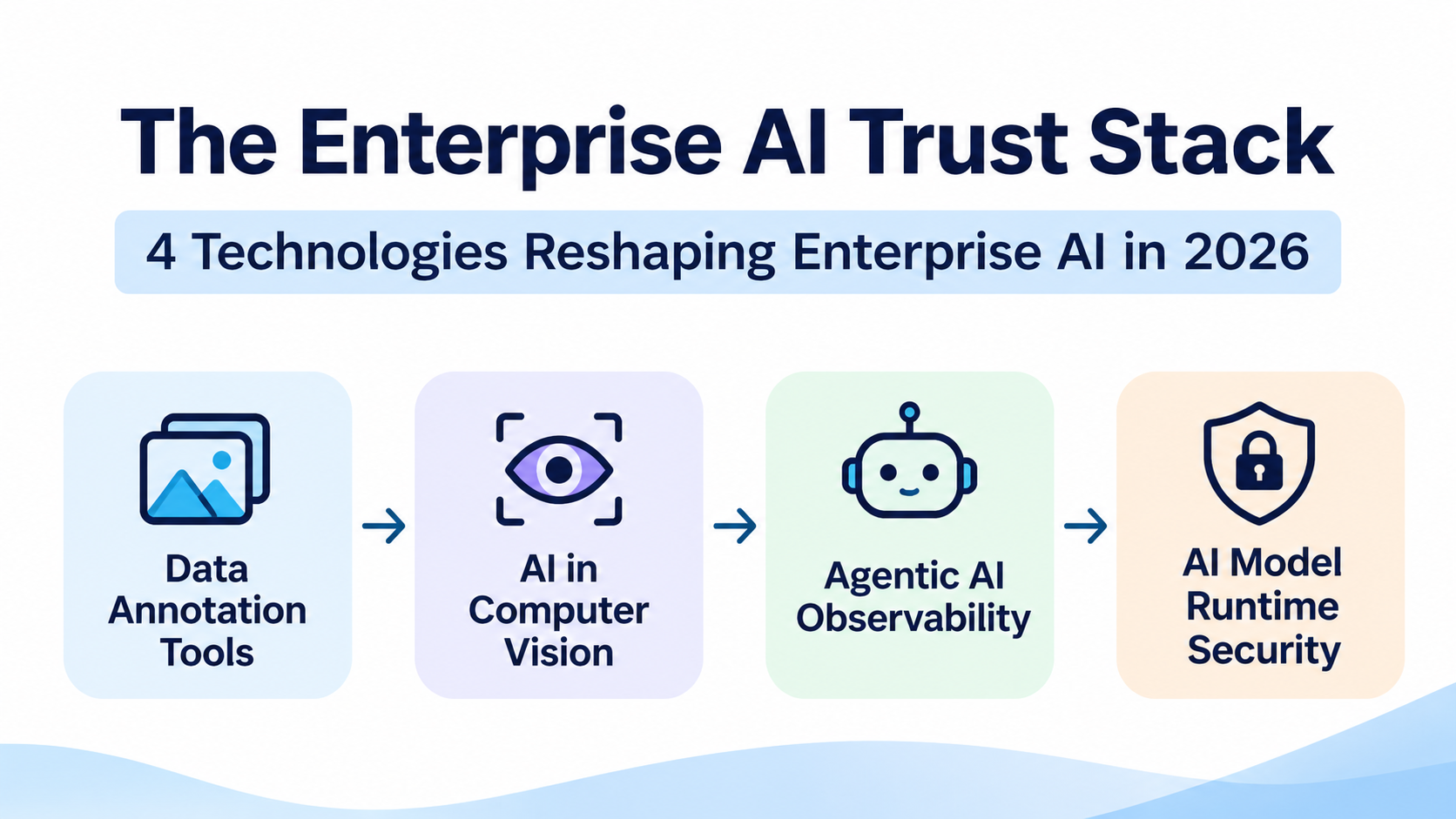
Organizations need an integrated technology ecosystem that supports reliable data preparation, intelligent processing, continuous monitoring and real-time protection. This emerging architecture can be described as the Enterprise AI Trust Stack.
Four interconnected technologies are particularly relevant: data annotation tools, AI in computer vision, agentic AI observability and AI model runtime security. Together, they illustrate how enterprise AI is evolving from isolated applications into more dependable, production-ready systems.
Every successful AI deployment begins with data quality. Whether an AI model analyzes medical images, identifies manufacturing defects or processes business documents, its performance depends partly on the accuracy and representativeness of its training and evaluation data.
Data annotation tools transform raw images, text, audio and video into structured information that AI systems can learn from.
For example, manufacturers developing automated inspection systems need accurately labeled images showing different defect categories. Healthcare AI developers may require specialist-reviewed medical images, while autonomous systems depend on annotated visual and sensor data.
The challenge becomes more significant as organizations scale AI applications. Manually labeling large datasets is expensive and time-consuming, while inconsistent annotations can introduce errors that affect model performance.
Consequently, annotation workflows increasingly combine automated pre-labeling, human review and quality assurance.
These capabilities are expanding the role of the Data Annotation Tools Market beyond basic labeling toward continuous dataset improvement, multimodal AI development and human-in-the-loop evaluation.
For enterprise buyers, annotation quality is becoming an important consideration alongside model selection, particularly in applications where incorrect predictions carry substantial operational consequences.
Computer vision is among the most commercially established applications of artificial intelligence. It enables machines to interpret images and video, identify objects, detect anomalies and generate information that supports business decisions.
Its applications are expanding across manufacturing, healthcare, automotive, logistics and retail.
According to KBV Research, the global AI in Computer Vision Market is projected to reach USD 145.6 billion by 2033, expanding at a CAGR of 23.7% during 2026–2033.
Manufacturing remains a major application area, where AI-powered inspection systems can identify product defects, monitor assembly processes and improve quality consistency.
Healthcare presents another significant opportunity. Computer vision supports medical image analysis, diagnostic assistance and image-based clinical workflows, although these applications require rigorous validation and appropriate professional oversight.
An important technological development is the emergence of vision-language models. Unlike traditional image recognition systems, these models can connect visual interpretation with natural-language instructions.
For instance, a manufacturing system could identify an unusual component and generate a contextual explanation for an engineer.
KBV Research identifies generative AI and vision-language models as the fastest-growing technology segment in its computer vision forecast, with a projected CAGR of 39.5%.
However, expanding capabilities also introduce new operational risks. A model that performs accurately in controlled testing may behave differently when lighting, camera positioning or environmental conditions change.
This makes continuous evaluation and monitoring essential.
As enterprises introduce autonomous AI agents, traditional application monitoring is becoming insufficient.
Unlike conventional software workflows, AI agents can interpret instructions, retrieve information, invoke external tools and execute multistep tasks. Their actions may vary depending on the information encountered during execution.
Consider an AI-powered customer service agent that retrieves order information, checks inventory availability and recommends a resolution.
If the agent produces an incorrect response, organizations need to determine whether the problem originated from inaccurate data, a failed tool call, inappropriate reasoning or an unexpected workflow decision.
Agentic AI observability addresses this challenge by capturing execution traces, tool interactions, model responses, performance indicators and task outcomes.
KBV Research projects that the global Agentic AI Observability Market will grow from approximately USD 670 million in 2026 to USD 8.9 billion by 2033, registering a CAGR of 44.6%.
The report also identifies multi-agent systems as a particularly fast-growing segment, reflecting the increasing complexity of AI workflows involving several collaborating agents.
Industry initiatives such as OpenTelemetry's Generative AI Semantic Conventions illustrate efforts to standardize how AI-related operations are instrumented and described.
For businesses, observability is not simply about identifying technical errors. It also supports cost optimization, response-quality evaluation, workflow improvement and operational accountability.
As AI agents gain greater independence, organizations will need better visibility into both what these systems accomplish and how they reach their outcomes.
Greater AI autonomy also introduces security challenges that conventional cybersecurity controls do not fully address.
AI applications frequently interact with external documents, user instructions, enterprise databases and third-party tools. These interactions can expose systems to prompt injection, sensitive-data leakage, unauthorized tool execution and malicious manipulation.
For example, an AI agent processing a retrieved document could encounter embedded instructions attempting to redirect its behavior. If the agent has excessive permissions, the consequences could extend beyond an incorrect response to unauthorized data access or system actions.
AI model runtime security focuses on protecting AI systems while they process requests, generate outputs and execute tasks.
According to KBV Research, the global AI Model Runtime Security Market is expected to reach USD 28.7 billion by 2033, growing at a CAGR of 39.2% during 2026–2033.
Within the market, AI agent access and tool-use security is projected to be the fastest-growing security function, with a CAGR of 54.5%.
This reflects an important shift in enterprise security priorities: protecting AI systems increasingly involves controlling not only what models generate but also what connected agents are permitted to do.
The OWASP Top 10 for LLM Applications highlights relevant vulnerabilities, including prompt injection and other risks associated with AI applications.
For enterprises, effective protection requires a combination of runtime monitoring, access controls, data protection, policy enforcement and appropriate human oversight.
The commercial significance of the Enterprise AI Trust Stack becomes clearer when these technologies are viewed as complementary capabilities rather than isolated markets.
Consider an AI-powered manufacturing inspection workflow.
First, annotated production images help train and evaluate a computer vision model. The model then analyzes live images to identify potential defects.
An AI agent may investigate unusual findings by retrieving production records and preparing a diagnostic summary. Observability tools capture the agent's execution path, while runtime security controls restrict access to sensitive information and prevent unauthorized operational changes.
Each technology addresses a different requirement, but the overall reliability of the system depends on how effectively they operate together.
| Technology | Primary enterprise value |
|---|---|
| Data Annotation Tools | Reliable training and evaluation data |
| AI in Computer Vision | Automated visual interpretation |
| Agentic AI Observability | Workflow visibility and performance evaluation |
| AI Model Runtime Security | Protection and policy enforcement during execution |
The broader implication is that enterprises must increasingly evaluate AI investments across the entire deployment lifecycle.
The NIST AI Risk Management Framework reinforces the importance of managing AI risks throughout development, deployment and ongoing use.
For technology providers, this creates opportunities around integration, monitoring, governance and managed AI infrastructure. For enterprise buyers, it increases the importance of interoperability, security, measurable performance and total operating costs.
The next phase of enterprise AI adoption will be influenced by how successfully organizations transition from promising demonstrations to dependable operational deployments.
Three developments deserve particular attention.
First, AI evaluation will become more continuous. Organizations will need to monitor model performance as datasets, operating conditions and business requirements evolve.
Second, autonomous agents will require stronger operational controls. As agents interact with more enterprise systems, observability and authorization will become increasingly important.
Third, integrated AI infrastructure will gain strategic relevance. Businesses will seek solutions that connect data preparation, model deployment, monitoring and security without introducing unnecessary complexity.
These developments will create opportunities across AI software, enterprise infrastructure, cybersecurity and professional services.
Enterprise AI success is increasingly determined by more than model intelligence.
Reliable data, effective visual interpretation, transparent agent workflows and secure runtime operations are becoming essential components of production-ready AI systems.
The convergence of data annotation, computer vision, agentic AI observability and runtime security illustrates how the enterprise AI ecosystem is evolving toward greater operational maturity.
For businesses investing in AI, the competitive advantage will increasingly come from deploying systems that are not only intelligent, but also reliable, measurable and secure.
What is the Enterprise AI Trust Stack?
It is a conceptual framework connecting data quality, AI processing, operational observability and runtime security to support dependable enterprise AI deployment.
Why is agentic AI observability important?
It helps enterprises monitor AI agents, investigate workflow failures, evaluate task outcomes and understand operational costs.
How does AI runtime security differ from traditional cybersecurity?
AI runtime security focuses on risks arising during live AI interactions, including prompt injection, sensitive-data exposure and unauthorized agent actions, while complementing established cybersecurity controls.