“Global Agentic AI Observability Market to reach a market value of USD 61201.79 Million by 2033 growing at a CAGR of %”
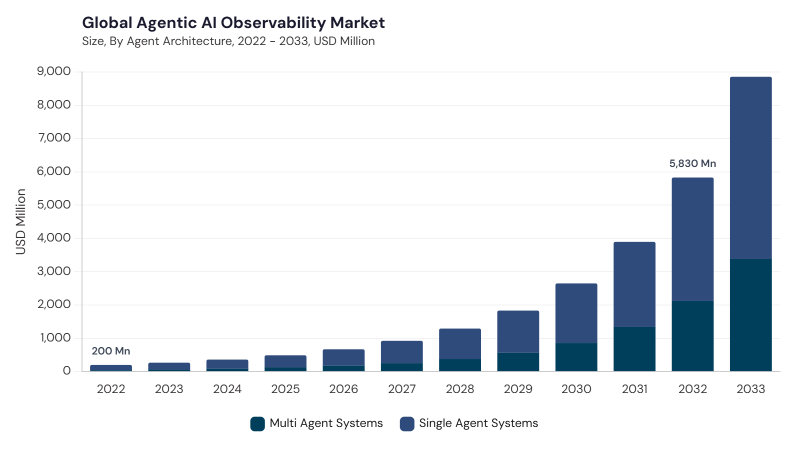
The Global Agentic AI Observability Market is expected to reach USD 8.9 billion by 2033, growing at a CAGR of 44.6% during 2026–2033, from a 2026 market size of USD 670.0 million. As organizations deploy autonomous AI agents in production, demand for AI observability and LLM observability is expanding toward end-to-end visibility into agent workflows, model calls, tool execution, performance, quality, and operational costs.
Agentic AI observability refers to software and related services that capture, analyze, and evaluate the behavior of AI systems performing multistep tasks through models, tools, retrieved information, and application workflows. Unlike basic LLM monitoring focused on individual model responses, agentic AI observability examines how an AI agent reaches an outcome through traces, tool calls, handoffs, and task evaluations. It also differs from AI-powered IT monitoring and the separate field of data observability: this market focuses on observing AI agents themselves.
Agent applications combine model calls with tool execution, retrieval, and application logic, creating more possible failure points than a simple request-response interaction. AI agent monitoring therefore requires workflow-level traces that show the sequence of model calls, tool use, and intermediate actions. LangSmith describes tracing and monitoring across agent workflows, illustrating how LLM observability tools can support agent troubleshooting. For organizations moving beyond pilots, troubleshooting must establish which step failed and how that affected the outcome. This supports spending on platforms that link recorded actions to application context. The commercial driver is dependable production operations as workflows grow in scope, with observability helping teams investigate failures and improve task completion rates.
An AI agent can accumulate expense through repeated LLM calls, retries, extended context, and paid external tools. Monitoring aggregate expenditure alone may not show which workflow or user interaction caused an increase. Langfuse documents token and cost tracking across traced activity, providing an example of instrumentation available to investigate these patterns. Buyers can use AI observability data to compare implementations and identify tasks that consume disproportionate resources. The purchasing case depends on improving cost per useful outcome rather than minimizing every model call. Platforms therefore gain value when token usage, latency, quality, and task completion can be assessed together rather than treated as an isolated billing dashboard.
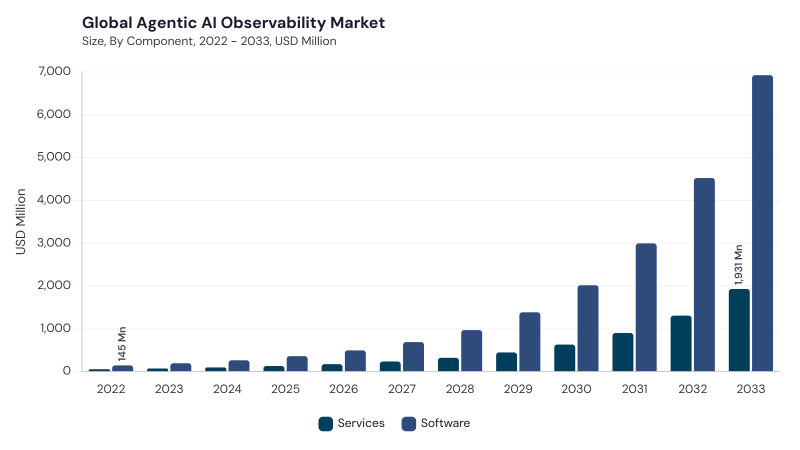
Based on Component, the market is segmented into Software, Services. Software dominated in 2025 and is projected to reach USD 6.9 billion by 2033, growing at a CAGR of 45.7%. Software is expected to record the highest CAGR of 45.7% during the forecast period.
The Component segmentation comprises Software and Services. Software includes platforms and tools for collecting agent telemetry, visualizing execution, monitoring performance and cost, evaluating task quality, and reporting relevant governance signals. Services cover consulting, implementation, instrumentation, integration, evaluator development, training, and continuing support. The two components are complementary: purchasing a platform does not define what an organization should capture or how it should interpret results. Classification should distinguish the software subscription or license from separately priced services, while bundled arrangements require a consistent allocation method. General AI development work belongs in this market only where the engagement specifically supports agent observability.
Based on Deployment Mode, the market is segmented into Cloud-Based, On-Premises. Cloud-Based dominated in 2025 and is projected to reach USD 6.7 billion by 2033, growing at a CAGR of 46.1%. Cloud-Based is expected to record the highest CAGR of 46.1% during the forecast period.
Cloud-based solutions operate on cloud infrastructure and may include managed SaaS or customer-controlled cloud deployments, depending on the defined measurement convention. On-premises solutions run within the organization’s own physical infrastructure and place more operational responsibility on the customer. Buyers assess hosting through data control, connectivity, maintenance, scalability, and internal capabilities. Self-hosting should not automatically be equated with on-premises deployment because a customer can operate the software within a public-cloud account. Hybrid arrangements should be assigned consistently according to the primary location of the observability platform rather than the location of the agent it monitors.
Based on Observability Function, the market is segmented into Agent Tracing & Workflow Monitoring, Performance & Cost Monitoring, Evaluation & Quality Assurance, Security & Governance and Compliance Monitoring. Agent Tracing & Workflow Monitoring dominated in 2025 and is projected to reach USD 3.0 billion by 2033, growing at a CAGR of 42.7%. Security & Governance and Compliance Monitoring is expected to record the highest CAGR of 50.1% during the forecast period.
Agent tracing reconstructs recorded execution across LLM calls, tools, retrieval, and handoffs, enabling workflow monitoring and root-cause investigation. Performance and cost monitoring examines latency, token consumption, errors, and resource usage. Evaluation and quality assurance assesses outputs and action sequences against task-specific criteria. Security, governance, and compliance monitoring provides telemetry relevant to access, policy adherence, and oversight requirements; it does not independently certify compliance. In contrast to conventional monitoring, which often emphasizes system health or availability, agentic AI observability connects operational signals with the quality and sequence of agent actions. As a platform can support several functions, revenue should be attributed through a consistent primary-function or allocated-revenue approach rather than counted in full within each category.
Based on Agent Architecture, the market is segmented into Single-Agent Systems, Multi-Agent Systems. Single-Agent Systems dominated in 2025 and is projected to reach USD 5.5 billion by 2033, growing at a CAGR of 41.0%. Multi-Agent Systems is expected to record the highest CAGR of 52.6% during the forecast period.
Single-agent observability follows the actions and outcomes of one principal AI agent, which may still invoke several tools and perform many steps. Multi-agent observability adds the need to understand agent-to-agent interactions, delegation, handoffs, and coordination between distinct agents participating in a task. Complexity depends on execution structure as well as agent count: one agent with lengthy asynchronous workflows can be difficult to monitor. Classification should follow whether several independently acting agents participate in the monitored workflow. Ordinary calls to non-agent tools should not by themselves move an application into the multi-agent category.
Based on Organization Size, the market is segmented into Large Enterprises, Small & Medium Enterprises. Large Enterprises dominated in 2025 and is projected to reach USD 6.0 billion by 2033, growing at a CAGR of 43.0%. Small & Medium Enterprises is expected to record the highest CAGR of 48.4% during the forecast period.
Large enterprises often need shared observability across teams and applications, with integration into established security, reporting, and support processes. SMEs may prioritize quick instrumentation, straightforward pricing, and a smaller operational burden, although their technical requirements can still be demanding. The distinction reflects the buying organization rather than the number of agents or traces it generates. Employee or revenue thresholds should remain consistent throughout the analysis. Commercial approaches therefore range from developer-led adoption and managed services to negotiated enterprise deployments with broader integration and support requirements.
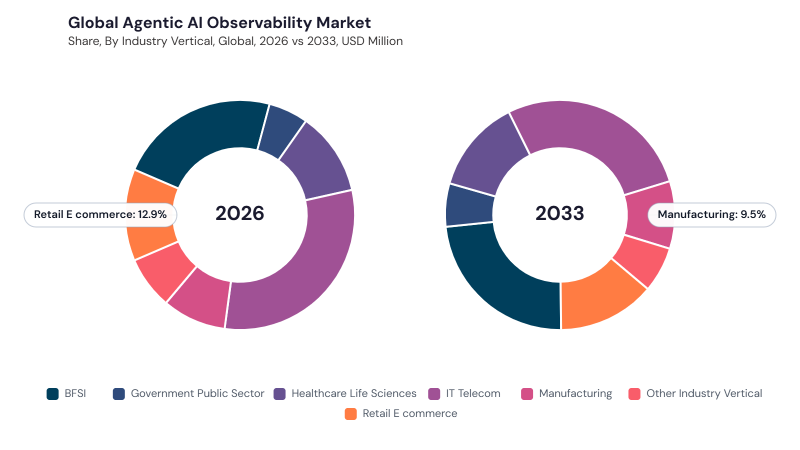
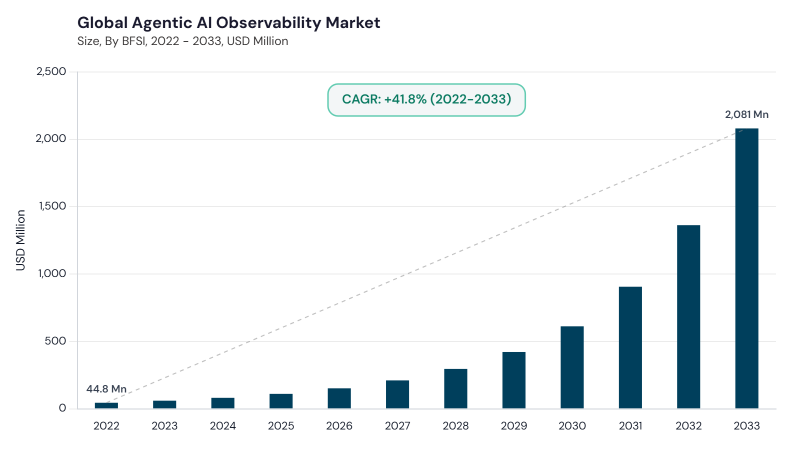
Based on Industry Vertical, the market is segmented into BFSI, IT & Telecom, Healthcare & Life Sciences, Retail & E-commerce, Manufacturing, Government & Public Sector, Other Industry Vertical. IT & Telecom dominated in 2025 and is projected to reach USD 2.4 billion by 2033, growing at a CAGR of 42.5%. Healthcare & Life Sciences is expected to record the highest CAGR of 47.0% during the forecast period.
BFSI requires monitoring suited to financial workflows and oversight; IT and telecom includes software, support, and digital operations. Healthcare and life sciences needs application-specific evaluation and careful data handling, while retail and e-commerce emphasizes customer interactions and transactional tasks. Manufacturing covers agents connected to engineering and operational processes, and government involves public-service and administrative use cases. Others captures remaining industries. Segment attribution should follow the end customer using the monitored workflow rather than automatically classifying every observability purchase as IT spending.
Region-wise, the Agentic AI Observability Market is analyzed across North America, Europe, Asia Pacific, LAMEA. North America led in 2025 and is projected to reach USD 3.4 billion by 2033, growing at a CAGR of 43.3%. Europe is projected to grow at a CAGR of 43.7%. Asia Pacific is projected to grow at a CAGR of 47.1%. LAMEA is projected to grow at a CAGR of 46.3%.
By Component
By Deployment Mode
By Observability Function
By Agent Architecture
By Organization Size
By Industry Vertical
By Geography
| Report Attribute | Details |
|---|---|
| Market size value in 2026 | USD 670.0 million |
| Market size forecast in 2033 | USD 8.9 billion |
| Base Year | 2025 |
| Historical Period | 2022 to 2024 |
| Forecast Period | 2026 to 2033 |
| Revenue Growth Rate | CAGR of 44.6% from 2026 to 2033 |
| Number of Tables | 780 |
| Number of Figures | 130 |
| Report Coverage | Market Trends, Revenue Estimation and Forecast, Segmentation Analysis, Regional and Country Breakdown, Competitive Landscape |
| Segments Covered | Component, Deployment Mode, Observability Function, Agent Architecture, Organization Size, Industry Vertical and Geography |
| Country Scope |
|
By Geography
It is the tracing, monitoring, and evaluation of AI agents across model calls, tools, retrieval, and multistep workflows, with attention to task outcomes, costs, quality, and governance signals.
LLM observability can focus on model inputs, outputs, latency, and token usage. Agentic AI observability extends this view across an agent’s tool use, intermediate steps, handoffs, and end-to-end task execution. The categories overlap but are not identical.
Monitoring typically tracks selected metrics and alerts. Observability combines traces and other telemetry to help teams investigate why an AI agent behaved a certain way, while recognizing that recorded traces do not expose every internal model process.
LangSmith and Langfuse are examples of tools associated with tracing and analyzing LLM or agent workflows. Their mention illustrates relevant observability capabilities and does not imply that all of their revenue belongs to this market.
The market is estimated at USD 670.0 million in 2026 and is projected to reach USD 8.9 billion by 2033, at a CAGR of 44.6% during 2026–2033.
Expansion of Multistep AI Workflows Into Production and Need to Control Inference and Tool Usage Costs
Our team of dedicated experts can provide you with attractive expansion opportunities for your business.