
“Global AI in Computer Vision Market to reach a market value of USD 145587.22 Million by 2033 growing at a CAGR of %”
The Global AI in Computer Vision Market is expected to reach USD 145.6 billion by 2033, growing at a CAGR of 23.7% during (2026 - 2033).
AI in computer vision refers to the hardware, software, and services that enable artificial intelligence (AI) systems to interpret images and video using machine learning and deep learning. For readers asking “what is computer vision in AI?”, it is the technology that transforms visual inputs into image classifications, object detections, measurements, movement estimates, and other outputs used in operational decisions. Computer vision applications include industrial quality inspection, warehouse guidance, medical image analysis, retail recognition, and security monitoring. The market includes AI-specific visual processing capabilities rather than all cameras, image storage systems, or purely rule-based inspection equipment. This boundary matters because a complete computer vision installation can include substantial general-purpose infrastructure.
Manufacturers invest in AI computer vision applications when visual decisions affect product quality, throughput, and the cost of correcting defects. Manual inspection can be difficult to sustain across long shifts, high-speed production lines, and products with subtle appearance differences. AI-powered quality inspection and object detection help identify defects and patterns that would require complex manually written rules. Computer vision projects in manufacturing are particularly valuable when defects can be traced to production stages before further value is added to faulty items. Electronics assemblers, packaging producers, and component manufacturers can evaluate these systems against reject rates, rework costs, and inspection coverage.
Successful enterprise computer vision projects require more than a trained machine learning model. Buyers need suitable image capture, computer vision tools, edge AI or cloud inference infrastructure, integration with line controls, operator interfaces, and review processes for uncertain results. Visual evidence can also inform process improvement and supplier discussions. Adoption depends on measurable performance under real production conditions, including changes in lighting, camera angles, and product characteristics. Repeatable deployments create opportunities for software, hardware, integration, and lifecycle services.

Based on Component, the market is segmented into Hardware, Software, Services. Hardware dominated in 2025 and is projected to reach USD 68.2 billion by 2033, growing at a CAGR of 22.0%. Services is expected to record the highest CAGR of 26.1% during the forecast period.
Hardware occupies the largest position within the supplied component distribution, reflecting the need to capture suitable images and execute visual workloads. Software follows as the layer that converts inputs into repeatable interpretation and connects the result to applications. Services has a smaller recorded share but plays an important role in preparing data, integrating systems, and sustaining deployments. These categories should be allocated according to the purchased deliverable so that bundled equipment, embedded software, and support are treated consistently. Hardware intensity can vary considerably between a new physical installation and an application using existing capture infrastructure.
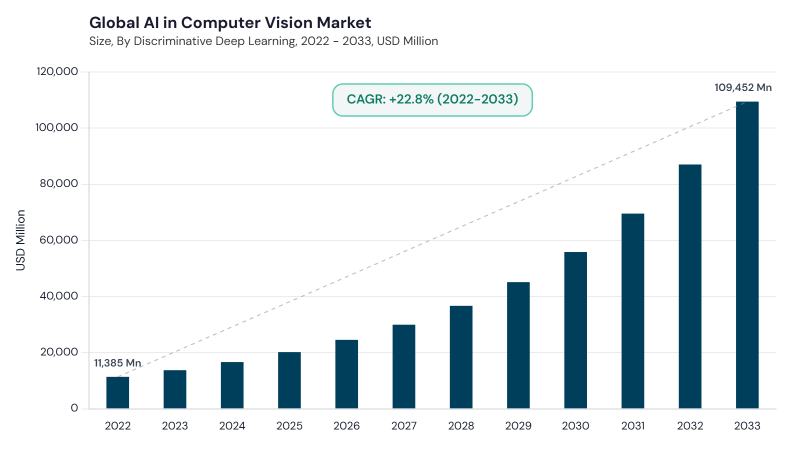
Based on Technology, the market is segmented into Discriminative Deep Learning, Traditional Machine Learning, Generative AI and Vision-Language Models. Discriminative Deep Learning dominated in 2025 and is projected to reach USD 109.5 billion by 2033, growing at a CAGR of 23.8%. Generative AI and Vision-Language Models is expected to record the highest CAGR of 39.5% during the forecast period.
Traditional machine learning and discriminative deep learning support visual classification, object detection, segmentation, and recognition. Generative AI and vision-language models (VLMs) add capabilities for describing images, interpreting visual context, and connecting visual information with natural-language instructions. Their commercial relevance depends on application accuracy, deployment cost, and evaluation under real-world conditions; not every generative AI product belongs within the computer vision market.
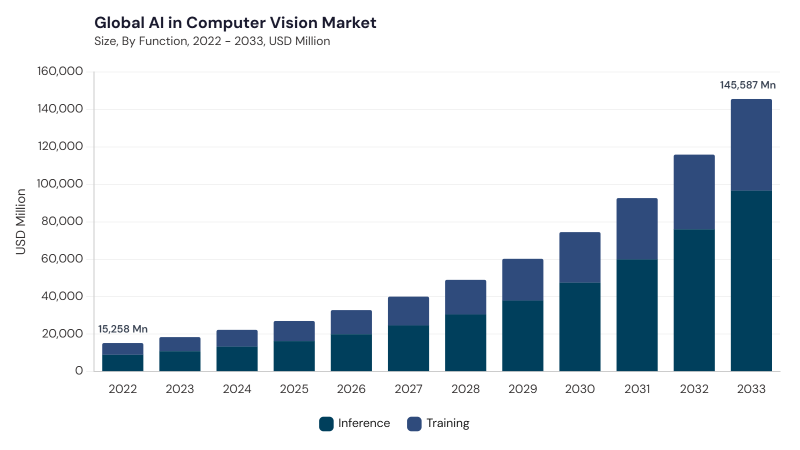
Based on Function, the market is segmented into Inference, Training. Inference dominated in 2025 and is projected to reach USD 96.6 billion by 2033, growing at a CAGR of 25.2%. Inference is expected to record the highest CAGR of 25.2% during the forecast period.
Inference refers to using a trained computer vision model to interpret incoming images or video, including real-time object detection, visual inspection, and edge AI processing. Training covers model development and improvement using representative image datasets. Deployment choices depend on latency, data privacy, computing requirements, and the need to maintain model accuracy as operating conditions change.
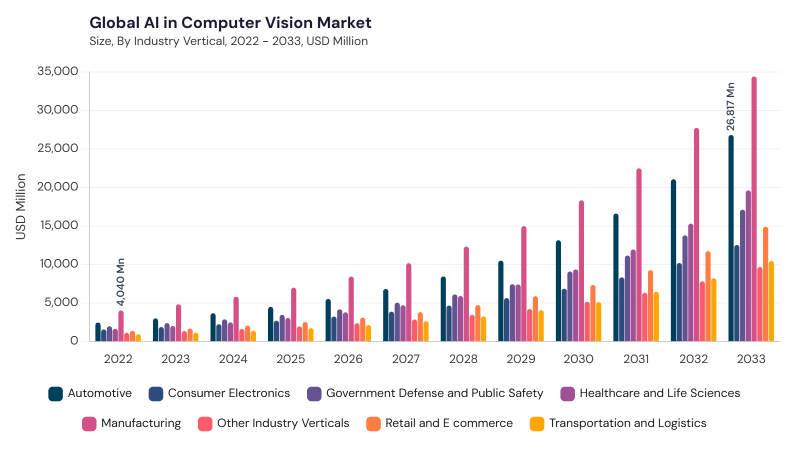
Based on Industry Vertical, the market is segmented into Manufacturing, Automotive, Healthcare and Life Sciences, Government & Defense and Public Safety, Retail and E-commerce, Consumer Electronics, Transportation and Logistics, Other Industry Verticals. Manufacturing dominated in 2025 and is projected to reach USD 34.4 billion by 2033, growing at a CAGR of 22.2%. Healthcare and Life Sciences is expected to record the highest CAGR of 26.4% during the forecast period.
Computer vision in healthcare includes AI-assisted medical image analysis and related visual interpretation workflows, while manufacturing emphasizes quality assurance and inspection. Other industry applications include automotive perception, retail image recognition, logistics guidance, and security and surveillance. These use cases have different performance, validation, and regulatory requirements, which shape purchasing decisions and deployment timelines.
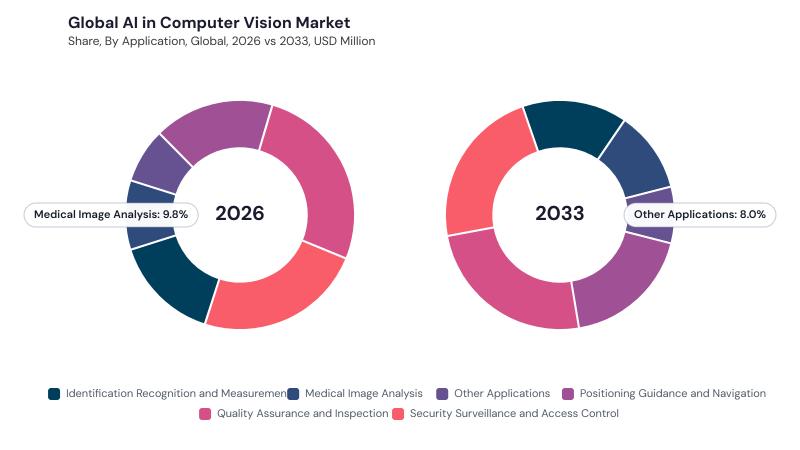
Based on Application, the market is segmented into Quality Assurance and Inspection, Security & Surveillance and Access Control, Positioning & Guidance and Navigation, Identification & Recognition and Measurement, Medical Image Analysis, Other Applications. Quality Assurance and Inspection dominated in 2025 and is projected to reach USD 36.0 billion by 2033, growing at a CAGR of 22.4%. Medical Image Analysis is expected to record the highest CAGR of 26.5% during the forecast period.
AI computer vision applications span quality assurance, object recognition, security monitoring, positioning, navigation, and medical image analysis. For buyers comparing computer vision tools, selection criteria include accuracy on representative images, inference speed, integration requirements, deployment environment, and ongoing model monitoring. Medical image analysis is the fastest-growing application segment in the supplied forecast, but healthcare use cases require careful validation and appropriate human oversight.
Region-wise, the AI in Computer Vision Market is analyzed across North America, Europe, Asia Pacific, LAMEA. North America led in 2025 and is projected to reach USD 50.4 billion by 2033, growing at a CAGR of 22.8%. Europe is projected to grow at a CAGR of 25.4%. Asia Pacific is projected to grow at a CAGR of 22.9%. LAMEA is projected to grow at a CAGR of 23.7%.
By Component
By Technology
By Function
By Industry Vertical
By Application
| Report Attribute | Details |
|---|---|
| Market size value in 2026 | USD 32.9 billion |
| Market size forecast in 2033 | USD 145.6 billion |
| Base Year | 2025 |
| Historical Period | 2022 to 2024 |
| Forecast Period | 2026 to 2033 |
| Revenue Growth Rate | CAGR of 23.7% from 2026 to 2033 |
| Number of Tables | 1110 |
| Number of Figures | 185 |
| Report Coverage | Market Trends, Revenue Estimation and Forecast, Segmentation Analysis, Regional and Country Breakdown, Competitive Landscape |
| Segments Covered | Component, Technology, Function, Industry Vertical, Application and Geography |
| Country Scope |
|
By Geography
Computer vision in AI uses machine learning to interpret images and video, producing outputs such as object detection, classification, recognition, and measurement for practical applications.
Applications covered by this market include quality assurance and inspection, security and surveillance, positioning and navigation, identification and recognition, and medical image analysis.
Generative AI and vision-language models can describe visual content and combine image understanding with natural-language instructions. In this report, they are a technology segment rather than the entire market.
Manufacturers use computer vision projects to improve defect detection, inspection consistency, and the speed of visual decisions on production lines.
The global market is projected to reach USD 145.6 billion by 2033, growing at a CAGR of 23.7% during 2026–2033, according to the supplied report estimates.
Demand for consistent inspection and earlier defect detection and Need for immediate visual decisions near equipment
Our team of dedicated experts can provide you with attractive expansion opportunities for your business.




 Unique Offerings
