“Global AI Model Runtime Security Market to reach a market value of USD 28740.01 Million by 2033 growing at a CAGR of %”
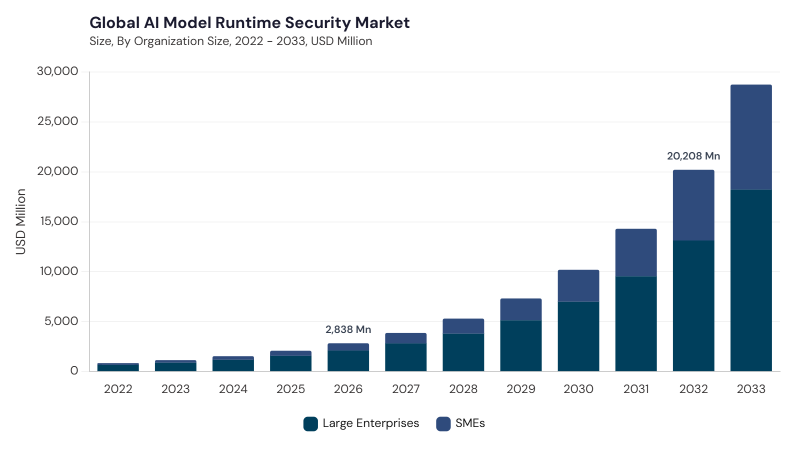
The Global AI Model Runtime Security Market is expected to reach USD 28.7 billion by 2033, growing at a CAGR of 39.2% during (2026 - 2033).
AI model runtime security comprises solutions and services that monitor and protect deployed AI systems while they process requests, generate outputs, or initiate actions. Also described in relevant use cases as LLM runtime security or AI inference security, these controls operate during live model and application interactions. The scope includes prompt injection and jailbreak protection, sensitive-data protection, input and output inspection, model threat detection, runtime policy enforcement and AI guardrails, and controls over AI agent access to external tools. This market concerns production-facing safeguards around model execution, not the entire AI security lifecycle. Predeployment testing, model scanning, and AI observability may support runtime protection, but their revenues require separate attribution unless they provide an in-scope runtime security function.
AI applications can receive malicious instructions through direct user prompts and indirectly through retrieved documents, webpages, and other untrusted content. This makes prompt injection protection and jailbreak detection important capabilities in LLM security deployments. OWASP identifies direct and indirect prompt injection and notes that retrieval-augmented generation and fine-tuning do not fully remove the vulnerability. AI runtime security controls can inspect prompts, retrieved context, model outputs, and tool requests at the point of use, helping organizations identify suspicious behavior and enforce application policies. The commercial case is strongest when these controls reduce the impact of compromised interactions without blocking legitimate tasks. No single detector or AI guardrail should be assumed to eliminate the underlying risk.
Business AI applications may process customer records, confidential documents, credentials, and internal knowledge. Sensitive-data protection during AI inference therefore requires attention to both inputs and generated outputs, as well as actions performed through connected tools. Amazon Bedrock Guardrails documents sensitive-information filtering, while Cisco AI Defense describes inspection of prompts and responses against configured policies. These examples illustrate how runtime guardrails and output protection can complement identity, retrieval permissions, and data access controls. Commercial value depends on enforcing the organization’s rules with acceptable latency and false-positive rates; output filtering alone cannot establish whether every disclosure is authorized.
Based on Component, the market is segmented into Solutions, Services. Solutions dominated in 2025 and is projected to reach USD 19.3 billion by 2033, growing at a CAGR of 36.9%. Services is expected to record the highest CAGR of 45.0% during the forecast period.
By Component, the market comprises Solutions and Services. Solutions include deployable software or platform capabilities for LLM runtime security, prompt and response inspection, model threat detection, sensitive-data protection, AI agent access controls, and runtime policy enforcement. Services include eligible consulting, integration, configuration, testing support, training, and managed operation associated with those controls. Combined software and support subscriptions require consistent revenue allocation. Predeployment assessments belong in this market only to the extent that the scope explicitly includes their contribution to runtime security.
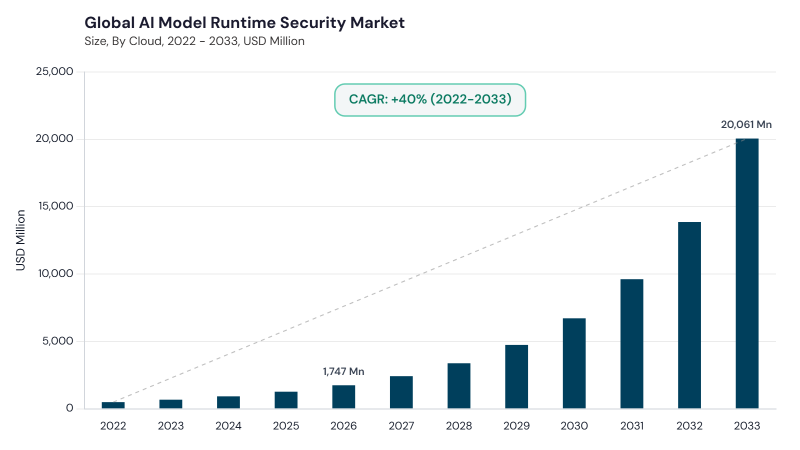
Based on Deployment Mode, the market is segmented into Cloud, On-Premises, Hybrid. Cloud dominated in 2025 and is projected to reach USD 20.1 billion by 2033, growing at a CAGR of 41.7%. Cloud is expected to record the highest CAGR of 41.7% during the forecast period.
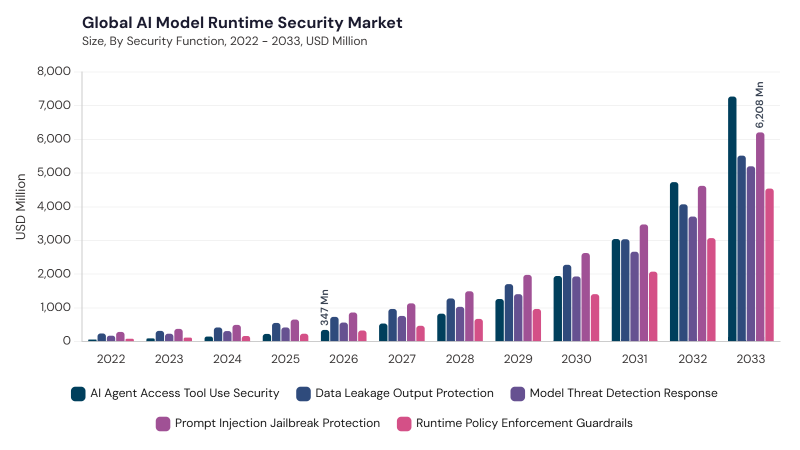
Based on Security Function, the market is segmented into Prompt Injection & Jailbreak Protection, Data Leakage & Output Protection, Model Threat Detection & Response, AI Agent Access & Tool-Use Security, Runtime Policy Enforcement & Guardrails. Prompt Injection & Jailbreak Protection dominated in 2025 and is projected to reach USD 6.2 billion by 2033, growing at a CAGR of 32.6%. AI Agent Access & Tool-Use Security is expected to record the highest CAGR of 54.5% during the forecast period.
Security functions address different points of exposure during live AI interactions. Prompt injection and jailbreak protection evaluates attempts to redirect model behavior; data leakage and output protection examines sensitive information entering or leaving the application; model threat detection and response identifies suspicious activity; and runtime policy enforcement and guardrails applies configured rules. AI agent access and tool-use security adds checks around permissions, external actions, and delegated workflows. These capabilities can overlap in one product, so the market analysis should not count the same revenue in several functions.
Based on Ai Workload, the market is segmented into Large Language Models, Agentic AI Systems, Traditional Machine Learning Models, Multimodal AI Models. Large Language Models dominated in 2025 and is projected to reach USD 11.3 billion by 2033, growing at a CAGR of 37.0%. Agentic AI Systems is expected to record the highest CAGR of 52.0% during the forecast period.
Large language model security focuses on live prompt, response, retrieval, and tool interactions. Agentic AI systems introduce additional exposure because an agent may plan multiple steps and invoke external tools with operational consequences. Multimodal models can process images, audio, or other inputs alongside text, while traditional machine learning workloads may require different runtime threat controls. The relevant distinction is the workload being protected, not the general popularity of an AI model category.
Based on Organization Size, the market is segmented into Large Enterprises, SMEs. Large Enterprises dominated in 2025 and is projected to reach USD 18.2 billion by 2033, growing at a CAGR of 36.1%. SMEs is expected to record the highest CAGR of 46.4% during the forecast period.
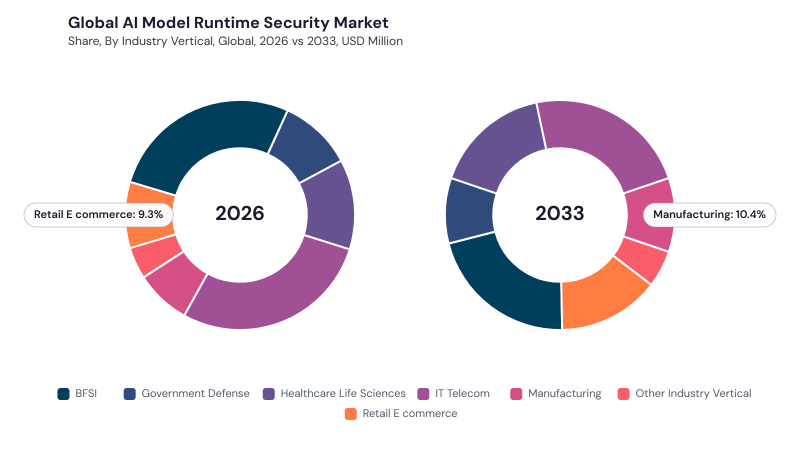
Based on Industry Vertical, the market is segmented into BFSI, IT & Telecom, Healthcare & Life Sciences, Government & Defense, Retail & E-commerce, Manufacturing, Other Industry Vertical. IT & Telecom dominated in 2025 and is projected to reach USD 6.6 billion by 2033, growing at a CAGR of 35.3%. Retail & E-commerce is expected to record the highest CAGR of 48.0% during the forecast period.
Region-wise, the AI Model Runtime Security Market is analyzed across North America, Europe, Asia Pacific, LAMEA. North America led in 2025 and is projected to reach USD 10.6 billion by 2033, growing at a CAGR of 35.1%. Europe is projected to grow at a CAGR of 36.9%. Asia Pacific is projected to grow at a CAGR of 46.8%. LAMEA is projected to grow at a CAGR of 43.3%.
By Component
By Deployment Mode
By Security Function
By Ai Workload
By Organization Size
By Industry Vertical
| Report Attribute | Details |
|---|---|
| Market size value in 2026 | USD 2.8 billion |
| Market size forecast in 2033 | USD 28.7 billion |
| Base Year | 2025 |
| Historical Period | 2022 to 2024 |
| Forecast Period | 2026 to 2033 |
| Revenue Growth Rate | CAGR of 39.2% from 2026 to 2033 |
| Number of Pages | 900 |
| Number of Figues | 150 |
| Report Coverage | Market Trends, Revenue Estimation and Forecast, Segmentation Analysis, Regional and Country Breakdown, Competitive Landscape |
| Segments Covered | Component, Deployment Mode, Security Function, Ai Workload, Organization Size, Industry Vertical and Geography |
| Country Scope |
|
By Geography
It is the protection of deployed AI systems during live requests, responses, and actions, including threat detection, data protection, and runtime policy enforcement.
Runtime security applies safeguards during production interactions; predeployment testing evaluates vulnerabilities before release. The activities complement each other but are not interchangeable.
Untrusted inputs or retrieved content can attempt to redirect an AI application. Runtime controls can inspect suspicious interactions and limit their impact alongside access controls.
They are configured checks and policies that inspect or constrain inputs, outputs, or agent actions during execution. Their effectiveness depends on the application and deployment context.
AI agents may use external tools and perform multi-step actions, making authorization, tool-use monitoring, and policy enforcement important beyond checking generated text.
Expected to reach USD 28.7 billion by 2033
Our team of dedicated experts can provide you with attractive expansion opportunities for your business.