The sample copy of this report is available for access.
“Global WLAN IC Market to reach a market value of USD 29162.66 Million by 2033 growing at a CAGR of %”
The Global WLAN IC Market is expected to reach USD 29.1 billion by 2033, growing at a CAGR of 8.5% during (2026 – 2033).
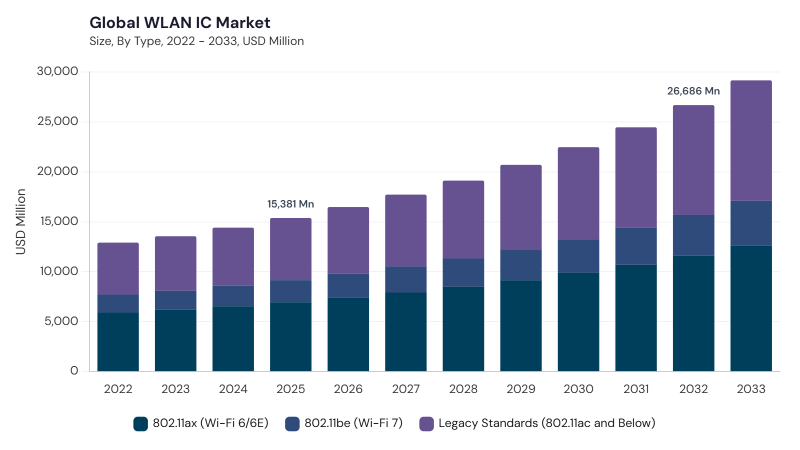
WLAN IC demand is increasing as connected devices, high-speed wireless networks, and Wi-Fi-enabled products expand across consumer electronics, enterprise networking, automotive, industrial, and IoT applications. These chipsets support faster data transfer, lower latency, improved power efficiency, and stable multi-device connectivity in smartphones, laptops, routers, smart-home products, wearables, connected vehicles, and industrial systems. Market growth is being driven by Wi-Fi 6, Wi-Fi 6E, and Wi-Fi 7 adoption, along with smart-home ecosystems, cloud connectivity, edge applications, and the need for seamless wireless performance.
Rising adoption of connected devices is strengthening WLAN IC demand across homes, enterprises, factories, vehicles, hospitals, public infrastructure, and embedded IoT environments. The migration toward Wi-Fi 6, Wi-Fi 6E, and Wi-Fi 7 is pushing chipset manufacturers to deliver higher throughput, wider spectrum support, lower latency, and stronger performance in dense networks. IoT and industrial automation are also widening requirements for low-power, secure, and reliable WLAN ICs capable of supporting sensors, actuators, smart appliances, and connected machinery. Miniaturization and power efficiency remain important as WLAN ICs are increasingly embedded in compact and battery-operated products. The market’s future growth is closely linked to semiconductor integration, spectrum availability, device replacement cycles, and demand for high-performance wireless connectivity.
Competition in the WLAN IC market is innovation-driven and shaped by wireless-standard migration, chipset integration, RF performance, power efficiency, cost control, and OEM relationships. Leading vendors focus on Wi-Fi 6/6E and Wi-Fi 7 platforms, multiprotocol connectivity, advanced security, compact design, and AI-assisted network optimization. Strategic collaboration with device manufacturers, module makers, access-point vendors, chipset foundries, and software providers helps accelerate commercialization and reduce integration complexity. Global incumbents benefit from scale, patent portfolios, R&D depth, and established design wins, while specialized vendors compete in IoT, embedded systems, smart-home products, and cost-sensitive connected devices.

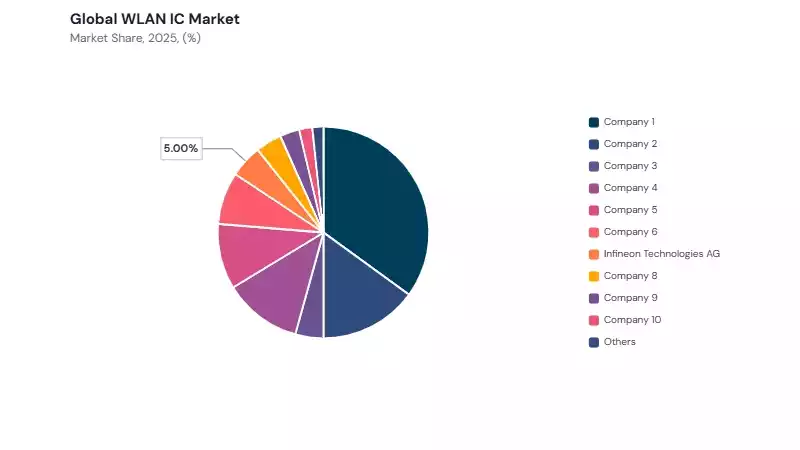
The global WLAN IC market is highly concentrated, with established semiconductor companies holding strong positions due to advanced RF design capability, intellectual property, Wi-Fi certification expertise, OEM relationships, and high-volume manufacturing scale. Broadcom, Qualcomm Technologies, and MediaTek lead through broad wireless connectivity portfolios spanning smartphones, routers, broadband gateways, enterprise access points, and connected consumer devices. Realtek and Intel maintain strong positions in PC connectivity, embedded systems, and client computing, while NXP, Infineon, HiSilicon, Beken, and Espressif address automotive, industrial, IoT, smart-home, and specialized embedded applications. Competition is increasingly shaped by Wi-Fi 7 commercialization, multiprotocol integration, energy efficiency, security, smartphone and PC design wins, and IoT expansion.
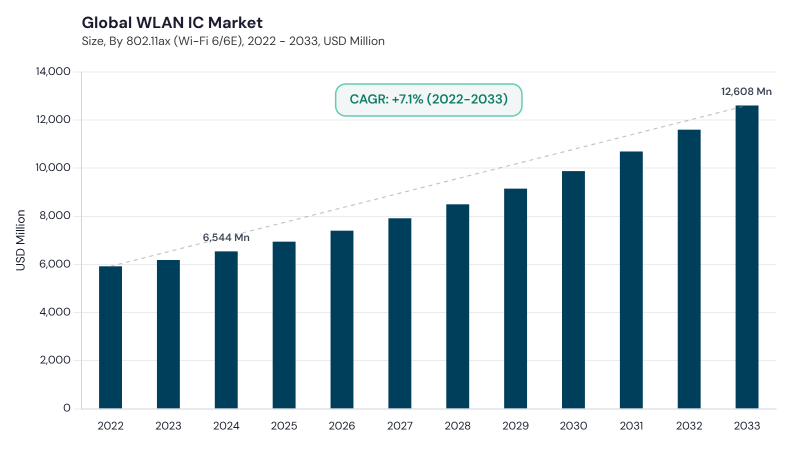
Based on type, the market is segmented into 802.11ax (Wi-Fi 6/6E), Legacy Standards (802.11ac and Below), and 802.11be (Wi-Fi 7). The 802.11ax (Wi-Fi 6/6E) market dominated the Global WLAN IC Market by Type in 2025, and would continue to be a dominant market till 2033; thereby, achieving a market value of USD 12.6 billion by 2033, growing at a CAGR of 7.9 % during the forecast period. The Legacy Standards (802.11ac and Below) market is expected to witness a CAGR of 8.8% during (2026 - 2033). Additionally, The 802.11be (Wi-Fi 7) market is expected to witness highest CAGR of 9.4% during (2026 - 2033).
802.11ax (Wi-Fi 6/6E) supports higher device density, improved spectral utilization, lower latency, and better performance across homes, offices, campuses, healthcare facilities, factories, and public infrastructure. Legacy Standards remain relevant because many routers, embedded systems, low-cost consumer electronics, industrial sensors, and established devices continue to rely on proven WLAN technologies where ultra-high throughput is not essential. 802.11be (Wi-Fi 7) is emerging as the high-performance category for premium smartphones, laptops, routers, gateways, enterprise access points, cloud gaming, AR/VR, immersive media, and advanced industrial applications. The shift across these standards reflects a gradual migration path, where Wi-Fi 6/6E serves as the mainstream transition platform and Wi-Fi 7 expands into performance-intensive environments. Semiconductor vendors are focusing on wider channels, multi-link operation, advanced modulation, power efficiency, and integrated RF capabilities to support next-generation WLAN requirements.
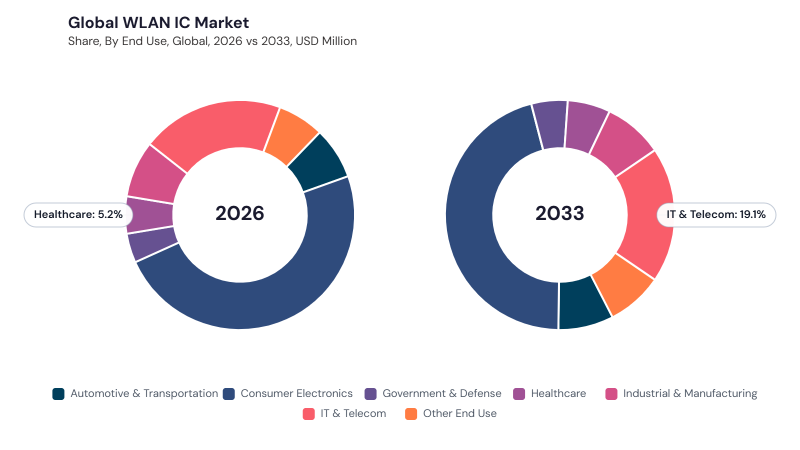
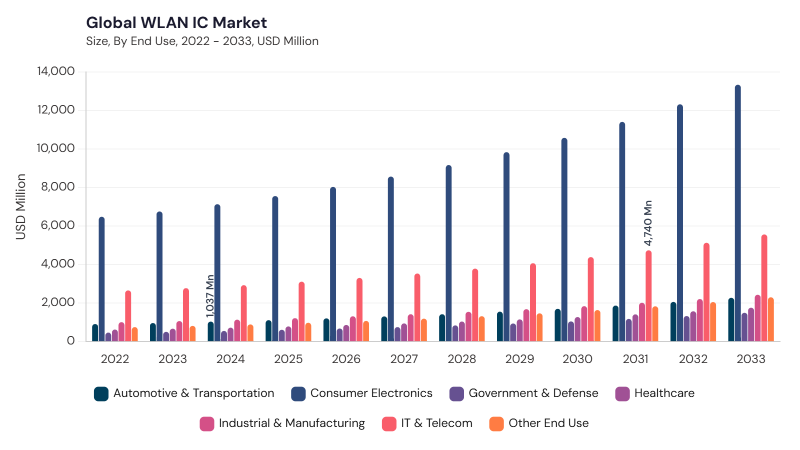
Based on end use, the market is segmented into Consumer Electronics, IT & Telecom, Industrial & Manufacturing, Automotive & Transportation, Healthcare, Government & Defense, and Other End Use. The Consumer Electronics market dominated the Global WLAN IC Market by End Use in 2025, and would continue to be a dominant market till 2033; thereby, achieving a market value of USD 13.3 billion by 2033, growing at a CAGR of 7.5 % during the forecast period. The IT & Telecom market is expected to witness a CAGR of 7.7% during (2026 - 2033). Additionally, The Industrial & Manufacturing market is expected to witness highest CAGR of 9.2% during (2026 - 2033).
Consumer Electronics represents the broadest application area, with WLAN ICs integrated into smartphones, laptops, tablets, smart televisions, gaming systems, smart-home products, wearables, and connected appliances. IT & Telecom demand is linked to routers, access points, communication hubs, enterprise networks, broadband infrastructure, cloud connectivity, and high-density wireless traffic management. Industrial & Manufacturing uses WLAN ICs in automation, robotics, machine monitoring, asset tracking, edge computing, and Industry 4.0 environments requiring rugged and reliable connectivity. Automotive & Transportation adoption is growing through infotainment, telematics, diagnostics, software updates, passenger connectivity, and connected vehicle systems. Healthcare relies on WLAN ICs for medical devices, patient monitoring, hospital connectivity, telemedicine, and wireless clinical workflows. Government & Defense requires secure and resilient connectivity, while Other End Use includes education, hospitality, retail, public venues, and commercial facilities.
Free Valuable Insights: WLAN IC Market Size to reach $29.1 Billion by 2033
Based on region, the market is segmented into North America, Europe, Asia Pacific, and LAMEA. The Asia Pacific market dominated the Global WLAN IC Market by Region in 2025, and would continue to be a dominant market till 2033; thereby, achieving a market value of USD 12.1 billion by 2033, growing at a CAGR of 8.9 % during the forecast period. The Europe market is expected to witness a CAGR of 8.3% during (2026 - 2033). Additionally, The North America market is expected to witness a CAGR of 7.8% during (2026 - 2033).
North America demand is driven by advanced Wi-Fi adoption, connected consumer electronics, enterprise networking, cloud applications, industrial automation, and high-bandwidth digital usage. Europe is supported by digitalization, connected industrial systems, automotive connectivity, smart infrastructure, privacy-aware network modernization, and broader use of wireless technologies across consumer and enterprise environments. Asia Pacific leads the market due to its electronics manufacturing base, semiconductor supply chains, connected-device production, broadband expansion, and strong demand from smartphones, computers, routers, and IoT products. LAMEA remains smaller but is developing through improving broadband availability, rising connected-device penetration, telecom infrastructure investment, and wireless connectivity adoption across consumer, commercial, industrial, and public-sector applications.
| Report Attribute | Details |
|---|---|
| Market size value in 2026 | USD 16.4 billion |
| Market size forecast in 2033 | USD 29.1 billion |
| Base Year | 2025 |
| Historical Period | 2022 to 2024 |
| Forecast Period | 2026 to 2033 |
| Revenue Growth Rate | CAGR of 8.5% from 2026 to 2033 |
| Number of Pages | 493 |
| Tables | 390 |
| Report Coverage | Market Trends, Revenue Estimation and Forecast, Segmentation Analysis, Regional and Country Breakdown, Competitive Landscape, Market Share Analysis, Company Profiling, Companies Strategic Developments, SWOT Analysis, Product Life Cycle Analysis, Value Chain Analysis, Market Consolidation Analysis, Key Customer Criteria, Pandemic Impact Analysis, and Winning Imperatives |
| Segments Covered | Type, End Use, and Geography |
| Country Scope |
|
| Companies Included | Broadcom Inc.; Qualcomm Technologies, Inc.; MediaTek Inc.; Realtek Semiconductor Corp.; Intel Corporation; NXP Semiconductors N.V.; Infineon Technologies AG; HiSilicon; Beken Corporation; Espressif Systems |
2025-October: Qualcomm collaborated with Ubiquiti to scale Wi-Fi 7 enterprise access points using Qualcomm Dragonwing Networking Infrastructure platforms across enterprise WLAN deployments.
2025-May: Espressif moved its dual-band ESP32-C5 Wi-Fi 6 SoC into mass production, expanding cost-oriented dual-band Wi-Fi 6 silicon availability for high-volume IoT designs.
2024-October: Qualcomm launched Networking Pro A7 Elite, combining Wi-Fi 7 networking with edge-AI processing for routers, mesh systems, broadband gateways, and enterprise access points.
2024-June: Infineon expanded its AIROC portfolio with the CYW5591x Wi-Fi 6/6E connected MCU family for IoT applications requiring low power consumption and robust wireless connectivity.
2024-June: Infineon partnered with Murata and AzureWave to commercialize CYW5591x-based Wi-Fi modules for personal, industrial, mobile, consumer-electronics, and home-appliance applications.
2024-February: Qualcomm launched the FastConnect 7900 AI-optimized Wi-Fi 7 connectivity chip, integrating Wi-Fi 7, Bluetooth, and Ultra Wideband technologies in a single 6 nm device.
2024-January: Espressif introduced ESP32-C61 to expand affordable Wi-Fi 6 and Bluetooth LE connectivity for cost-sensitive connected-device applications.
2023-November: MediaTek expanded its Wi-Fi 7 IC portfolio with Filogic 860 and Filogic 360, supporting enterprise access points, gateways, mesh nodes, edge devices, streaming hardware, and consumer electronics.
By Type
By End Use
By Geography
The WLAN IC market is valued at USD 16.4 billion in 2026.
802.11ax (Wi-Fi 6/6E) leads, projected to reach USD 12.6 billion by 2033.
Broadcom, Qualcomm, MediaTek, Realtek, Intel, NXP, Infineon, HiSilicon, Beken, Espressif dominate the market.
Asia Pacific leads, projected to reach USD 12.1 billion by 2033.
Smart connected devices and IoT adoption are elevating WLAN IC demand.
Consumer Electronics leads, projected to reach USD 13.3 billion by 2033.
Our team of dedicated experts can provide you with attractive expansion opportunities for your business.






 Unique Offerings
