The sample copy of this report is available for access.
The Europe WLAN IC Market is expected to reach USD 5.6 billion by 2031, growing at a CAGR of 8.3% during (2026 - 2033).
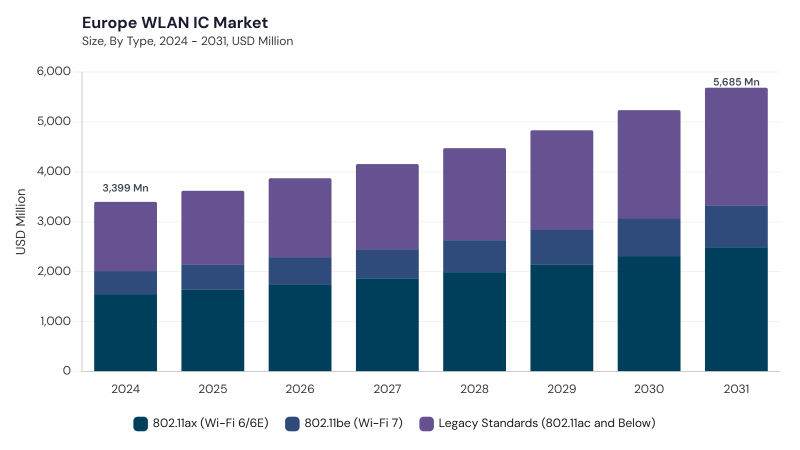
The Europe WLAN IC Market originated with the early development of IEEE 802.11 standards in the late 1990s, when WLAN integrated circuits were mainly used to enable basic wireless connectivity across enterprise and consumer environments. As Wi-Fi adoption expanded, successive standards such as 802.11b, 802.11g, 802.11n, 802.11ac, and 802.11ax improved throughput, range, and reliability. Over time, MIMO, enhanced modulation schemes, lower power consumption, smartphones, laptops, IoT devices, smart homes, and stricter European regulatory frameworks transformed WLAN ICs into advanced connectivity components supporting heterogeneous residential, commercial, industrial, and enterprise networks.
Current market growth is shaped by Wi-Fi 6 adoption, WLAN and 5G convergence, security integration, AI-supported network management, and energy-efficient chipset design. Manufacturers are increasingly developing WLAN ICs with high throughput, low latency, multi-mode and multi-band capabilities, hardware-level encryption, secure boot, real-time threat detection, SoC architectures, advanced packaging, and spectrum-compliant designs. Demand is also rising for chipsets that support dense urban networks, enterprise upgrades, industrial automation, smart cities, edge computing, augmented reality, connected healthcare, automotive systems, and secure wireless connectivity across Europe.
Based on Type, the market is segmented into 802.11ax (Wi-Fi 6/6E), Legacy Standards (802.11ac and Below), and 802.11be (Wi-Fi 7). The 802.11ax (Wi-Fi 6/6E) market dominated the Europe WLAN IC Market by Type in 2025, and would continue to be a dominant market till 2033; thereby, achieving a market value of USD 2.4 billion by 2031, growing at a CAGR of 7.7 % during the forecast period. The Legacy Standards (802.11ac and Below) market is expected to witness a CAGR of 8.6% during (2026 - 2033). Additionally, The 802.11be (Wi-Fi 7) market is expected to witness highest CAGR of 9.2% during (2026 - 2033).
802.11ax (Wi-Fi 6/6E) remains the leading type as it supports enterprises, residential users, educational institutions, healthcare providers, transportation hubs, hospitality operators, dense environments, hybrid working, cloud applications, gigabit broadband, lower 6 GHz spectrum use, and Wi-Fi 6E-compatible equipment. Legacy Standards (802.11ac and Below) maintain a significant foothold through residential and commercial installed equipment, older network deployments, budget devices, embedded products, standard internet browsing, moderate video streaming, economical routers, printers, surveillance systems, point-of-sale systems, and long-lifecycle industrial controllers. 802.11be (Wi-Fi 7) represents an emerging presence through premium routers, advanced client devices, high-performance broadband, enterprise connectivity, gaming, digital media, professional applications, wider channels, reduced latency, high-throughput use cases, premium laptops, smartphones, mesh systems, and next-generation gateways.
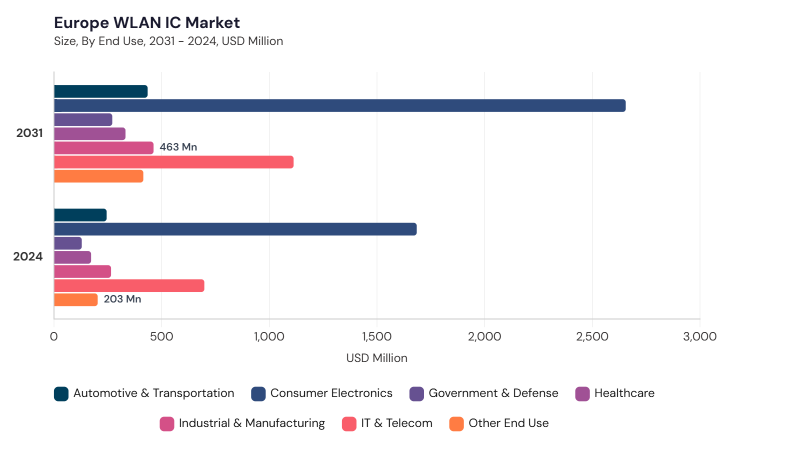
Based on End Use, the market is segmented into Consumer Electronics, IT & Telecom, Industrial & Manufacturing, Automotive & Transportation, Healthcare, Government & Defense, and Other End Use. Consumer Electronics remains the leading end use as WLAN ICs support smartphones, laptops, smart televisions, gaming consoles, smart speakers, wearables, connected appliances, smart-home equipment, multimedia streaming, cloud gaming, Bluetooth coexistence, low power consumption, compact designs, Wi-Fi 6/6E, Wi-Fi 7, and multi-generation device compatibility. IT & Telecom holds a substantial standing through enterprise access points, routers, broadband gateways, mesh systems, network interface modules, cloud-managed infrastructure, telecom customer-premises equipment, hybrid working, cloud applications, unified communications, and lower 6 GHz-enabled upgrades. Industrial & Manufacturing secures a considerable presence through industrial gateways, robots, automated guided vehicles, production equipment, sensors, machine-vision systems, handheld terminals, industrial IoT, real-time monitoring, predictive maintenance, and flexible factory automation.
Automotive & Transportation demonstrates a steady foothold through infotainment systems, in-vehicle hotspots, wireless smartphone integration, OTA software updates, diagnostic interfaces, rear-seat entertainment, connected vehicles, public transport, rail, and intelligent transportation systems. Healthcare registers an advancing presence through patient monitoring equipment, medical tablets, infusion systems, diagnostic devices, wearable health products, hospital communication systems, mobile clinical workstations, electronic health records, telemedicine, and remote patient monitoring. Government & Defense represents a promising outlook through public administration, defense installations, emergency response systems, secure government networks, command environments, rugged computers, secure tablets, training infrastructure, encryption, authentication, and specialized communication equipment. Other End Use develops a noteworthy position through education, retail, hospitality, entertainment, smart buildings, utilities, logistics, public venues, digital signage, smart meters, building automation, warehouse equipment, guest connectivity, and location-aware applications.
Free Valuable Insights: The Worldwide WLAN IC Market is projected to reach USD 29.1 Billion billion by 2033, at a CAGR of 8.5%
Based on Country, the market is segmented into Germany, UK, France, Russia, Spain, Italy, and Rest of Europe. The UK market dominated the Europe WLAN IC Market by Country in 2025, and would continue to be a dominant market till 2033; thereby, achieving a market value of USD 1.0 billion by 2031, growing at a CAGR of 6.6 % during the forecast period. The Germany market is expected to witness a CAGR of 7.2% during (2026 - 2033). Additionally, The France market is expected to witness a CAGR of 9.1% during (2026 - 2033).
Germany is shaped by Wi-Fi 6/6E, IoT, industrial automation, energy-efficient chip designs, smart buildings, automotive connectivity, and regulatory compliance, while the UK reflects Wi-Fi 6 integration, WLAN and 5G convergence, IC-level security, AI-assisted network management, SoC architectures, and local testing support. France is supported by multi-protocol WLAN ICs, Bluetooth and Zigbee convergence, low-power IoT solutions, Wi-Fi 6 and Wi-Fi 6E adoption, advanced security, and AI-enabled chipsets. Russia is influenced by domestic semiconductor manufacturing, Wi-Fi 6 adoption, IoT growth, local supply resilience, advanced security, multi-protocol support, and national certification needs, whereas Spain is advancing through Wi-Fi 6, WLAN and 5G convergence, energy-efficient designs, smart city projects, AI-enabled spectrum management, and localized supply-chain efforts. Italy is driven by Wi-Fi 6, energy-efficient WLAN ICs, hardware-level security, 5G integration, regional design centers, and smart manufacturing use cases, while Rest of Europe is shaped by Wi-Fi 6/6E, IoT integration, ultra-low-power ICs, embedded security, regulatory compliance, Wi-Fi 7 readiness, and multi-protocol system-on-chip solutions.

By Type
By End Use
By Country
Set to reach $5.6 Billion by 2031, growing at 8.3% CAGR during 2026-2033.
The UK leads with a market value of USD 1.0 billion by 2031, growing at a CAGR of 6.6% during 2026-2033.
Rising adoption of 802.11ax (Wi-Fi 6/6E) is a key driver, reaching USD 2.4 billion by 2031.
The 802.11be (Wi-Fi 7) segment will witness the highest CAGR of 9.2% during 2026-2033.
The Germany market is expected to witness a CAGR of 7.2% during 2026-2033.
The France market is expected to witness a CAGR of 9.1% during 2026-2033.
Our team of dedicated experts can provide you with attractive expansion opportunities for your business.




 Unique Offerings
