The sample copy of this report is available for access.
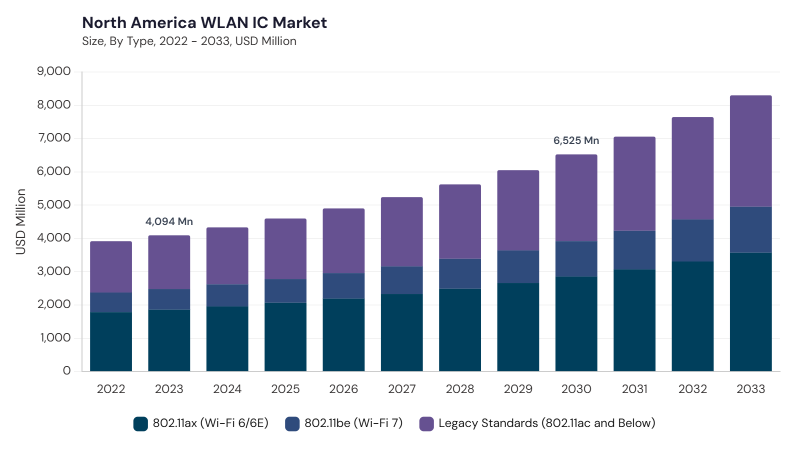
The North America WLAN IC Market is expected to reach USD 7.6 billion by 2032, growing at a CAGR of 7.8% during (2026 - 2033).
The North America WLAN IC Market originated alongside early wireless local area network adoption in the late 1990s and early 2000s, when enterprise and consumer environments began requiring reliable wireless connectivity. Initial development focused on integrating radio frequency components and digital logic into single-chip solutions supporting IEEE 802.11 standards such as 802.11b and 802.11g. Over time, the transition from discrete WLAN components to system-on-chip architectures, the adoption of 802.11n and 802.11ac, multi-function SoCs, mobile and IoT integration, and embedded WLAN capability alongside cellular and Bluetooth radios shaped the market into a mature connectivity ecosystem.
Current market growth is shaped by Wi-Fi 6, Wi-Fi 6E, emerging Wi-Fi 7, multi-band operation, power efficiency, and security integration. Manufacturers are increasingly developing WLAN ICs supporting 2.4 GHz, 5 GHz, and 6 GHz bands, dynamic adaptation across heterogeneous wireless environments, low-power design techniques, sleep-mode optimization, hardware-level encryption, WPA3, secure elements, and advanced authentication modules. Demand is also rising for chips that support higher throughput, lower latency, dense-device environments, enterprise wireless upgrades, IoT endpoints, smart homes, industrial connectivity, and secure wireless communication across North America.
Based on Type, the market is segmented into 802.11ax (Wi-Fi 6/6E), Legacy Standards (802.11ac and Below), and 802.11be (Wi-Fi 7). The 802.11ax (Wi-Fi 6/6E) market dominated the North America WLAN IC Market by Type in 2025, and would continue to be a dominant market till 2033; thereby, achieving a market value of USD 3.3 billion by 2032, growing at a CAGR of 7.2 % during the forecast period. The Legacy Standards (802.11ac and Below) market is expected to witness a CAGR of 8.1% during (2026 - 2033). Additionally, The 802.11be (Wi-Fi 7) market is expected to witness highest CAGR of 8.7% during (2026 - 2033).
802.11ax (Wi-Fi 6/6E) remains the leading type as it supports residential broadband gateways, enterprise wireless infrastructure, educational campuses, retail locations, healthcare facilities, public venues, cloud-based applications, congestion management, 6 GHz spectrum use, dense device environments, and Wi-Fi 6E device ecosystems. Legacy Standards (802.11ac and Below) retain a substantial presence through installed networking infrastructure, low-cost consumer devices, IoT equipment, embedded systems, mature enterprise networks, older residential gateways, security cameras, printers, smart appliances, inexpensive routers, and long-lifecycle industrial equipment. 802.11be (Wi-Fi 7) represents a promising outlook through premium home networking systems, high-end consumer electronics, enterprise access points, operator-supplied broadband gateways, cloud gaming, immersive collaboration, high-resolution streaming, AR/VR, advanced manufacturing, and high-density corporate networking.
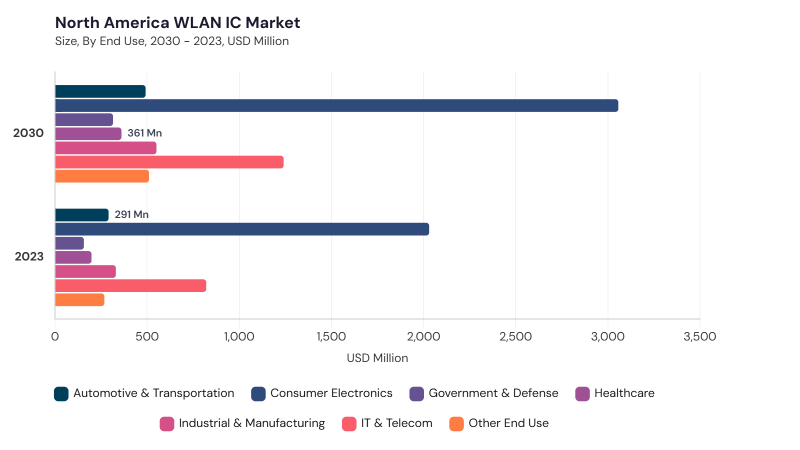
Based on End Use, the market is segmented into Consumer Electronics, IT & Telecom, Industrial & Manufacturing, Automotive & Transportation, Healthcare, Government & Defense, and Other End Use. Consumer Electronics remains the leading end use as WLAN ICs support smartphones, tablets, smart TVs, wearables, smart home gadgets, compact chip design, energy efficiency, multi-band connectivity, IoT-enabled home automation, smart speakers, AR/VR headsets, fast handoff, secure protocols, and coexistence with Bluetooth and cellular radios. IT & Telecom holds a significant position through routers, access points, network adapters, enterprise networking, dense user environments, cloud computing, edge networking, 5G integration, Wi-Fi 6 and Wi-Fi 7 adoption, QoS features, WPA3, MU-MIMO, and OFDMA. Industrial & Manufacturing maintains a considerable foothold through smart factories, automation systems, machine-to-machine communication, asset tracking, predictive maintenance, ruggedized connectivity, interference resistance, real-time process control, AGVs, robotic arms, and secure industrial wireless communication.
Automotive & Transportation develops a steady presence through infotainment systems, telematics, V2X communication, connected vehicles, passenger internet access, streaming, navigation, real-time diagnostics, automotive-grade standards, and EV or autonomous vehicle requirements. Healthcare sustains an emerging position through connected medical devices, wireless infusion pumps, portable diagnostic equipment, telemedicine platforms, hospital networks, remote patient monitoring, secure data transmission, wearable health monitors, and clinical workflow connectivity. Government & Defense forms a promising presence through secure wireless networks, military bases, emergency response systems, defense logistics, encrypted communication, jamming resistance, secure access control, hardened hardware, and government modernization programs. Other End Use registers a noteworthy standing through retail, education, hospitality, smart city projects, public venues, digital signage, point-of-sale systems, campus networks, smart infrastructure, high-density access, and location-based customer experiences.
Free Valuable Insights: The Global WLAN IC Market will hit USD 29.1 Billion billion by 2033, at a CAGR of 8.5%
Based on Country, the market is segmented into US, Canada, Mexico, and Rest of North America. The US market dominated the North America WLAN IC Market by Country in 2025, and would continue to be a dominant market till 2033; thereby, achieving a market value of USD 5.9 billion by 2032, growing at a CAGR of 7.1 % during the forecast period. The Canada market is expected to witness a CAGR of 10.4% during (2026 - 2033). Additionally, The Mexico market is expected to witness a CAGR of 9.4% during (2026 - 2033).
The US is shaped by Wi-Fi 6, Wi-Fi 6E, emerging Wi-Fi 7, multi-band support, power efficiency, advanced modulation, hardware-level security, RF front-end innovation, and 5G-linked wireless strategies, while Canada reflects Wi-Fi 6 adoption, IoT integration, smart home growth, public Wi-Fi infrastructure, security-enhanced WLAN ICs, AI-based network optimization, low-power chipsets, and domestic support for connected infrastructure. Mexico is supported by Wi-Fi 6 and Wi-Fi 6E adoption, OFDMA, MU-MIMO, miniaturized WLAN ICs, Bluetooth integration, advanced encryption, secure boot, rural broadband needs, and industrial automation use cases. Rest of North America is influenced by Wi-Fi 6/6E technologies, IoT convergence, ultra-low-power integration, multi-band connectivity, advanced security features, emerging Wi-Fi 7 capabilities, AI-enabled network optimization, and customized support for smart homes, industrial automation, and connected vehicles.

By Type
By End Use
By Country
Set to reach $7.6 Billion by 2032, growing at 7.8% CAGR during 2026-2033.
The US leads with $5.9 billion by 2032, growing at a CAGR of 7.1% during the forecast period.
Rising adoption of 802.11ax (Wi-Fi 6/6E) with a market value of $3.3 billion by 2032.
Expected to reach $3.3 billion by 2032, growing at a CAGR of 7.2% during 2026-2033.
Canada is expected to witness a CAGR of 10.4% during 2026-2033.
The 802.11be (Wi-Fi 7) segment is expected to witness a CAGR of 8.7% during 2026-2033.
Our team of dedicated experts can provide you with attractive expansion opportunities for your business.




 Unique Offerings
