The sample copy of this report is available for access.
The LAMEA WLAN IC Market is expected to reach USD 1308.6 million by 2029, growing at a CAGR of 10.1% during (2026 - 2033).
The LAMEA WLAN IC Market originated alongside the global rise of wireless local area networking technology, initially marked by basic Wi-Fi integrated circuits used for limited connectivity across enterprises and households. Early development focused on cost reduction and power efficiency, supported by demand for laptops and wireless peripherals. Over time, the market progressed from 802.11b/g to 802.11n and 802.11ac, improving throughput and range. Mobile device penetration, IoT adoption, multifunctional chip integration, government-led digital infrastructure, and demand for embedded WLAN solutions gradually shifted the market toward higher-performance and cost-effective ICs suited to resource-constrained LAMEA environments.
Current market growth is shaped by IoT ecosystem expansion, government and commercial digitization, enhanced WLAN security, localized manufacturing, and supply-chain diversification. Manufacturers are increasingly developing ultra-low-power, scalable, multi-standard WLAN ICs with advanced encryption, real-time threat detection, power optimization, miniaturization, software-defined functionality, and compatibility with emerging 5G-enabled networks. Demand is also rising for ICs that support smart cities, industrial automation, consumer electronics, public-sector digitization, smart infrastructure, wireless sensors, connected machinery, healthcare connectivity, and secure networks across Latin America, the Middle East, and Africa.
Based on Type, the market is segmented into 802.11ax (Wi-Fi 6/6E), Legacy Standards (802.11ac and Below), and 802.11be (Wi-Fi 7). The 802.11ax (Wi-Fi 6/6E) market dominated the LAMEA WLAN IC Market by Type in 2025, and would continue to be a dominant market till 2033; thereby, achieving a market value of USD 585.5 million by 2029, growing at a CAGR of 9.4 % during the forecast period. The Legacy Standards (802.11ac and Below) market is expected to witness a CAGR of 10.3% during (2026 - 2033). Additionally, The 802.11be (Wi-Fi 7) market is expected to witness highest CAGR of 11.3% during (2026 - 2033).
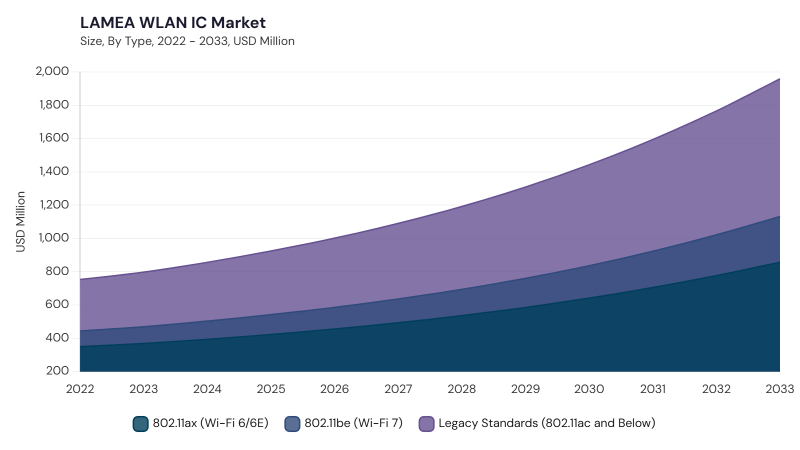
802.11ax (Wi-Fi 6/6E) remains the leading type as it supports higher throughput, dense urban centers, enterprise campuses, MU-MIMO, OFDMA, lower latency, commercial hotspots, office WLAN infrastructure, smart city applications, broadband expansion, IoT endpoints, public venues, corporate offices, cloud-based applications, and future-ready WLAN infrastructure. Legacy Standards (802.11ac and Below) sustain a significant presence through economical routers, established networking infrastructure, affordable home routers, entry-level enterprise access points, basic IoT devices, legacy industrial equipment, residential users, small businesses, moderate-speed connectivity, and cost-sensitive deployments. 802.11be (Wi-Fi 7) represents a promising foothold through premium networking hardware, advanced consumer devices, multi-gigabit speeds, ultra-low latency, 320 MHz channel bandwidth, multi-link operation, AR, VR, ultra-high-definition streaming, advanced industrial automation, smart campuses, digital media hubs, and high-performance wireless venues.
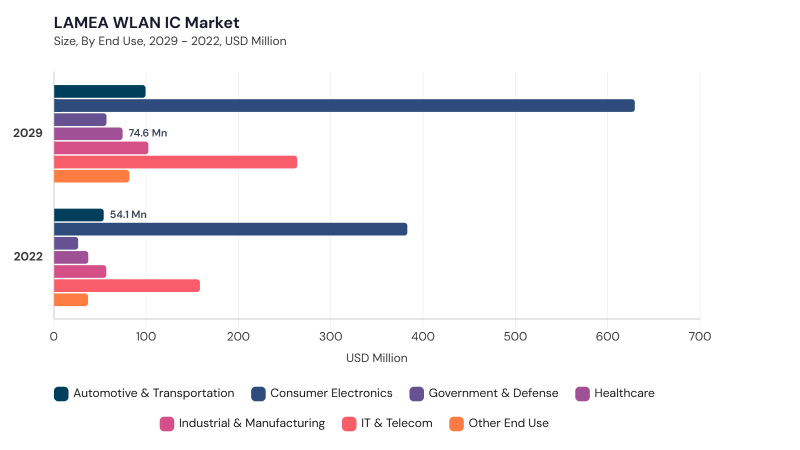
Based on End Use, the market is segmented into Consumer Electronics, IT & Telecom, Industrial & Manufacturing, Automotive & Transportation, Healthcare, Government & Defense, and Other End Use. Consumer Electronics remains the leading end use as WLAN ICs support smartphones, tablets, smart TVs, wearables, streaming, gaming, IoT interoperability, smart homes, compact form factors, low power consumption, multi-band connectivity, Bluetooth integration, consumer mobility, and cost-effective connected devices. IT & Telecom holds a substantial position through enterprise Wi-Fi infrastructure, routers, access points, broadband connectivity devices, telecom networks, enterprise-grade WLAN solutions, Wi-Fi 6/6E adoption, smart offices, remote work, scalable network management, and secure high-throughput connectivity. Industrial & Manufacturing demonstrates a considerable presence through automation systems, robotics, industrial IoT, machine-to-machine communication, remote diagnostics, predictive maintenance, asset tracking, wireless sensor networks, real-time monitoring, and robust connectivity in harsh operating conditions.
Automotive & Transportation maintains a steady foothold through in-vehicle connectivity, infotainment systems, V2X communications, passenger connectivity, fleet communication, smart transportation infrastructure, cellular and Bluetooth integration, and reliable wireless protocols in mobile environments. Healthcare registers an evolving presence through medical devices, patient monitoring systems, hospital information infrastructure, remote diagnostics, telemedicine, wireless clinical equipment, continuous data transmission, medical sensors, and secure healthcare connectivity. Government & Defense forms an emerging outlook through mission-critical communications, secure data exchange, tactical wireless networks, field communication devices, command center networks, encryption, frequency agility, electronic-interference resistance, public-sector digitization, and modernization of specialized communication systems. Other End Use develops a noteworthy standing through education, hospitality, retail facilities, commercial establishments, public utilities, Wi-Fi-enabled devices, automation, scalable wireless deployment, and integrated security features.
Free Valuable Insights: WLAN IC Market Size Worth USD 29.1 Billion billion by 2033
Based on Country, the market is segmented into Brazil, Argentina, UAE, Saudi Arabia, South Africa, Nigeria, and Rest of LAMEA. The Brazil market dominated the LAMEA WLAN IC Market by Country in 2025, and would continue to be a dominant market till 2033; thereby, achieving a market value of USD 347.5 million by 2029, growing at a CAGR of 8.7 % during the forecast period. The Argentina market is expected to witness a CAGR of 11.5% during (2026 - 2033). Additionally, The UAE market is expected to witness a CAGR of 8.9% during (2026 - 2033).
Brazil is shaped by Wi-Fi 6 adoption, smart city demand, Bluetooth and ultra-wideband convergence, energy-efficient WLAN ICs, telecom partnerships, and localized supply chains, while Argentina reflects dual-band and multi-band ICs, energy-efficient designs, Wi-Fi 6 compatibility, local telecom collaboration, regional manufacturing, and machine learning-enabled adaptive capabilities. The UAE is supported by smart city projects, Wi-Fi 6, MU-MIMO, spectrum efficiency, encryption, low-latency designs, IoT integration, and localized smart infrastructure needs, whereas Saudi Arabia is driven by IoT proliferation, Wi-Fi 6/6E, local manufacturing, supply-chain resilience, smart infrastructure, AI-driven functionality, and regional R&D hubs. South Africa is advancing through low-power WLAN ICs, dual-band and tri-band integration, advanced security protocols, telecom partnerships, regional R&D centers, and AI-enabled chip designs. Nigeria is influenced by remote work, local content development, IoT applications, smart infrastructure, adaptive frequency selection, power management, local telecom partnerships, and affordability-focused solutions, while Rest of LAMEA is shaped by low-power WLAN ICs, Wi-Fi 6/6E, IoT expansion, localized design, AI-driven adaptive connectivity, embedded security, and cost-efficient regional customization.

By Type
By End Use
By Country
Set to reach $1308.6 Million by 2029, growing at 10.1% CAGR during 2026-2033.
Brazil leads with $347.5 million by 2029, growing at 8.7% CAGR during 2026-2033.
802.11ax (Wi-Fi 6/6E) leads by type, reaching $585.5 million by 2029 at 9.4% CAGR during 2026-2033.
802.11be (Wi-Fi 7) will grow at the highest CAGR of 11.3% during 2026-2033.
The UAE market is expected to witness a CAGR of 8.9% during 2026-2033.
The Argentina market is expected to grow at a CAGR of 11.5% during 2026-2033.
Our team of dedicated experts can provide you with attractive expansion opportunities for your business.




 Unique Offerings
