The sample copy of this report is available for access.
“Global Wearable Payments Devices Market to reach a market value of USD 196,363.89 Million by 2033 growing at a CAGR of 13.9%”
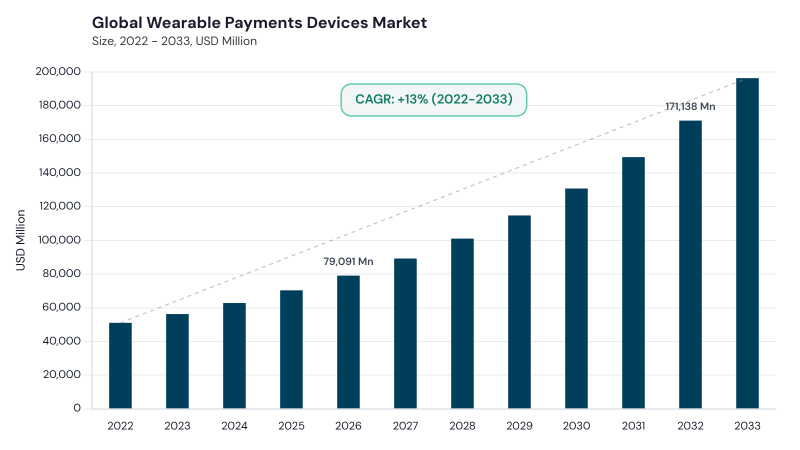
The Global Wearable Payments Devices Market is expected to reach USD 196.3 billion by 2033, growing at a CAGR of 13.9% during (2026 - 2033).
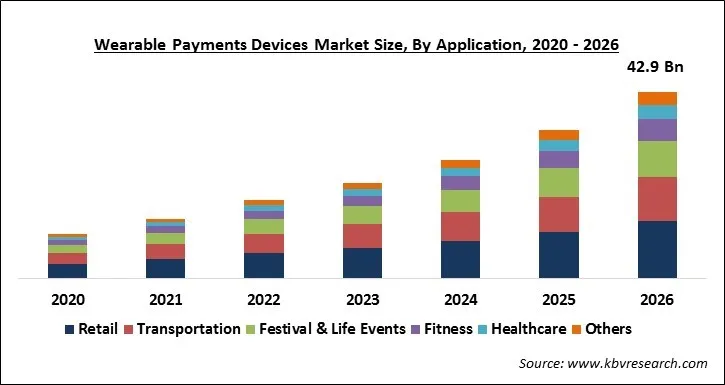
Rising demand for convenient, contactless, secure, hands-free, and faster payment experiences is driving the Wearable Payments Devices Market across retail, transportation, hospitality, entertainment, healthcare, fitness, and everyday consumer transactions. Growth is further strengthened by expanding contactless payment infrastructure, NFC adoption, smartwatch and fitness tracker penetration, digital wallet integration, tokenization, biometric authentication, longer battery life, and improved device compatibility.
Growth in the Wearable Payments Devices Market is driven by the global shift toward cashless, contactless, and frictionless payment behavior. Consumers increasingly prefer wearable devices that reduce dependence on cards, wallets, and smartphones while enabling quick transactions in retail stores, transit systems, gyms, events, and healthcare environments. Manufacturers are embedding payment functionality into multifunctional devices that also support fitness tracking, health monitoring, communication, digital identity, and loyalty programs. At the same time, improvements in NFC, RFID, QR codes, POS compatibility, biometric verification, tokenization, and fraud prevention are strengthening trust and expanding commercial viability.
The competitive environment is ecosystem-driven and moderately consolidated, with consumer electronics companies, smartwatch brands, fitness wearable manufacturers, payment network partners, and specialized wearable technology providers competing through device ecosystems, secure wallet integration, merchant acceptance, and user experience. Apple, Samsung, Garmin, Huawei, Alphabet, Xiaomi, Zepp Health, OPPO, Mobvoi, and Swatch compete through payment-enabled watches, fitness wearables, connected platforms, payment wallets, tokenization, and regional payment partnerships. Competitive success increasingly depends on combining hardware, digital wallets, security, smartphone integration, health features, application ecosystems, affordability, and broad merchant compatibility.

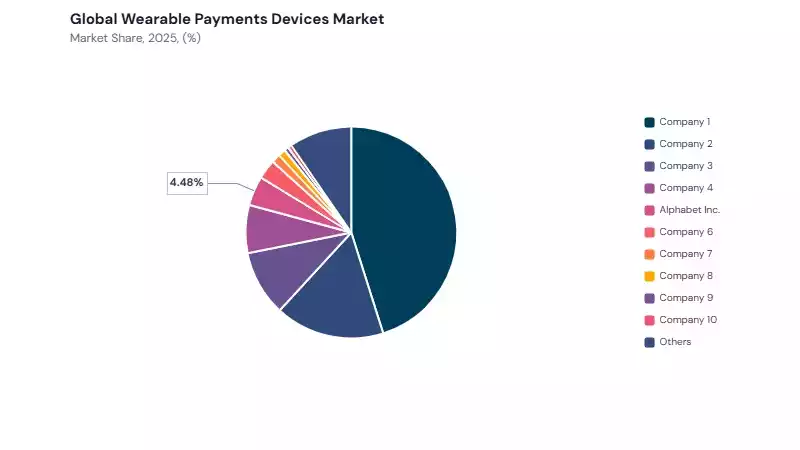
The global Wearable Payments Devices Market reflects a relatively concentrated and ecosystem-led competitive landscape, with Apple holding a commanding leadership position and Samsung serving as the strongest large-scale challenger. Garmin and Huawei form an important second tier through sports, fitness, outdoor, and connected-device ecosystems, while Alphabet and Xiaomi maintain meaningful positions through Android-linked services, digital payment infrastructure, and affordable wearable portfolios. Zepp Health, OPPO, Mobvoi, and Swatch strengthen the market through fitness-oriented devices, smartwatch ecosystems, and differentiated contactless watch formats.
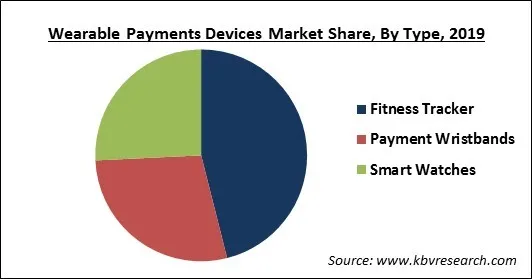
Based on Device, the market is segmented into Fitness Tracker, Smart Watches, and Payment Wristbands. The Fitness Tracker market dominated the Global Wearable Payments Devices Market by Device in 2025, and would continue to be a dominant market till 2033; thereby, achieving a market value of USD 80.1 billion by 2033, growing at a CAGR of 13.4 % during the forecast period. The Smart Watches market is expected to witness a CAGR of 14.1% during (2026 - 2033).
Fitness Tracker remains important as consumers increasingly prefer lightweight wearables that combine health monitoring, activity tracking, and convenient payment functionality. Smart Watches continue to serve as multifunctional digital companions that integrate communication, health features, wallet access, authentication, and app ecosystems. Payment Wristbands support targeted use cases where quick, durable, and simple tap-based payments are needed. These device categories are shaped by user convenience, security expectations, design comfort, battery performance, payment compatibility, and the growing demand for wallet-free transactions.
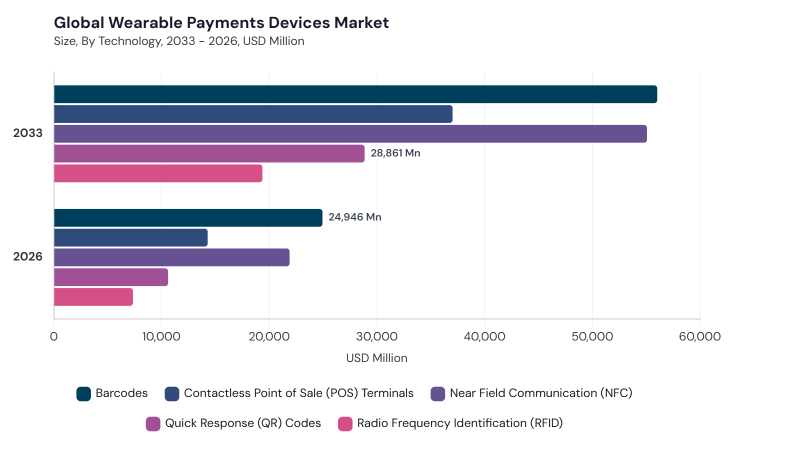
Based on Technology, the market is segmented into Barcodes, Near Field Communication (NFC), Contactless Point of Sale (POS) Terminals, Quick Response (QR) Codes, and Radio Frequency Identification (RFID). The Barcodes market dominated the Global Wearable Payments Devices Market by Technology in 2025, and would continue to be a dominant market till 2033; thereby, achieving a market value of USD 56.0 billion by 2033, growing at a CAGR of 12.3 % during the forecast period. The Near Field Communication (NFC) market is expected to witness a CAGR of 14.1% during (2026 - 2033). Additionally, The Contactless Point of Sale (POS) Terminals market is expected to witness highest CAGR of 14.6% during (2026 - 2033).
Barcodes support wearable-linked transactions where affordability, scanning compatibility, and simple account identification remain important. NFC remains a core payment technology due to its fast tap-and-pay experience, secure communication, and broad compatibility with contactless terminals. Contactless POS terminals provide the merchant-side infrastructure required for wider wearable payment acceptance. QR Codes support flexible, software-oriented payment interactions, while RFID enables rapid identification, access control, fare collection, and closed-loop payment applications in specialized environments.
Based on Application, the market is segmented into Retail, Transportation, Fitness, Festival & Live Events, Healthcare, and Other Application. The Retail market dominated the Global Wearable Payments Devices Market by Application in 2025, and would continue to be a dominant market till 2033; thereby, achieving a market value of USD 71.3 billion by 2033, growing at a CAGR of 12.6 % during the forecast period. The Transportation market is expected to witness a CAGR of 13.5% during (2026 - 2033). Additionally, The Fitness market is expected to witness highest CAGR of 14.4% during (2026 - 2033).
Retail remains the primary application area as wearable payments reduce checkout friction and support quick, contactless purchases across stores and service locations. Transportation benefits from tap-based fare collection, automated ticketing, and faster passenger movement across transit systems. Fitness applications are expanding as consumers use payment-enabled wearables during workouts, running, cycling, and wellness activities without carrying cards or phones. Festival & Live Events rely on wrist-based payment systems for cashless venues, while Healthcare and Other Application segments use wearables for secure payments, identification, access control, and specialized connected-service environments.
Free Valuable Insights: Wearable Payments Devices Market Size to reach $196.3 Billion by 2033
Region-wise, the Wearable Payments Devices Market is analyzed across North America, Europe, Asia Pacific, and LAMEA. The North America market dominated the Global Wearable Payments Devices Market by Region in 2025, and would continue to be a dominant market till 2033; thereby, achieving a market value of USD 65.6 billion by 2033, growing at a CAGR of 13.3 % during the forecast period. The Europe market is expected to witness a CAGR of 13.5% during (2026 - 2033). Additionally, The Asia Pacific market is expected to witness a CAGR of 14.5% during (2026 - 2033).
North America remains a major regional market due to strong contactless payment adoption, advanced smartwatch penetration, established digital wallet ecosystems, and broad merchant acceptance. Europe benefits from mature tap-to-pay behavior, digital payment modernization, strong data-security expectations, and expanding wearable-payment use across retail, transit, and events. Asia Pacific is expanding through rising smartphone adoption, growing digital wallets, affordable wearables, payment infrastructure modernization, and strong consumer electronics manufacturing. LAMEA is developing steadily as cashless payment adoption, fintech expansion, financial inclusion initiatives, and localized wearable payment solutions gain traction.
| Report Attribute | Details |
|---|---|
| Market size value in 2026 | USD 79.0 billion |
| Market size forecast in 2033 | USD 196.3 billion |
| Base Year | 2025 |
| Historical Period | 2022 to 2024 |
| Forecast Period | 2026 to 2033 |
| Revenue Growth Rate | CAGR of 13.9% from 2026 to 2033 |
| Number of Pages | 599 |
| Tables | 750 |
| Report Coverage | Market Trends, Revenue Estimation and Forecast, Segmentation Analysis, Regional and Country Breakdown, Competitive Landscape, Market Share Analysis, Company Profiling, Companies Strategic Developments, SWOT Analysis, Product Life Cycle Analysis, Value Chain Analysis, Market Consolidation Analysis, Key Customer Criteria, Pandemic Impact Analysis, and Winning Imperatives |
| Segments Covered | Device, Technology, Application, and Geography |
| Country Scope |
|
| Companies Included | Apple Inc.; Samsung Electronics Co., Ltd.; Garmin Ltd.; Huawei Technologies Co., Ltd.; Alphabet Inc.; Xiaomi Corporation; Zepp Health Corporation; OPPO; Mobvoi Information Technology Company Limited; The Swatch Group Ltd. |
By Device
By Technology
By Application
By Geography
Valued at USD 79.0 billion in 2026, it's projected to reach USD 196.3 billion by 2033, growing at 13.9% CAGR during the forecast period (2026-2033).
Fitness Tracker segment leads, expected to achieve USD 80.1 billion by 2033.
Apple Inc., Samsung Electronics Co., Ltd., Garmin Ltd., Huawei Technologies Co., Ltd., Alphabet Inc., Xiaomi Corporation, Zepp Health Corporation, OPPO, Mobvoi Information Technology Company Limited, The Swatch Group Ltd.
North America dominates, projected to reach USD 65.6 billion by 2033.
Expansion of contactless payment infrastructure and rising consumer demand for convenience drive growth.
The Barcodes segment leads, expected to reach USD 56.0 billion by 2033.
Our team of dedicated experts can provide you with attractive expansion opportunities for your business.








 Unique Offerings