The sample copy of this report is available for access.
The Asia Pacific Wearable Payments Devices Market is expected to reach USD 35.6 billion by 2030, growing at a CAGR of 14.5% during (2026 - 2033).
The Asia Pacific Wearable Payments Devices Market evolved from early NFC-enabled wristbands and smartwatches into a broader ecosystem of multifunctional payment wearables integrated with digital wallets, transit systems, health platforms, and retail networks. Advances in biometric authentication, tokenization, secure elements, device miniaturization, and mobile connectivity improved transaction security and user convenience. Government initiatives promoting cashless economies and continued expansion of digital payment infrastructure further accelerated adoption. The market now includes fitness trackers, smartwatches, payment wristbands, smart rings, and other connected formats designed for increasingly seamless financial interactions.
Health-payment convergence, AI-enabled security, localized fintech ecosystems, 5G connectivity, and broader contactless infrastructure are shaping current market development. Consumers increasingly favor devices that combine payments with health monitoring, biometric authentication, personalized services, and digital-wallet integration. Advances in biosensors, predictive analytics, secure tokenization, IoT connectivity, and real-time fraud detection are strengthening device functionality and consumer confidence. At the same time, regulatory fragmentation, uneven infrastructure maturity, data privacy concerns, interoperability requirements, and affordability continue to influence adoption across developed and emerging Asia Pacific markets.
Based on Device, the market is segmented into Fitness Tracker, Smart Watches, and Payment Wristbands. The Fitness Tracker market dominated the Asia Pacific Wearable Payments Devices Market by Device in 2025, and would continue to be a dominant market till 2033; thereby, achieving a market value of USD 14.7 billion by 2030, growing at a CAGR of 14 % during the forecast period. The Smart Watches market is expected to witness a CAGR of 14.7% during (2026 - 2033).
Fitness Tracker devices combine health monitoring with cashless payment capabilities and appeal to consumers seeking lightweight, affordable, and multifunctional wearables. Smart Watches provide broader functionality through communication, navigation, health monitoring, authentication, mobile-wallet integration, and payment services, supported by strong electronics manufacturing and diverse pricing options across the region. Payment Wristbands offer simple and rapid transactions in controlled environments such as theme parks, resorts, educational campuses, sporting facilities, tourist destinations, public transportation, and event venues where identification and payments can be integrated.
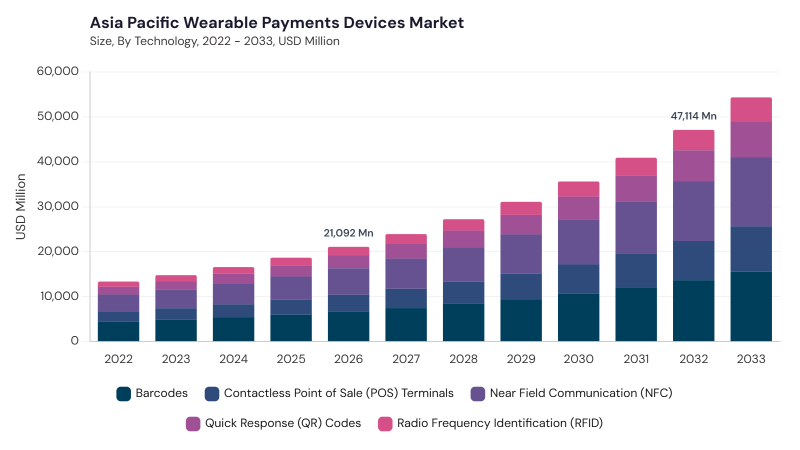
Based on Technology, the market is segmented into Barcodes, Near Field Communication (NFC), Contactless Point of Sale (POS) Terminals, Quick Response (QR) Codes, and Radio Frequency Identification (RFID). The Barcodes market dominated the Asia Pacific Wearable Payments Devices Market by Technology in 2025, and would continue to be a dominant market till 2033; thereby, achieving a market value of USD 10.6 billion by 2030, growing at a CAGR of 12.8 % during the forecast period. The Near Field Communication (NFC) market is expected to witness a CAGR of 14.7% during (2026 - 2033). Additionally, The Contactless Point of Sale (POS) Terminals market is expected to witness highest CAGR of 15.2% during (2026 - 2033).
Barcodes provide an accessible approach for payment, ticketing, loyalty, membership, and identification applications using established scanning systems. Near Field Communication (NFC) supports secure tap-based transactions through tokenization, biometric authentication, and secure-element technologies, particularly across developed contactless ecosystems. Contactless Point of Sale (POS) Terminals provide essential acceptance infrastructure across retail, hospitality, transportation, and service locations. Quick Response (QR) Codes benefit from strong consumer familiarity, super-app integration, and domestic digital-wallet ecosystems, while Radio Frequency Identification (RFID) supports payment, access control, admission, and identity management within entertainment venues, campuses, transit systems, hospitality properties, and other closed-loop environments.
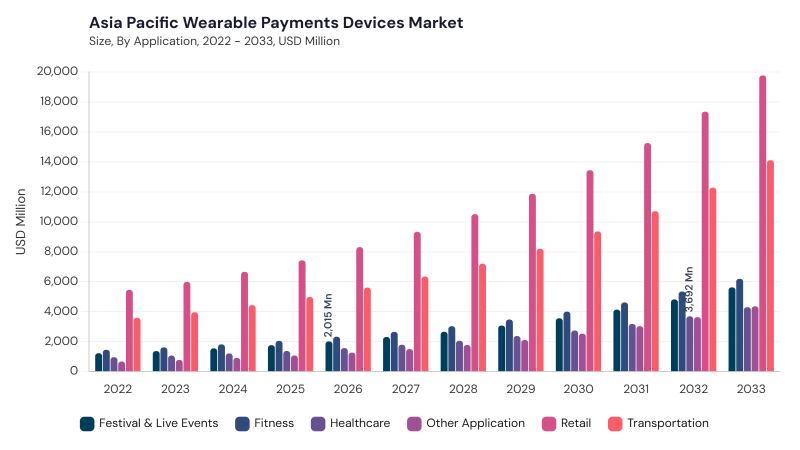
Based on Application, the market is segmented into Retail, Transportation, Fitness, Festival & Live Events, Healthcare, and Other Application. Retail applications benefit from contactless checkout, loyalty integration, personalized offers, and omnichannel commerce, while Transportation uses payment-enabled wearables for rapid fare validation across metro, rail, bus, and other transit systems. Fitness combines payment functionality with health and performance monitoring for consumers seeking wallet-free purchases during physical activity.
Festival & Live Events uses wearable credentials for admission, onsite spending, visitor identification, and restricted-area access. Healthcare applications combine identification and transaction functions within smart hospitals and connected wellness environments, while Other Application includes corporate campuses, universities, residential communities, hotels, tourist facilities, and other specialized digital-payment settings.
Free Valuable Insights: Wearable Payments Devices Market is Predicted to reach USD 196.3 Billion billion by 2033, at a CAGR of 13.9%
Based on Country, the market is segmented into China, Japan, India, South Korea, Singapore, Malaysia, and Rest of Asia Pacific. The China market dominated the Asia Pacific Wearable Payments Devices Market by Country in 2025, and would continue to be a dominant market till 2033; thereby, achieving a market value of USD 11.3 billion by 2030, growing at a CAGR of 12.7 % during the forecast period. The Japan market is expected to witness a CAGR of 13.6% during (2026 - 2033). Additionally, The India market is expected to witness a CAGR of 15.4% during (2026 - 2033).
Across Asia Pacific, wearable payment adoption is being shaped by biometric authentication, fintech localization, digital-wallet integration, health-payment convergence, regulatory support, and expanding connectivity. China emphasizes AI-enabled security, ecosystem expansion, localized payment platforms, biometric authentication, and multifunctional wearables, while Japan focuses on cashless initiatives, biometric security, domestic payment ecosystems, 5G connectivity, and health-payment integration. India is advancing UPI-enabled wearables, tokenization, secure elements, affordability, and localized payment solutions, whereas South Korea emphasizes mobile-financial integration, eSIM, 5G connectivity, biometrics, and ecosystem-based services. Singapore focuses on AI-driven risk management, IoT connectivity, offline payments, advanced biometrics, and local-network interoperability, while Malaysia emphasizes 5G-enabled payments, AI-based security, biometric authentication, digital-banking integration, and broader urban and semi-urban accessibility. Rest of Asia Pacific continues to develop affordable wearable formats, contactless payments, biometric authentication, 5G-enabled transactions, transit integration, and localized payment ecosystems.

By Device
By Technology
By Application
By Country
Set to reach $35.6 Billion by 2030, growing at 14.5% CAGR during 2026-2033.
China leads with $11.3 billion by 2030, growing at a CAGR of 12.7% during the forecast period.
Rising adoption of fitness trackers, reaching $14.7 billion by 2030, is a key driver.
Fitness Tracker segment hits $14.7 billion by 2030, growing at a 14% CAGR during the forecast period.
India market is expected to witness a CAGR of 15.4% during 2026-2033.
NFC technology is expected to witness a CAGR of 14.7% during 2026-2033.
Our team of dedicated experts can provide you with attractive expansion opportunities for your business.




 Unique Offerings