The sample copy of this report is available for access.
The LAMEA Wearable Payments Devices Market is expected to reach USD 11.1 billion by 2029, growing at a CAGR of 15.5% during (2026 - 2033).
The LAMEA Wearable Payments Devices Market evolved from early contactless payment solutions supported by smartphones and NFC technology into a broader ecosystem of multifunctional financial wearables. Improvements in device miniaturization, secure encryption, biometric authentication, sensor integration, and mobile connectivity strengthened usability and transaction security. Expanding financial inclusion initiatives and government efforts to promote cashless economies further supported adoption. The market now includes fitness trackers, smartwatches, payment wristbands, rings, and other connected devices integrated with financial services, digital wallets, retail systems, health functions, and access-management applications.
Contactless payments, biometric security, localized payment ecosystems, multifunctional devices, and expanding digital infrastructure are shaping current market development. Consumers increasingly favor convenient and hygienic transactions supported by NFC, secure elements, tokenization, biometric verification, and mobile-wallet integration. Partnerships among banks, fintech companies, telecom operators, retailers, and wearable manufacturers are widening acceptance, while AI-enabled financial services, BLE connectivity, IoT integration, and health-payment convergence are strengthening device utility. Affordability, cybersecurity, regulatory harmonization, merchant infrastructure, and interoperability remain important factors influencing broader regional adoption.
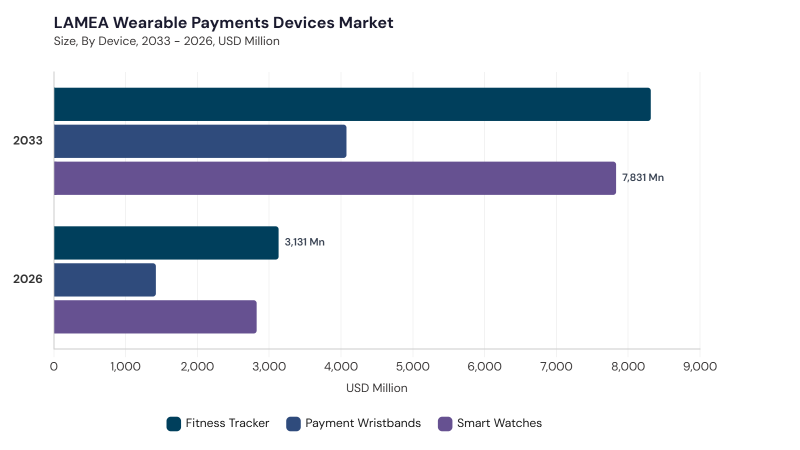
Based on Device, the market is segmented into Fitness Tracker, Smart Watches, and Payment Wristbands. The Fitness Tracker market dominated the LAMEA Wearable Payments Devices Market by Device in 2025, and would continue to be a dominant market till 2033; thereby, achieving a market value of USD 4.6 billion by 2029, growing at a CAGR of 15 % during the forecast period. The Smart Watches market is expected to witness a CAGR of 15.7% during (2026 - 2033).
Fitness Tracker devices combine health monitoring with contactless payment functionality, appealing particularly to younger and health-conscious consumers seeking convenient multifunctional wearables. Smart Watches provide broader capabilities through communications, lifestyle applications, health monitoring, biometric authentication, digital wallets, and payment access, with strong appeal among technology-oriented urban consumers. Payment Wristbands provide simple, durable, and rapid transaction functionality for resorts, tourist attractions, sporting facilities, entertainment venues, transportation systems, and hospitality environments where payment, identification, and access control can be combined.
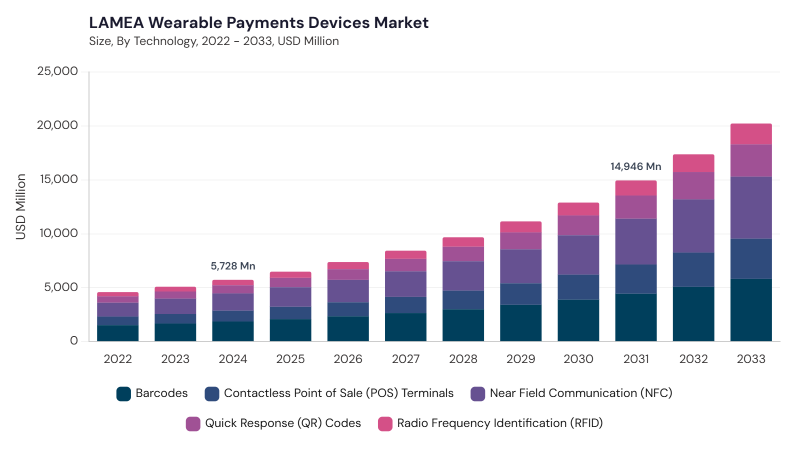
Based on Technology, the market is segmented into Barcodes, Near Field Communication (NFC), Contactless Point of Sale (POS) Terminals, Quick Response (QR) Codes, and Radio Frequency Identification (RFID). The Barcodes market dominated the LAMEA Wearable Payments Devices Market by Technology in 2025, and would continue to be a dominant market till 2033; thereby, achieving a market value of USD 3.4 billion by 2029, growing at a CAGR of 13.8 % during the forecast period. The Near Field Communication (NFC) market is expected to witness a CAGR of 15.7% during (2026 - 2033). Additionally, The Contactless Point of Sale (POS) Terminals market is expected to witness highest CAGR of 16.2% during (2026 - 2033).
Barcodes provide a comparatively straightforward payment approach in markets with differing levels of digital infrastructure and financial inclusion. Near Field Communication (NFC) supports secure tap-based transactions through mobile wallets, tokenization, and secure-element technologies, particularly across modern urban and Gulf payment environments. Contactless Point of Sale (POS) Terminals provide the merchant acceptance infrastructure necessary for wearable transactions across retail, airports, hospitality, and restaurants. Quick Response (QR) Codes offer low-hardware digital payment integration suited to mobile-wallet and fintech ecosystems, while Radio Frequency Identification (RFID) supports closed-loop transactions, visitor identification, access control, hospitality, events, and leisure applications.
Based on Application, the market is segmented into Retail, Transportation, Fitness, Festival & Live Events, Healthcare, and Other Application. Retail applications benefit from faster checkout, contactless transactions, tokenized payments, and growing wearable acceptance across modern commercial environments. Transportation uses NFC- and RFID-enabled credentials for fare collection, smart ticketing, and efficient passenger movement, while Fitness combines payment functionality with exercise and health monitoring.
Festival & Live Events utilizes wearable credentials for admission, concessions, merchandise purchases, and restricted-area access. Healthcare applications integrate secure payments with connected patient and wellness environments, while Other Application includes education, corporate campuses, residential developments, hospitality properties, tourism facilities, and other specialized closed-loop environments.
Free Valuable Insights: Wearable Payments Devices Market Size Worth USD 196.3 Billion billion by 2033
Based on Country, the market is segmented into Brazil, Argentina, UAE, Saudi Arabia, South Africa, Nigeria, and Rest of LAMEA. The Brazil market dominated the LAMEA Wearable Payments Devices Market by Country in 2025, and would continue to be a dominant market till 2033; thereby, achieving a market value of USD 2.9 billion by 2029, growing at a CAGR of 14.2 % during the forecast period. The Argentina market is expected to witness a CAGR of 16.5% during (2026 - 2033). Additionally, The UAE market is expected to witness a CAGR of 14.3% during (2026 - 2033).
Across LAMEA, wearable payment adoption is being shaped by contactless infrastructure, biometric authentication, financial inclusion, localization, multifunctionality, and expanding digital ecosystems. Brazil emphasizes Pix-linked transactions, NFC and BLE connectivity, affordability, financial inclusion, and biometric security, while Argentina focuses on biometric authentication, health-payment convergence, NFC optimization, and localized payment integration. The UAE is advancing AI-enabled payment wearables, IoT connectivity, smart-city applications, biometric security, and health-payment convergence, whereas Saudi Arabia emphasizes Vision 2030-driven cashless adoption, cross-border interoperability, biometric authentication, and integrated financial ecosystems. South Africa focuses on contactless adoption, digital banking integration, tokenization, localized payment systems, and interoperable platforms, while Nigeria emphasizes financial inclusion, NFC and QR-based payments, biometric verification, offline capabilities, and fintech partnerships. Rest of LAMEA continues to develop multifunctional wearables, digital identity integration, biometric security, localized payment support, AI-based fraud detection, and broader contactless acceptance.

By Device
By Technology
By Application
By Country
Set to reach $11.1 Billion by 2029, growing at 15.5% CAGR during 2026-2033.
Brazil leads with a market value of USD 2.9 billion by 2029, growing at a CAGR of 14.2% during the forecast period.
Fitness Trackers dominate by device, reaching USD 4.6 billion by 2029, with a 15% CAGR during 2026-2033.
Smart Watches segment is expected to witness a CAGR of 15.7% during 2026-2033.
Argentina market is expected to witness a CAGR of 16.5% during 2026-2033.
Contactless POS Terminals market is expected to witness the highest CAGR of 16.2% during 2026-2033.
Our team of dedicated experts can provide you with attractive expansion opportunities for your business.




 Unique Offerings