The sample copy of this report is available for access.
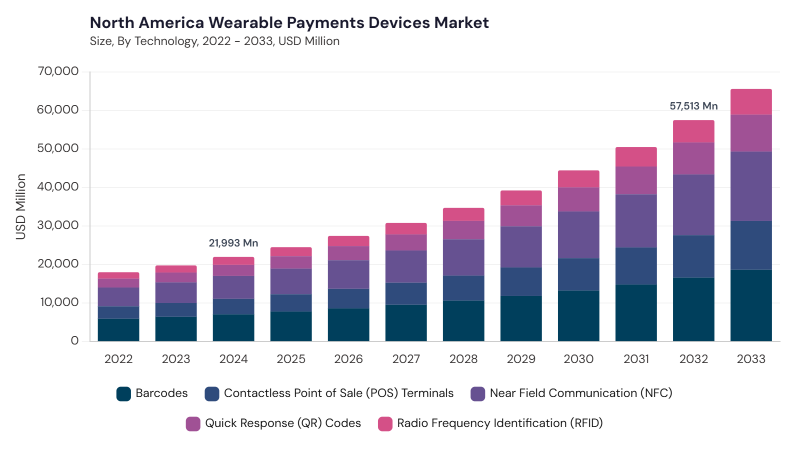
The North America Wearable Payments Devices Market is expected to reach USD 57.5 billion by 2032, growing at a CAGR of 13.3% during (2026 - 2033).
The North America Wearable Payments Devices Market evolved from early contactless payment functionality embedded in smartwatches and fitness bands into a broader ecosystem of secure, multifunctional financial wearables. Advances in NFC, secure-element technology, biometric authentication, encryption, device miniaturization, and smartphone-wallet integration improved transaction convenience and consumer confidence. Expanding merchant acceptance and stronger interoperability gradually moved payment wearables beyond niche technology users into everyday financial interactions. Current devices increasingly combine payments with health monitoring, digital identity, loyalty services, mobility, and lifestyle applications.
Biometric security, contactless infrastructure, ecosystem integration, multifunctionality, and compact device designs are shaping current market development. Consumers increasingly favor frictionless payment experiences supported by tokenization, biometric authentication, and seamless integration with mobile wallets and banking applications. Payment functionality is also converging with fitness, health monitoring, loyalty programs, transit services, and personalized financial tools. Continued innovation in AI-driven analytics, battery efficiency, sensor technology, NFC capabilities, and cross-platform interoperability is broadening functionality, while security, privacy compliance, affordability, and merchant acceptance remain important considerations for wider adoption.
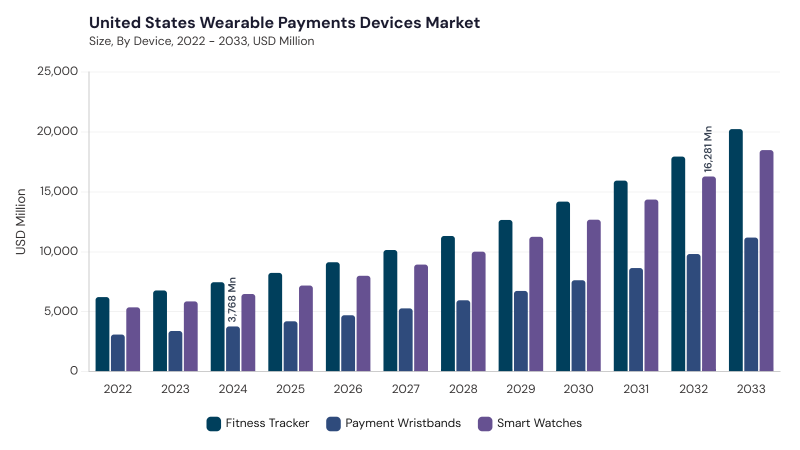
Based on Device, the market is segmented into Fitness Tracker, Smart Watches, and Payment Wristbands. The Fitness Tracker market dominated the North America Wearable Payments Devices Market by Device in 2025, and would continue to be a dominant market till 2033; thereby, achieving a market value of USD 23.4 billion by 2032, growing at a CAGR of 12.8 % during the forecast period. The Smart Watches market is expected to witness a CAGR of 13.4% during (2026 - 2033).
Fitness Tracker devices support convenient payments during workouts, outdoor activities, and health-focused routines while maintaining lightweight designs and integrated wellness capabilities. Smart Watches provide broader functionality through digital wallets, communication, biometric authentication, health monitoring, loyalty programs, and app ecosystems, making them versatile payment interfaces for everyday transactions. Payment Wristbands focus on simple tap-based payments and integrated access functions, making them particularly suitable for festivals, resorts, campuses, sporting environments, transportation, and other controlled or closed-loop payment settings.
Based on Technology, the market is segmented into Barcodes, Near Field Communication (NFC), Contactless Point of Sale (POS) Terminals, Quick Response (QR) Codes, and Radio Frequency Identification (RFID). The Barcodes market dominated the North America Wearable Payments Devices Market by Technology in 2025, and would continue to be a dominant market till 2033; thereby, achieving a market value of USD 16.5 billion by 2032, growing at a CAGR of 11.6 % during the forecast period. The Near Field Communication (NFC) market is expected to witness a CAGR of 13.5% during (2026 - 2033). Additionally, The Contactless Point of Sale (POS) Terminals market is expected to witness highest CAGR of 14% during (2026 - 2033).
Barcodes provide a cost-effective approach for account-linked and controlled payment environments using existing scanning systems. Near Field Communication (NFC) enables secure tap-to-pay transactions through tokenization and secure-element technologies and benefits from mature contactless infrastructure. Contactless Point of Sale (POS) Terminals support acceptance of payments from compatible wearable devices across retail and service locations, while Quick Response (QR) Codes provide flexible software-oriented integration with digital wallets, loyalty programs, tickets, and account-based services. Radio Frequency Identification (RFID) supports rapid identification, access management, transit, events, hospitality, and closed-loop transactions where integrated payment and access functionality is required.
Based on Application, the market is segmented into Retail, Transportation, Fitness, Festival & Live Events, Healthcare, and Other Application. Retail applications benefit from contactless checkout, loyalty integration, omnichannel commerce, and personalized customer engagement. Transportation uses wearable payment credentials for tap-based fare collection and streamlined passenger movement, while Fitness integrates payments with connected health and exercise devices.
Festival & Live Events uses wrist-based payment systems for admission, purchases, identification, and access control. Healthcare applications combine payment, identification, account access, and wellness functionality within privacy-sensitive environments, while Other Application includes hospitality, education, corporate campuses, leisure facilities, vending services, and other specialized payment settings.
Free Valuable Insights: The Global Wearable Payments Devices Market will hit USD 196.3 Billion billion by 2033, at a CAGR of 13.9%
Based on Country, the market is segmented into US, Canada, Mexico, and Rest of North America. The US market dominated the North America Wearable Payments Devices Market by Country in 2025, and would continue to be a dominant market till 2033; thereby, achieving a market value of USD 44.0 billion by 2032, growing at a CAGR of 12.5 % during the forecast period. The Canada market is expected to witness a CAGR of 16.1% during (2026 - 2033). Additionally, The Mexico market is expected to witness a CAGR of 14.8% during (2026 - 2033).
Across North America, wearable payment adoption is being shaped by contactless infrastructure, biometric authentication, payment ecosystem integration, multifunctional devices, and digital-wallet familiarity. The US emphasizes NFC payments, secure elements, biometric authentication, mobile-wallet integration, and broader merchant acceptance, while Canada focuses on contactless infrastructure, payment security, tokenization, health-payment convergence, and ecosystem compatibility. Mexico is advancing biometric security, interoperability, multifunctional wearables, digital-wallet integration, and partnerships with banks and retailers, whereas Rest of North America emphasizes transit payments, interoperable ecosystems, biometric verification, localized payment infrastructure, secure connectivity, and diverse wearable form factors.

By Device
By Technology
By Application
By Country
Set to reach $57.5 Billion by 2032, growing at 13.3% CAGR during 2026-2033.
The US leads with $44.0 billion by 2032, growing at a CAGR of 12.5% during 2026-2033.
Fitness Tracker segment to reach $23.4 billion by 2032, growing at 12.8% CAGR during 2026-2033.
NFC technology will grow at a CAGR of 13.5% during 2026-2033.
The Canada market is expected to witness a CAGR of 16.1% during 2026-2033.
Contactless POS Terminals market to witness highest CAGR of 14% during 2026-2033.
Our team of dedicated experts can provide you with attractive expansion opportunities for your business.




 Unique Offerings