The sample copy of this report is available for access.
“Global Threat Modeling Tools Market to reach a market value of USD 3,784.58 Million by 2033 growing at a CAGR of 15.1%”
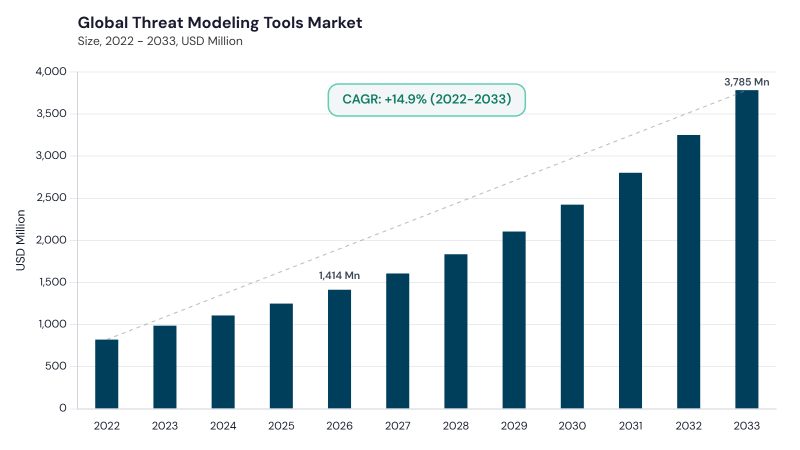
The Global Threat Modeling Tools Market is expected to reach USD 3,784.6 million by 2033, growing at a CAGR of 15.1% during 2026 - 2033.

The Global Threat Modeling Tools Market has evolved from traditional manual security assessment methodologies designed to identify vulnerabilities during software design and architecture reviews. Initially, threat modeling was performed through expert-driven workshops, checklists, and risk assessment exercises focused on identifying potential attack vectors and security weaknesses. As software architectures became increasingly complex and cyber threats more sophisticated, organizations began adopting specialized threat modeling platforms capable of automating threat identification, risk prioritization, attack path analysis, and security design validation.
The market is experiencing strong growth due to escalating cybersecurity threats, increasing regulatory compliance requirements, widespread adoption of cloud-native applications, expansion of DevSecOps practices, and growing awareness of secure-by-design development principles. Organizations are increasingly embedding threat modeling into software development workflows to identify vulnerabilities earlier, reduce remediation costs, and strengthen overall security posture. The emergence of AI-driven applications, software supply chain security concerns, zero-trust architectures, and cloud transformation initiatives continues to create significant demand for advanced threat modeling capabilities across industries.
The Threat Modeling Tools Market is characterized by a moderately fragmented but innovation-driven competitive landscape comprising specialized threat modeling vendors, application security providers, cybersecurity software companies, cloud platform providers, and enterprise security solution vendors. Competition primarily revolves around automation capabilities, AI integration, DevSecOps compatibility, compliance support, threat intelligence integration, and user experience. Vendors are increasingly investing in machine learning, cloud-native architectures, real-time risk assessment, and collaborative threat analysis features to strengthen competitive positioning. Strategic partnerships, product innovation, cloud ecosystem integration, and geographic expansion remain key growth strategies across the market.


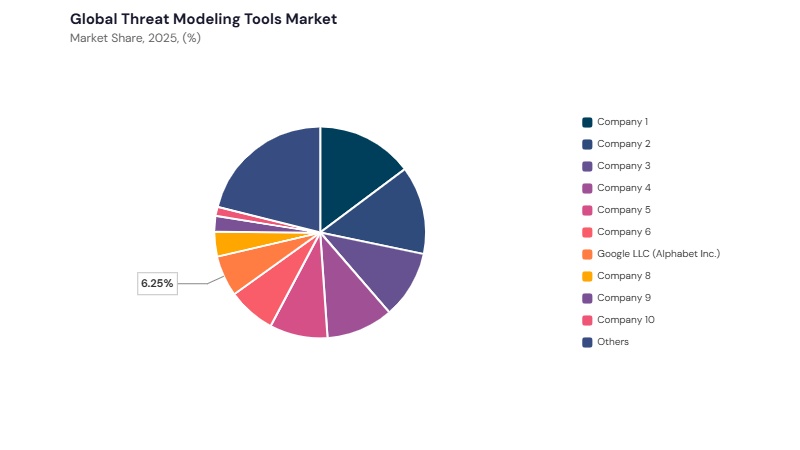
The Threat Modeling Tools Market demonstrates a moderately consolidated structure where the top market participants collectively account for nearly 79% of global market revenue. The market is led by specialized threat modeling vendors and large cybersecurity providers that integrate threat modeling capabilities into broader application security, DevSecOps, governance, risk management, and cloud security ecosystems. Market competition increasingly centers on automation, AI-assisted threat analysis, secure software development integration, compliance support, and cloud-native deployment capabilities. The growing convergence of threat modeling, application security testing, software supply chain security, and cloud security continues to reshape competitive dynamics globally.
Based on Component, the market is segmented into Solutions and Services. The Solutions market dominated the Global Threat Modeling Tools Market by Component in 2025, and would continue to be a dominant market till 2033; thereby, achieving a market value of USD 2831.3 million by 2033, growing at a CAGR of 14.8 % during the forecast period. The Services market is expected to witness a CAGR of 16% during (2026 - 2033).
Solutions accounted for the largest revenue share of 76.27% in 2025, driven by increasing adoption of automated threat identification, risk assessment, attack path analysis, and vulnerability management platforms across enterprises. Organizations continue investing heavily in integrated security solutions supporting DevSecOps and secure software development initiatives. Services represented 23.73% of market revenue, supported by growing demand for consulting, implementation, customization, managed security services, training, and compliance advisory services associated with threat modeling deployments.
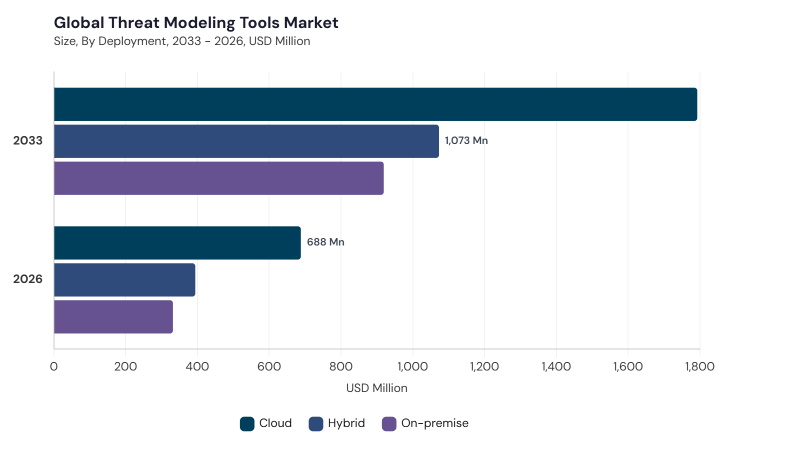
Based on Deployment, the market is segmented into Cloud, Hybrid, and On-premise. The Cloud market dominated the Global Threat Modeling Tools Market by Deployment in 2025, and would continue to be a dominant market till 2033; thereby, achieving a market value of USD 1792.4 million by 2033, growing at a CAGR of 14.7 % during the forecast period. The Hybrid market is expected to witness a CAGR of 15.4% during (2026 - 2033).
Cloud accounted for the largest revenue share of 48.82% in 2025 due to scalability, flexibility, remote accessibility, and seamless integration with cloud-native development environments. Hybrid represented 27.81% of market revenue, supported by organizations balancing cloud agility with enhanced control over sensitive assets and regulated workloads. On-premise accounted for 23.37%, driven by organizations operating under strict data sovereignty, security, privacy, and regulatory compliance requirements.
Based on Enterprise Size, the market is segmented into Large Enterprise and Small & Medium Enterprises. The Large Enterprise market dominated the Global Threat Modeling Tools Market by Enterprise Size in 2025, and would continue to be a dominant market till 2033; thereby, achieving a market value of USD 2529.1 million by 2033, growing at a CAGR of 14.9 % during the forecast period. Additionally, The Small & Medium Enterprises market is expected to witness highest CAGR of 15.6% during (2026 - 2033).
Large Enterprise accounted for the largest market share of 67.97% in 2025 due to extensive cybersecurity budgets, complex IT infrastructures, heightened exposure to sophisticated cyber threats, and increasing regulatory obligations. Small & Medium Enterprises represented 32.03% of market revenue, supported by growing cybersecurity awareness, increasing affordability of cloud-based threat modeling solutions, and the rising adoption of proactive security practices.
Based on Industry Vertical, the market is segmented into BFSI, IT & Telecom, Government & Defense, Healthcare & Life Sciences, Manufacturing & Industrial, and Other Industry Vertical. BFSI accounted for the largest revenue share of 26.34% in 2025 due to the need to protect financial assets, digital banking infrastructure, and customer information from increasingly sophisticated cyberattacks. IT & Telecom represented 20.44% of market revenue, followed by Government & Defense at 18.68%. Healthcare & Life Sciences accounted for 14.08%, Manufacturing & Industrial represented 11.57%, and Other Industry Vertical contributed 8.90% of market revenue.
Free Valuable Insights: Threat Modeling Tools Market Size to reach $3,784. Million by 2033
Region-wise, the Threat Modeling Tools Market is analyzed across North America, Europe, Asia Pacific, and LAMEA. The North America market dominated the Global Threat Modeling Tools Market by Region in 2025, and would continue to be a dominant market till 2033; thereby, achieving a market value of USD 1397.8 million by 2033, growing at a CAGR of 14.4 % during the forecast period.The Asia Pacific market is expected to witness a CAGR of 16% during (2026 - 2033). Additionally, The Europe market is expected to witness a CAGR of 14.9% during (2026 - 2033).
North America is expected to dominate the market owing to advanced cybersecurity infrastructure, extensive adoption of DevSecOps practices, high regulatory compliance requirements, and strong presence of leading cybersecurity vendors. Europe remains a major market supported by GDPR compliance initiatives, software security modernization programs, and growing investments in cyber resilience. Asia Pacific is witnessing rapid growth due to increasing digital transformation initiatives, cloud adoption, expanding software development ecosystems, and rising cybersecurity awareness. LAMEA continues to gain momentum through growing investments in cybersecurity infrastructure and digital governance frameworks.
Threat Modeling Tools Market Coverage:
| Report Attribute | Details |
|---|---|
| Market size value in 2026 | USD 1,414.1 Million |
| Market size forecast in 2033 | USD 3,784. Million |
| Base Year | 2025 |
| Historical Period | 2022 to 2024 |
| Forecast Period | 2026 to 2033 |
| Revenue Growth Rate | CAGR of 15.1% from 2026 to 2033 |
| Number of Pages | 647 |
| Tables | 750 |
| Report Coverage | Market Trends, Revenue Estimation and Forecast, Segmentation Analysis, Regional and Country Breakdown, Competitive Landscape, Market Share Analysis, Company Profiling, Companies Strategic Developments, SWOT Analysis, Value Chain Analysis, Market Consolidation Analysis, Key Customer Criteria, COVID-19 Impact Analysis, and Winning Imperatives |
| Segments Covered | Component, Deployment, Enterprise Size, Industry Vertical, Region |
| Country Scope |
|
| Companies Included | ThreatModeler Software, Inc., Microsoft Corporation, Synopsys, Inc., IBM Corporation, Snyk Limited, Cisco Systems, Inc., Google LLC, Intel Corporation, Securonix, Inc., and Aristiun BV |
By Component
By Deployment
By Enterprise Size
By Industry Vertical
By Geography
Expected to reach USD 3,784.6 Million by 2033, growing at 15.1% CAGR during the forecast period (2026-2033).
Cloud segment leads, growing at a CAGR of 14.7% during the forecast period.
ThreatModeler Software, Inc., Microsoft Corporation, and Synopsys, Inc. are key players.
North America dominates, achieving USD 1,397.8 Million by 2033, growing at 14.4% CAGR during the forecast period.
Increasing regulatory compliance and AI integration in threat modeling processes drive the market.
The market grows at a 15.1% CAGR during the forecast period (2026-2033).
Our team of dedicated experts can provide you with attractive expansion opportunities for your business.








 Unique Offerings